Peak Shaving Battery Calculator
Size a battery for reducing peak demand from target kW reduction, shaving window, round-trip efficiency, depth of discharge, reserve margin, inverter rating, and discharge C-rate.
⚡Peak Shaving Presets
🔋Battery And Demand Inputs
Peak shaving battery estimate
Calculation breakdown
📊Peak Shaving Spec Grid
📋Battery Type Comparison
📘Peak Shaving Reference Tables
| Battery profile | Planning DoD | Efficiency | C-rate range |
|---|
| Peak reduction | 1 hour | 2 hours | 4 hours |
|---|
| Planning item | Typical range | Calculation effect | Use when |
|---|---|---|---|
| Round-trip efficiency | 85-95% | Raises battery kWh needed to deliver AC-side reduction | All peak shaving energy calculations |
| Depth of discharge | 50-90% | Converts shifted kWh into nominal battery capacity | Battery life and chemistry planning |
| Reserve margin | 10-20% | Holds capacity after the event instead of using the whole pack | Critical loads or uncertain peak duration |
| Inverter headroom | 10-30% | Raises continuous kW rating above the target reduction | Variable loads and short cycling appliances |
| C-rate limit | 0.25-1C | Checks whether battery can discharge at the planned power | High kW reduction from a compact battery |
| Home scenario | Peak cut | Window | Planning note |
|---|---|---|---|
| Network and office loads | 0.5-1.5 kW | 2-4 hr | Often capacity-driven with modest inverter power. |
| Mini split overlap | 1.5-3 kW | 1-3 hr | Check inverter headroom for compressor cycling. |
| EV charging overlap | 3-7 kW | 1-3 hr | Usually inverter and C-rate constrained. |
| Whole home demand | 4-10 kW | 2-5 hr | Needs both adequate kWh and continuous kW output. |
| Critical loads panel | 1-4 kW | 3-6 hr | Reserve matters because peak tails are hard to predict. |
🔧Peak Shaving Tips
There is a specific moment every winter evening when your electric bill feels personal. A few steps from the door and you’re in the kitchen; you switch on the lamp and begin brewing coffee. In the wall just behind you, the heat pump kicks in. And the fridge compressor engage for the third time in ten minutes. For a second, the two systems briefly match.
A demand spike is one of those moments when utility experiences a high cost to serve you and sends the expense right back onto your shoulders in the form of demand charges or peak rate structures. It is not because you used a lot of total energy that month. But because, at any given second, you drew it with an intensity. When you flatten the spikes, you smooth out the edges of your load; which makes you look more attractive to the grid.
How to Size Your Battery for Peak Shaving
Plug-in your own constraints and the calculator (above) do the math for you. This avoids the need to guess if a 10 kilowatt hour battery will run a four kilowatt load for two hours. For example, a lot of consumers purchase their batteries based off energy capacity. More kilowatt hours means longer range. As if they’re filling up their car’s “gas” tank. Ignoring that there are other constraints. Your battery might be able to store lots of electrons, but it doesn’t matter because the pipe that connects those stored electrons to your house isn’t wide enough to handle a surge.
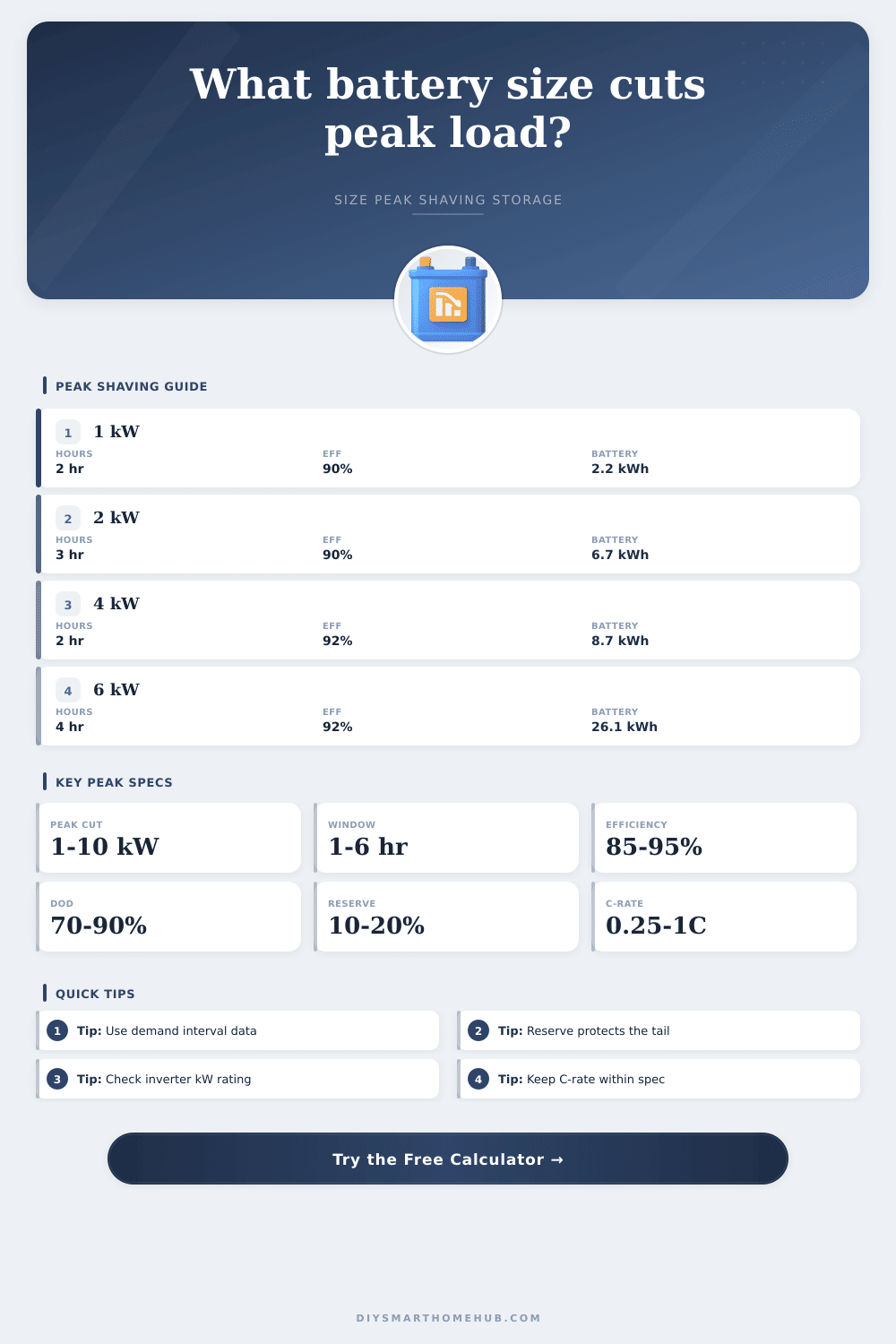
The tool makes you think about both ends of that equation at once. The first step is setting a target for how much of the peak spike you wish to shed. Say your peak interval reaches eight kilowatts, and you’d like not to exceed five. That means the system will have to provide three kilowatts. It must shift three kilowatts of load. You then determine how many hours that demand remains at or near its peak. Residential evening peaks; when folks get home and turn everything on, usually last around two hours. Why does it matter? Because it determines the amount of energy you’ll move. Multiply those three kilowatts by two. This tells you that the system has to deliver six kilowatt hours out of its battery terminals.
But that’s only part of the puzzle of how big to make it. That budget gets eaten up by inefficiencies. There is no such thing as a battery that are perfectly efficient during a round trip. Electrons exiting on their way to the inverter become something else (heat) when they come back around through the charger. Ninety percent efficiency is a reasonable assumption for batteries of today’s generation (lithium iron phosphate), and that means you have to extract just a bit more from the pack to get that clean six kilowatt hours out to the outlets. To make up for those unavoidable leaks, the calculator increase the nominal capacity demand accordingly. You don’t skimp now because the math gets real later, and then you pay for what you didn’t store upfront.
Depth of discharge settings show the amount of chemical abuse you intend to put the batteries through. The more shallowly you cycle them, the longer they will last. Many manufacturers advise staying well under 80% capacity. To account for older cell performance and surprise demands at the end of a tail (i.e. A colder than expected winter), add in some reserve capacity. That means the battery bank doesn’t go totally flat and then trip a low voltage disconnect, which would be bad news. It adds physical size to the battery bank. But it also keeps reliability and extends battery life.
Many projects fall short here because of inverter size: Can it carry the load continuously without shutting down? What about variable loads or startup surge? Do you add headroom? Or will this result in annoying trips at just the wrong moment? The C rate check verifies if your battery cells has the speed (fast enough) to provide the power you want. If not, a slower C rate causes a mismatch between the power you want and the capacity you need. You will either have to increase capacity, which uses more cabinet space and makes installation more complex.
The page lays out typical profiles for various chemistries, giving you reference tables to compare efficiencies and usable life between lead acid vs lithium options. So if your old AGM bank doesn’t seem to cut it where a new LiFePO4 system does, this helps paint a picture of what you’re dealing with. It’s not about meeting today’s peak. It’s about building a system that handles next year’s heat wave without having to retrofit.
When sizing your battery for peak shaving, there’s no single right answer. It’s all about making trade offs between performance, space and cost. In other words, it’s about making an up-front investment vs. It is about long term operating savings. You should of considered this earlier. Once you understand how those inputs play together, you’re not chasing some idealized theory, you’re building something that works. The winter evening spike is going to occur anyway. Now you’ve got a plan for smoothing it out ahead of time so the meter doesn’t see it.