Battery Parallel Capacity Calculator
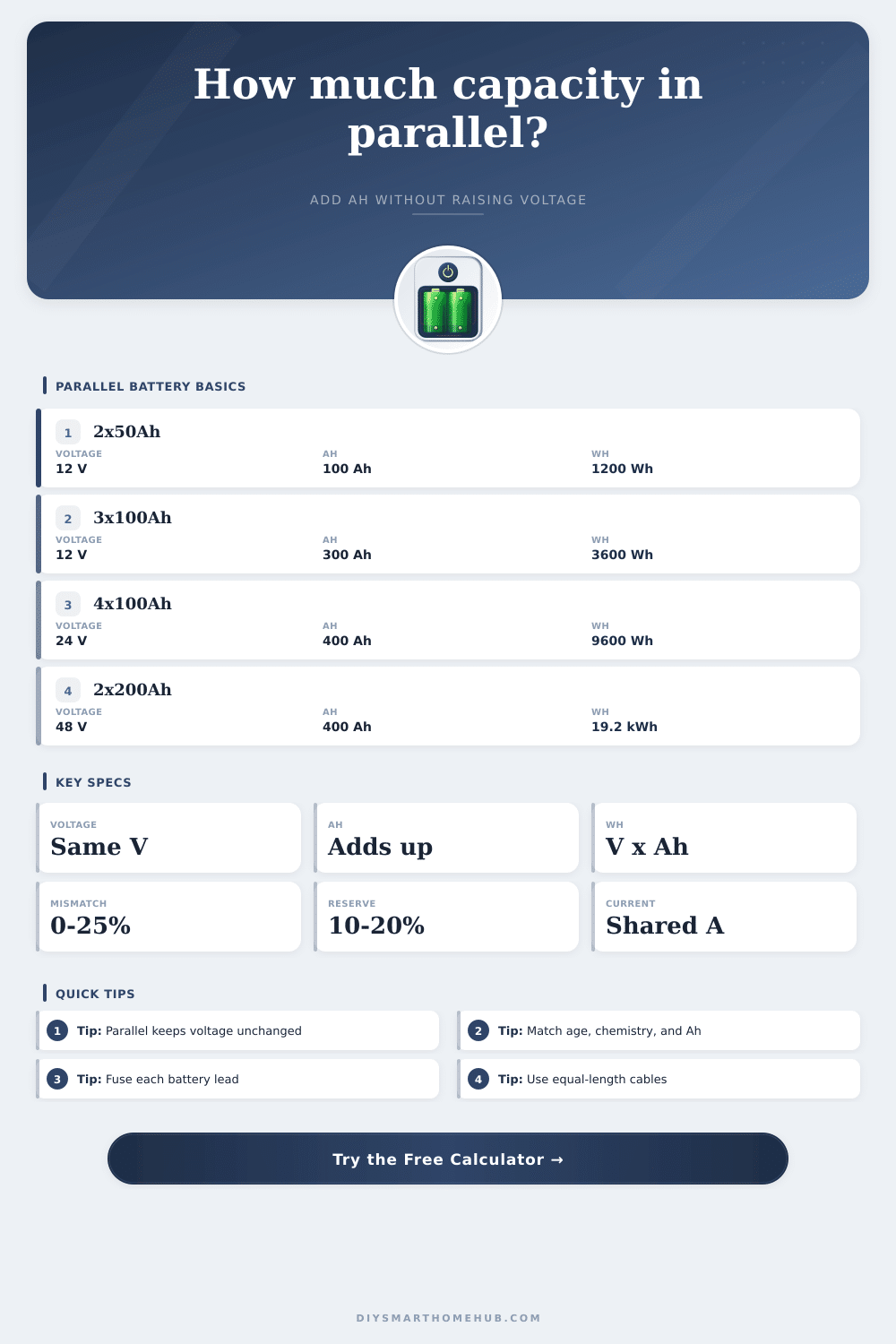
Calculate a parallel battery bank where voltage stays the same, amp-hours add together, watt-hours equal volts times total amp-hours, and usable capacity is adjusted for current sharing, mismatch, temperature, aging, reserve, and load.
⚡Parallel Battery Presets
🔋Parallel Bank Inputs
Parallel battery bank estimate
Calculation breakdown
📊Parallel Battery Comparison Grid
📘Reference Tables
| Parallel rule | Formula | Example | Result meaning |
|---|---|---|---|
| Bank voltage | Voltage does not add in parallel | 2 x 12 V in parallel | Still a 12 V bank, not 24 V. |
| Total amp-hours | Ah each x battery count | 3 x 100 Ah | 300 Ah at the same voltage. |
| Nominal watt-hours | Voltage x total Ah | 12 V x 300 Ah | 3600 Wh before losses and reserve. |
| Load current | Watts / voltage | 600 W / 12 V | 50 A DC before inverter adjustment. |
| Current per battery | Total DC current / count | 50 A / 2 batteries | About 25 A each when well balanced. |
| Bank profile | Typical DoD | Mismatch derate | Parallel use note |
|---|
| Parallel bank | Total Ah | Nominal energy | Best planning use |
|---|---|---|---|
| 2 x 12 V 50 Ah | 100 Ah | 1200 Wh | Router, modem, hub, and small DC loads. |
| 2 x 12 V 100 Ah | 200 Ah | 2400 Wh | Network closet, lights, camera bridge, and small inverter loads. |
| 4 x 12 V 100 Ah | 400 Ah | 4800 Wh | Large 12 V bank where cable balance and fusing matter. |
| 3 x 24 V 100 Ah | 300 Ah | 7200 Wh | Camera NVR, NAS, garage automation, and efficient inverter loads. |
| 2 x 48 V 200 Ah | 400 Ah | 19,200 Wh | Whole-home essentials with lower current for the same watts. |
| Example load | 12 V bank current | 24 V bank current | 48 V bank current |
|---|
🔧Parallel Battery Tips
The initial time you string two lead-acid batteries together, you think it’s as easy as 1-2-3 or, rather, 100 + 100 = 200. However, the real world isn’t so kind. In a parallel configuration, the voltage remain unchanged, check; but capacity story gets far messier then meets the eye on the label. You find there’s as much to do with balancing batteries as there is to adding them up.
That’s where the calculator comes in (the one at the top of page). It’ll do the hard work for you, taking your raw numbers and applying some realistic derating factors like temperature, mismatch, and overall health. Even brand-new batteries aren’t all alike; they may appear identical but they don’t perform the same way under load. They carry different amounts of current based off their slight differences in internal resistance, with each pulling a little more from their neighbor. Eventually, that imbalance stress out the stronger battery faster and wastes its weaker companion’s potential. To make up for this, the tool prompts you to guess how far apart in age (or capacity) your batteries are. Even a perfectly matched pair of fresh lithium battery might have just a five percent variance, whereas a mix-and-match batch of new-old stock can easily double that number. That’s where a portion of your hypothetical capacity is wasted.
Why You Need a Battery Calculator
In a parallel bank, the entire purpose is that the voltage stays the same. You’re not attempting to increase the system potential… You’re purchasing some time. With voltage staying the same, the reference table show how the amp-hours stack up. Six hundred amp-hours at a twelve volt system equals the same run time as three hundred amp hours at a twenty four volt system (same load). But because voltage is increased, you need less current to produce the same wattage. That means smaller cables, less heat buildup in connectors and less strain on each battery’s terminals. Small thing. But it is an enormously important thing for longevity and safety.
Add inverters into the equation, and runtime becomes dicey. Using DC power directly is almost 1:1 efficiency in terms of energy transfer. Anytime you run an AC appliance through an inverter, there’s some loss, typically between ten and fifteen percent depending on load level and quality. You can toggle this option in the calculator and actualy view the real-world drain on your bank. That additional draw will burn up your reserve margin quickly if you’re powering a computer tower or fridge. Will your bank still have enough juice to light the lights till morning after accounting for that loss?
Fuse every individual branch of the battery tree; this is mandatory safe practice. When batteries sits side by side, a short circuit in one can trigger a cascading failure that melts terminals and starts fires, which is why fusing every individual battery branch is non-negotiable. This tool reminds you about how much each branch can safely shares. You might have low average loads, but at start-up, those loads can be many times their normal value as surge current spikes. Your wiring must accommodate the max, otherwise the wire overheat before the fuse pops. Size your cable for the worst-case branch current (not the nice average).
The unseen influencer on battery capacity is temperature. Cold weather saps performance from lead-acid batteries faster than lithium variants. Even if you have a one-hundred-percent-rated bank in your heated garage, it will likely yield only about seventy percent in your unheated shed in winter time. The calculator factors that decline into its equation so you’re not embarrassed when you plan for ten hours and get four.
In the end, creating a parallel bank is about meeting the physical limits of what you can accomplish while setting reasonable expectations for it. Ideally you’d like both legs to be roughly the same length. You would also want both legs to have equal cable runs and use similarly aged equipment with equally strong surge protection. If you do all that, then the math’s got your back.
If you don’t sweat the details, then you’re just purchasing excess capacity (and potentially a headache). Begin with a set of well-matched components and allow the tool to steers your size selection. The numbers will reveal precisely how far you’ve got room to stretch.