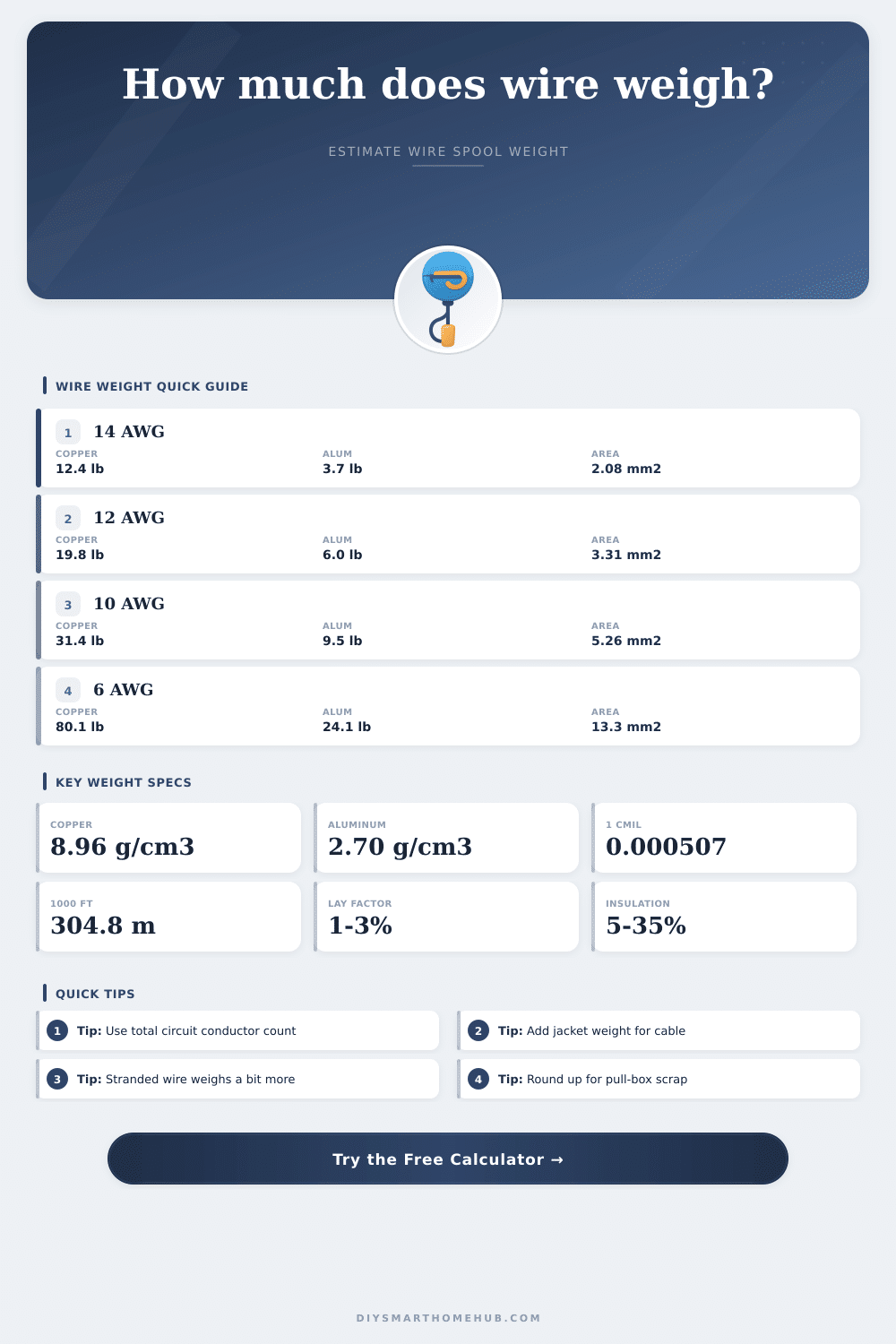
Wire Weight Calculator
Estimate spool, pull, and scrap weight from AWG or kcmil conductor area, copper or aluminum density, length, conductor count, stranding lay, and insulation allowance.
📌Smart Home Wire Presets
🔌Wire And Cable Inputs
Wire weight estimate
Calculation breakdown
⚙Material And Formula Reference
📊Conductor Comparison Grid
📋Reference Tables
| AWG size | Circular mil area | Area mm² | Copper lb / 1000 ft | Aluminum lb / 1000 ft |
|---|
| Material | Density used | Relative to copper | Typical wire use |
|---|
| Allowance item | Typical range | Weight effect | Use when |
|---|---|---|---|
| Stranding lay | 1-3% | Adds metal length before insulation | Flexible, stranded, or classed conductor |
| Thin insulation | 5-15% | Adds polymer weight estimate | Large THHN, XHHW, or feeder conductors |
| Small cable insulation | 20-45% | Can exceed metal weight on tiny conductors | Alarm, thermostat, network, and control cable |
| Outer jacket or filler | 5-30% | Adds cable assembly weight | NM-B, tray, control, coax, or low-voltage cable |
| Cutting buffer | 5-20% | Increases handled spool weight | Pull boxes, rack drops, bends, and field trimming |
| Smart home wire scenario | Typical size | Length basis | Planning note |
|---|---|---|---|
| Video doorbell transformer run | 18 AWG x 2 copper | 50-100 ft | Insulation can be a large part of small cable weight. |
| Thermostat and HVAC control | 18 AWG x 5 copper | 50-150 ft | Count every conductor inside the jacketed cable. |
| PoE camera or access point | 23 AWG x 8 copper | 100-300 ft | Twists, jacket, separator, and filler add assembly weight. |
| Smart switch branch circuit | 12 AWG x 2 or x 3 copper | 50-250 ft | Include neutral, switched leg, and ground if they are on the spool. |
| Garage or equipment feeder | 6 AWG to 2/0 | 50-200 ft | Large conductors are mostly metal by weight. |
🔧Wire Weight Tips
“Pickup a spool of wire, you think it’s gonna be lightweight but then it has its arms around you.” See the thing is, knowing how much something weigh isn’t realy about the thickness at all. It’s more about understanding exact what you’re measuring before you go hauling. Weight involves not just diameter of the individual wires but also their material density, the conductor area, the number of conductors inside the jacket, and the polymer insulation wrapping around and binding them together.
It is a little thing but important if you’ve got a big project going and want to estimate shipping costs or plan a lengthy pull. Once you enter the conductor specifications and distance to be run, the calculator do all the work for you (rather than needing to convert to circular mils or remember the density coefficient).
Why Does Wire Weigh What It Weighs?
Because each atom of copper closely pack together throughout the area of its cross sectional surface, it’s very dense, and therefore quite heavy. In contrast, aluminum is about three times less dense then copper per square millimeter of cross-sectional area. This means that even though an aluminum feeder may have same size as a copper one, it will be much lighter. But in this case, when we’re talking about running 6 AWG wire to a subpanel, the sheer bulk of the conductor metal dwarf other factors. The mass of the core conductor overpowers others and allows us to largely ignore those details.
At smaller gauges, the story are completely different. It’s common for the insulation in thin wire like speaker cable or control wiring to weigh more then what it insulates, the copper strands. Why? Because as you get down into thinner gauges, the ratio of volume to surface area shift. The outer jacket also becomes significant; it’s not just insulation, but it actualy takes up space.
So there are allowances for these things: outer jackets and insulation thicknesses. You might have five little wire encased in a hefty plastic sleeve in a thermostat cable, resulting in a package that’s nearly twice as heavy as the metal alone. If you don’t account for that jacket, you’ll come up short when estimating shipping or handling capacity.
Strand count is another overlooked layer of complexity. While it’s easy to weigh solid wire… Its length equals the run exactly… Stranded wire are composed of several individual strands, all twisted together into a helix (hence the name). Each strand is ever-so-slightly longer than total cable length. Over long runs, this “lay factor” result in a little extra metal which is added to the weight. On paper, it doesn’t sound like much, but that’s what causes manufacturer data sheets to occasionally show heavier weights then a simple geometric calculation would suggest. To account for this, the tool includes an option to adjust the stranding multiplier for the lay factor so your estimation reflect physical reality vs. Theoretical ideals.
Theoretical ideals. But don’t forget to include the cutting buffer. And there is always a buffer when you install something. Trimmed backs, mistakes that need to be corrected, rounding out of corners, etc., all use up additional material. Five to ten percent buffer for scrap is not pessimism, it’s pragmatism. Having this adjustment make sure your final handled weight has accounted for some of the inevitable waste that will occur onsite. Why? Because it will. You might as well have a little more weight planned for so you can keep your project time line intact and avoid running last minute to the supply house.
You should of known this. These numbers, however, were put into perspective with some help from the reference tables which allow you to compare gauges commonly used side by side. Want to know how quickly weight scales as gauge decreases? Or how much smaller 2 inches of aluminium is compared to 6 inches? How much does the weight increase and decrease based off gauge? These are all helpful things to have when you need something to use as a sanity check against your own situation, don’t worry about remembering them all though. That’s what this tool does for you.
Estimating wire weight is never about being exact. It’s always about planning. Do I have enough to pull through a long raceway? Will that conduit support the load? Can that spool even fit in my truck? If you get the inputs correct, then the output will be correct. The bottom line is, do you know what is important in your situation? A couple of tweaks to the strand count and the jacket thickness make a smart guess become an accurate one. Up you go with the spool again, only this time you have no questions about why it feels like it does.