Shelf Bracket Spacing Calculator
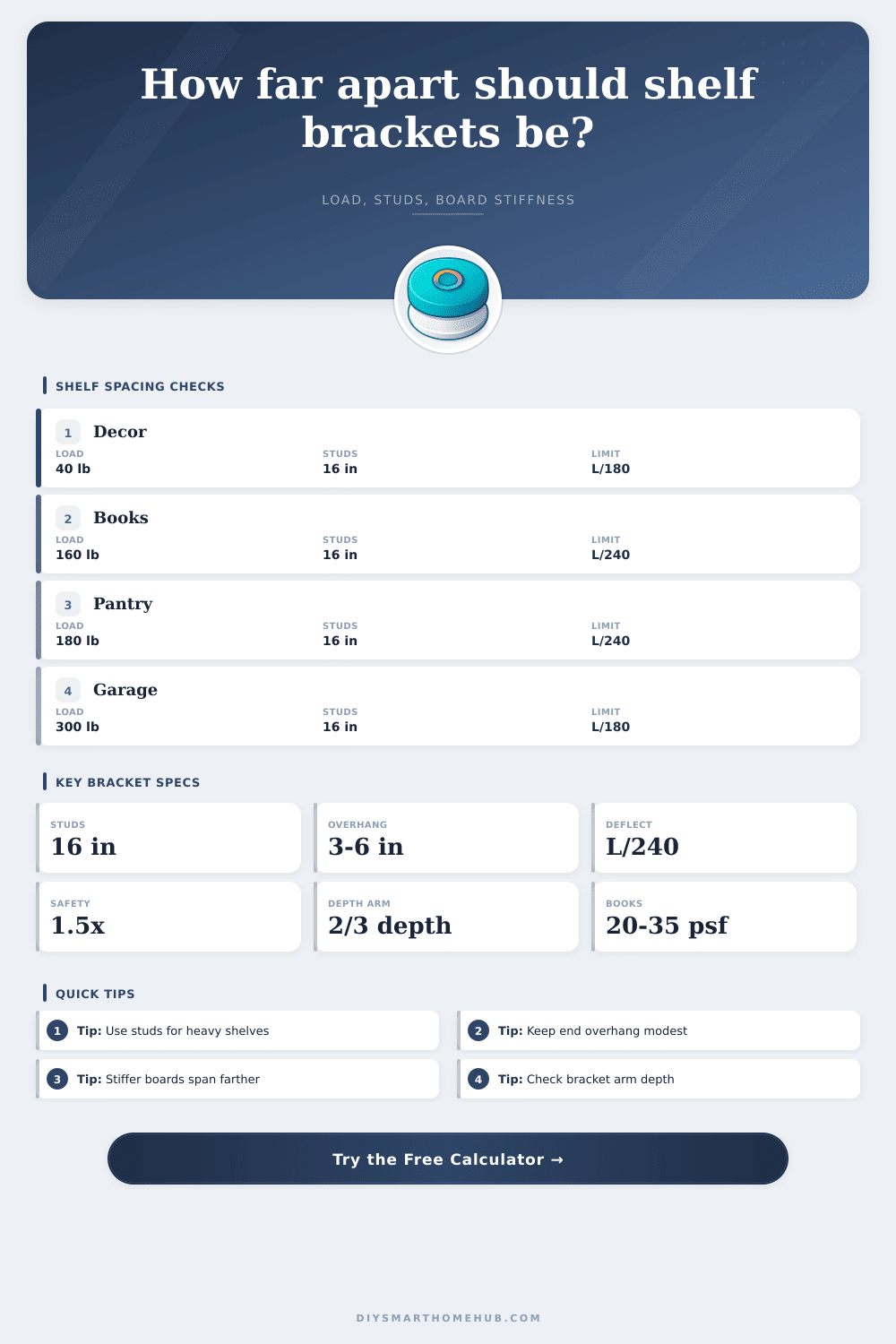
Estimate bracket spacing, bracket count, bracket load, and shelf deflection from shelf length, depth, load, board material, thickness, bracket rating, stud spacing, end overhang, and deflection limit.
📌Shelf presets
📏Shelf, load, bracket, and stud inputs
Shelf bracket spacing result
Recommended spacing and bracket count will appear here.
Calculation breakdown
🔧Bracket spec grid
📊Reference tables
| Board material | Stiffness used | Allowable bend stress | Planning note |
|---|---|---|---|
| Softwood / pine | 1.2 million psi | 900 psi | Good for light and medium shelves when knots are limited. |
| Cabinet plywood | 1.4 million psi | 1,200 psi | Stable choice for pantry, books, and utility shelves. |
| MDF shelf board | 0.55 million psi | 600 psi | Flat surface, but it sags sooner under long spans. |
| Particleboard / melamine | 0.45 million psi | 450 psi | Keep spans short and avoid concentrated heavy loads. |
| Oak hardwood | 1.6 million psi | 1,500 psi | Stiff display shelf material when properly supported. |
| Maple hardwood | 1.83 million psi | 1,600 psi | Strong and stiff, useful for longer premium shelves. |
| Bracket rating | Typical use | With 1.5x safety | Calculator meaning |
|---|---|---|---|
| 50 lb | Decor, small ledges | 33 lb usable | Good for short light shelves only. |
| 75 lb | Closet and laundry | 50 lb usable | Works for many 36-48 in shelves. |
| 100 lb | Books and pantry | 67 lb usable | Common medium-duty planning value. |
| 150 lb | Garage storage | 100 lb usable | Useful when anchored into framing. |
| 200 lb | Workshop storage | 133 lb usable | Still limited by wall, fasteners, and board span. |
| Stud spacing | Common bracket step | Best fit | Watch point |
|---|---|---|---|
| 12 in on center | Every stud or every other | Heavy loads and shallow shelves | Many brackets may be visible. |
| 16 in on center | 16 in, 32 in, 48 in | Most residential shelves | 32 in may sag with weak boards. |
| 19.2 in on center | 19.2 in, 38.4 in | Some engineered framing | Check actual stud locations. |
| 24 in on center | 24 in, 48 in | Utility walls and garages | Often needs stiffer boards or more brackets. |
| Deflection limit | Allowed sag | Use for | Calculator effect |
|---|---|---|---|
| L/120 | Span / 120 | Utility storage | Allows wider spacing with visible sag. |
| L/180 | Span / 180 | General shelves | Balanced default for mixed loads. |
| L/240 | Span / 240 | Books and pantry | Reduces spacing for a cleaner shelf line. |
| L/360 | Span / 360 | Display shelves | Requires closer brackets or thicker board. |
| L/480 | Span / 480 | Very stiff visual target | Often controls over bracket rating. |
💡Spacing tips
How? Well, most shelf failures start off as a little dip in the center of the board. When there’s nothing on the shelf, that sag doesn’t seem like much. But it proves that gravity won’t wait till you get busy filling up the shelves; gravity is already beating you at the game. Well, most shelf failure start off as a little dent in the center of the board. When there’s nothing on the shelf, that sag doesn’t seem like much. But it proves that gravity won’t wait till you get busy filling up the shelves; gravity is already winning at the game.
Sure, you can say “I’ll just use heavy duty brackets.” Yeah, except even a 200 pound-rated bracket will fail if you mount it into some drywall and don’t happen to find a stud. Or it can fail because the shelf board sag too far before the screws pull it out.
Why Shelves Sag and How to Fix Them
Enter your own data into the calculator above and let it do all the number crunching for you. It saves you from wondering if your spacing is good enough, considering how stiff the wood is and how much weight you plan to stack on top.
And remember: Wood is not all created equal. Strength comes from thickness, not width. It doesn’t really matter how deep a board is; doubling depth adds only marginally more strength different than increasing thickness. Why? Because stiffness rise rapidly with thickness. For example, a half-inch thick board made out of pine won’t resist sagging as well as a 3/4 inch thick pine board of identical width.
The tool allows you to choose exactly what kind of material you have (soft pine, rigid maple, engineered plywood). Every material has a set of strength values. It will recommend using closer spacing between brackets for materials like particleboard, MDF, etc. They don’t have the fiber structure which create the bending resistance in solid wood. Don’t try and use a less expensive material thinking you’ll get away with the same results…you’re going to need to change your support plan.
One way most do-it-yourself plans fall short is stud alignment. The calculator may indicate that it’s best to install the brackets at an interval of eighteen inches, but in reality, your wall studs will likely be spaced sixteen inches apart. Two extra inches make all the difference. Instead of boring holes through empty drywall to achieve a precise measurement, you typically has to shift your brackets around to align with the studs.
To address this problem, the calculator features a safety factor setting. By slightly reducing the bracket’s capacity, it ensures you’ll retain ample strength margin even when spacing your brackets to match the structure’s framing. This slight change helps you avoid growing mistakes which may lead to the brackets pulling out over time.
What happens with shelves depends on where you put the weight. A uniform load distributed across the entire surface is easier for brackets to manage than weight concentrated at the front edge. You can specify how much end overhang (the distance between the last bracket and the edge of the board), and large amounts cause leverage that adds load to these supports. Stacking stuff heavily past your last bracket tests the capacity of your wall anchors. Small amounts of end overhang help ensure the shelf stays balanced.
The tool’s deflection settings (how much a shelf will bend) helps you make this choice. Strict limits make the system suggest using stronger materials or more supports. For example, a display shelf for some glassware won’t tolerate any sway, so selecting a stricter limit results in recommendations for thicker wood or more supports. Better to add another hole today than have to replace a broken board tomorrow.
The right tool forces me to think through those trade offs in advance. When building shelves, it’s not so much about being physically strong as it is about getting the weights balanced properly. Whether the weight comes from tools in a garage or cook books in the pantry, the lesson holds true. There should of been no dip in the middle. The goal is to space everything correctly so that your storage stays straight and feels solid for years to come. Respect the limits of the wall behind, as well as the limits of the materials, and follow the numbers. They’ll lead you to stability.