Apparent Temperature Calculator
Estimate how air actually feels after humidity, wind, solar radiation, shade, clothing insulation, activity level, and indoor or outdoor exposure are combined.
1Presets
2Weather and exposure inputs
Calculated comfort reading
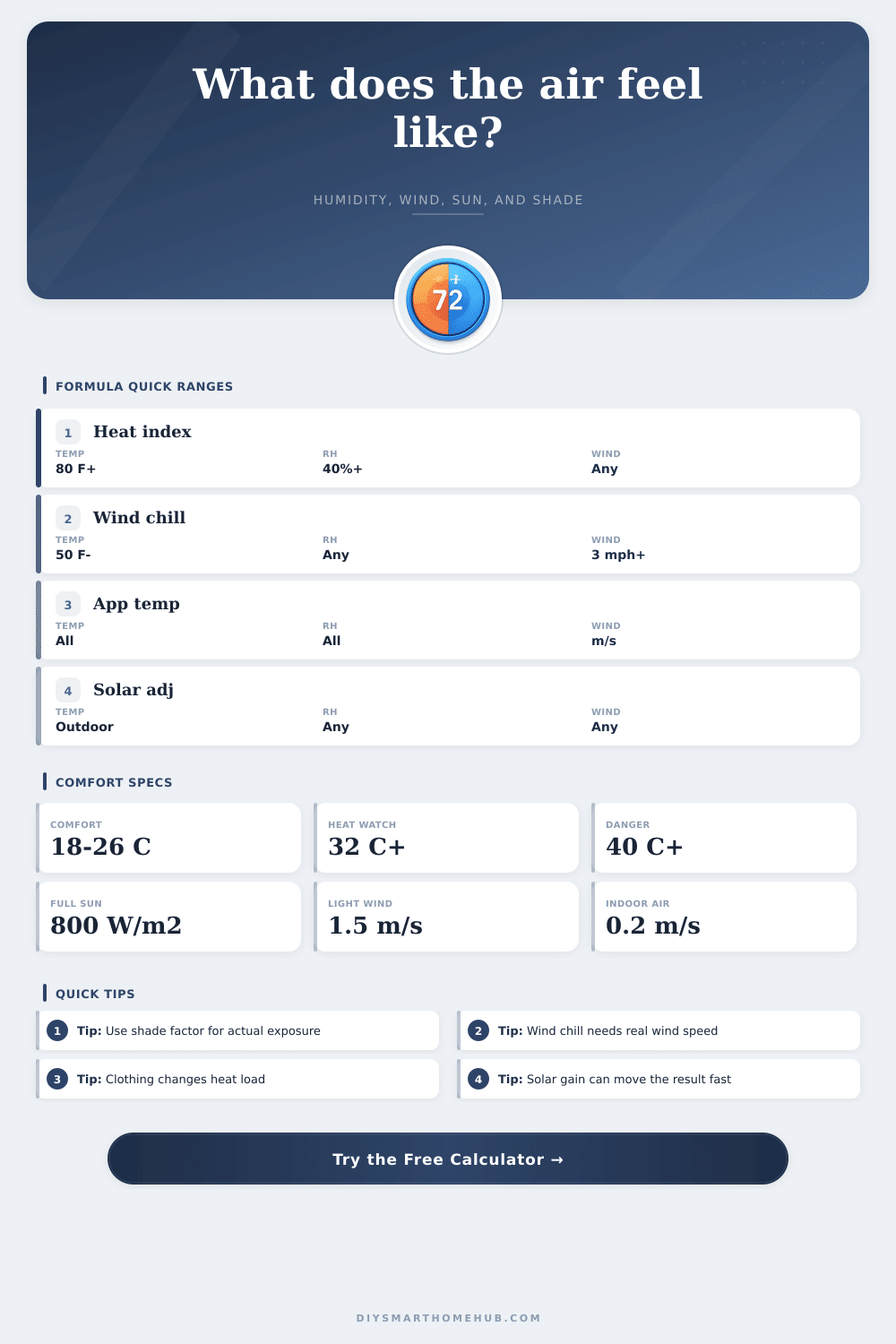
3Comfort spec grid
4Formula activation table
| Formula | Primary inputs | Common range | Output use |
|---|
5Comfort bands
| Adjusted apparent temp | Comfort band | Typical reading | Smart home response |
|---|
6Preset comparison
| Scenario | Mode | Weather | Solar / shade | Clothing / activity |
|---|
7Clothing and activity reference
| Profile | Approx clo or MET | Heat effect | Best used for |
|---|
8Practical calculation tips
Use air temperature from the occupied zone. A sensor in sun, near glass, or above a hot device can overstate the whole-room condition.
For outdoor automations, calculate both full exposure and shaded exposure. Solar gain and local wind often explain why two nearby spots feel different.
You may be wearing heavy gear in eighty degree weather but you might be feeling a lot more than that. A regular thermometer is measuring whats called “dry bulb” temperature. There are other factors such as wind and humidity which cause your body to react different. Wind blows off the heat from your skin, you feel cooler. Humidity prevents sweat from evaporating, you feel warmer.
The number on the dial doesn’t tell whole story when it comes to comfort. It’s about how your body is able to shed heat. Why do humid days seem so oppressive? That’s because of heat index formulas. Why does it get colder on a windy day? Wind chill. What if you’re in the sun or wearing clothes? Those factors aren’t considered by those models.
Why Temperature Does Not Tell The Whole Story
To get a better sense of how hot (or cold) you’ll be, this one consider your activity level and clothing insulation. It also looks at shade and solar radiation together. This gives a more accurate representation of how comfortable (or uncomfortable!). You will be.
In the equation, clothes become the thermal resistor. Clothing insulation holds in the heat our bodies produce (good in winter… Not so much in summer). Metabolic heat is the heat we produce by working. The calculator handles the conversion of that insulation value into an adjusted temperature reading. If you are wearing bulky clothing doing moderate work you will see a big difference in your comfort threshold. This is more significant than a ten-degree change in air temperature.
Heat stress is a common problem for outdoor workers because their protective clothing trap their own generated heat. Most folks don’t realize how much solar complicates things. Twenty degrees can be added in seconds if you’re exposed to direct sun. Just like a car hood, your body soaks up radiant energy from the sun. This increases your body temperature and shows why shade makes a big difference (it cuts down on heat radiating onto your body).
Next time you walk outside at noon from an air-conditioned house, you notice the difference. The shock you feel is the difference between convective cooling and radiant heating. Indoors, you aren’t directly under sun, so conditions change. There is typically little air movement indoors compared to outdoors. The stillness holds humidity more tightly to your body. Less airflow mean less efficient evaporation of sweat. Increasing local air speed; such as with a ceiling fan, restores some evaporative cooling. Fan creates that breezy effect. Knowing this will help determine when to run the fan (or just open windows) on humid evenings.
It’s tempting to rely only on raw temperature: That’s something we can measure easily. But most people forget that how they behave has an equal impact on thermal comfort. You’ll feel warmer going upstairs then by raising ambient temperature by ten degrees. You’ll endure more humid conditions when sitting still than if you were moving briskly. This doesn’t mean you need to guess, the tool will run those calculations for you quickly, and show you what’s causing your discomfort.
Thermoneutrality isn’t the objective. It’s never 100 percent all the time anyway; it’s usually unnecessary. But the idea is to eliminate surprise. It is a warm day in the sun. Plan for it! Go light instead of fashionable; go shady instead of exposed. And if you know what’s happening between your body and the environment, you won’t fight the weather anymore. You’ll start respecting variables that don’t show up on a thermometer. This keeps you comfy even as the numbers on the screen lie.