Wet Bulb Temperature Calculator
Estimate wet-bulb temperature from dry bulb, relative humidity, pressure or elevation, airflow, psychrometric method, safety margin, and target humidity for home HVAC, ventilation, and evaporative cooling checks.
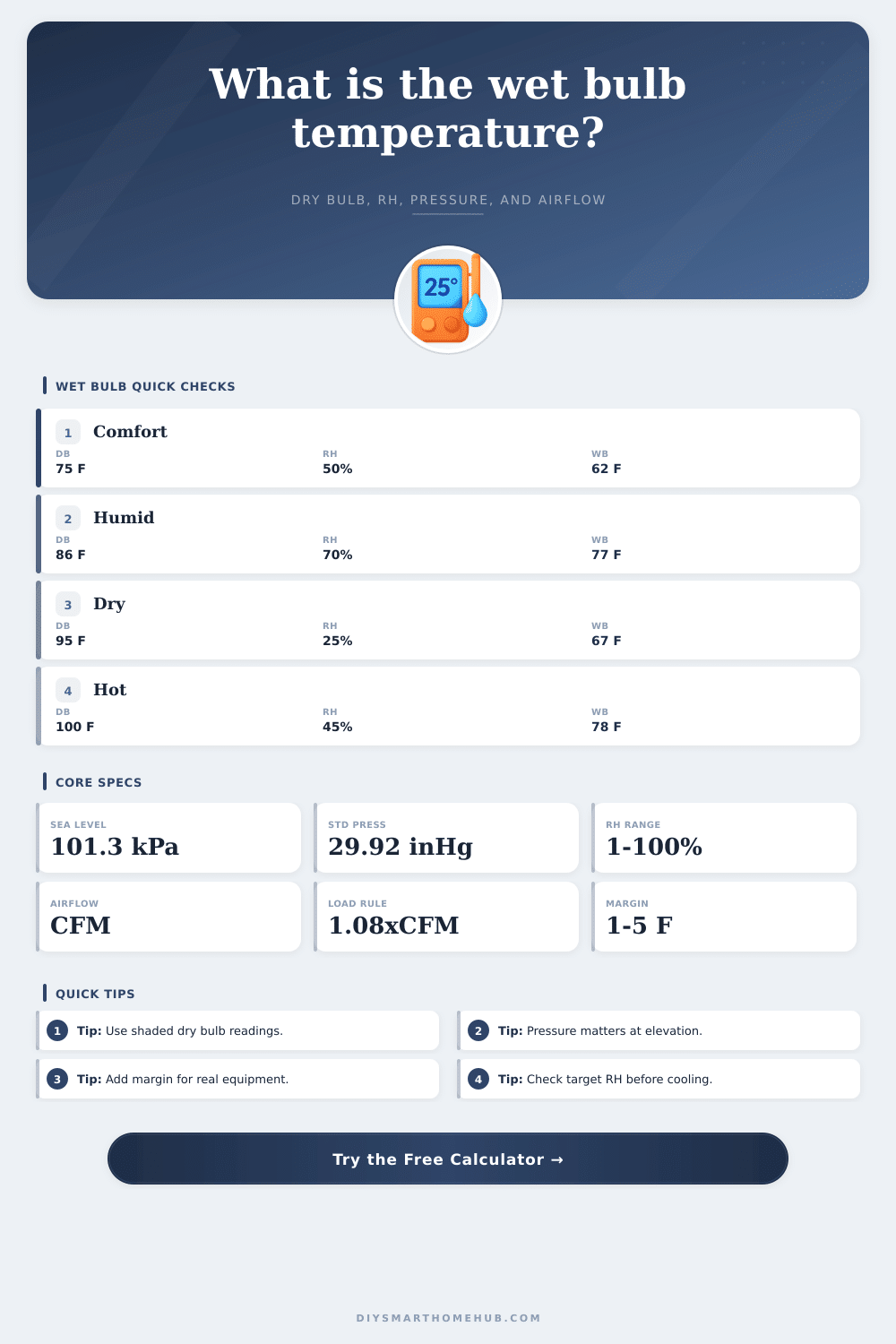
📌Wet Bulb Presets
Start with a common home air condition, then replace the readings with measured dry bulb, relative humidity, pressure, and airflow.
⚙Air State Inputs
📐Formulas Used
This calculator first solves vapor pressure from dry bulb and RH, then applies the selected wet-bulb method at the entered pressure.
| Step | Formula | Use |
|---|---|---|
| Saturation | Ps = 0.61094 exp(17.625T / (T + 243.04)) | Vapor pressure limit |
| Vapor | Pv = RH x Ps / 100 | Actual moisture |
| Ratio | W = 0.62198 Pv / (P - Pv) | Humidity ratio |
| Load | Q = 1.08 x CFM x usable delta F | Airflow potential |
📊Psychrometric Spec Grid
📋Wet Bulb Reference Tables
| Method | Inputs | Best use | Notes |
|---|---|---|---|
| Ventilated | DB, RH, P | Home HVAC | Psychrometer equation with pressure |
| Iterative | DB, RH, P | Psych chart | Matches saturated enthalpy line |
| Stull | DB, RH | Fast estimate | Convenient approximation |
| Conservative | DB, RH, P | Safety check | Uses the warmer solved result |
| Dry Bulb | RH | Wet Bulb | Depression |
|---|---|---|---|
| 75 F / 23.9 C | 50% | 62 F / 16.7 C | 13 F |
| 85 F / 29.4 C | 60% | 74 F / 23.3 C | 11 F |
| 95 F / 35.0 C | 25% | 67 F / 19.4 C | 28 F |
| 100 F / 37.8 C | 45% | 78 F / 25.6 C | 22 F |
| Elevation | Pressure | Effect | Check |
|---|---|---|---|
| 0 ft | 101.3 kPa | Standard | Sea level |
| 2,000 ft | 94.2 kPa | Small shift | Use pressure |
| 5,000 ft | 84.3 kPa | Visible shift | Correct it |
| 8,000 ft | 75.3 kPa | Large shift | Pressure needed |
| Airflow | Usable Drop | BTU/hr | Use case |
|---|---|---|---|
| 250 CFM | 5 F | 1,350 | Small room |
| 500 CFM | 8 F | 4,320 | Living area |
| 1,000 CFM | 10 F | 10,800 | Whole zone |
| 2,000 CFM | 12 F | 25,920 | Large airflow |
💡Wet Bulb Tips
On a hot summer afternoon, you notice how the air feels heavy, how even sitting still won’t allow your skin to cool off. It’s probably not the ninety degrees that thermometer says. Its likely water vapor. This is why the wet bulb temperature… How easily sweat can evaporates and cool you… Is important, rather than just dry bulb temperature, which is what a simple thermometer reads.
With this tool, all you need to do is input rainfall and your roof size. The calculator will do the rest of math for you, so you don’t have to waste time trying to figure out humidity ratios, pressure corrections, and coefficients.
What Is Wet Bulb Temperature?
People think of temperature as just one number, but air contain both heat and moisture. Dry bulb measures only the former: It’s what you see on your typical thermostat when your room is hot even though dial reads seventy-five. Wet bulb incorporates the latter, how cool the air would be if moisture were allowed to evaporate into it. Depression refers to the difference between dry and wet bulb temps; this is your cooling potential.
When humidity rises to a hundred percent, so will gap between them and they’ll shrink until they reach zero. At this point, no moisture can evaporate from your body. Sweat cannot escape, so there is no relief. It is not just for comfort but for survival.
You can select various psychrometric methods, an apparently academic choice until you realize it explain the variations in their solutions to the same problem. A ventilated psychrometer take barometric pressure into account and refines its answer accordingly. Stull provides a quicker approximation that simply doesn’t worry about altitude.
If you’re up in the mountains, you will need the correction, as thinner air behave differently than with respect to water vapor. At sea level, standard assumptions suffice. They change noticeable above five thousand feet. That’s where the difference is made in terms of thermodynamic reality. The reference table on page makes it all clear for you.
The result also depends on airflow. Evaporative cooling occur when sweat (or water) dries off, which is why a light breeze feels cooler than standing still. But if an HVAC unit blasts you with a focused stream rather than ambient air, it can move heat out of your body much faster then a breeze ever will. The calculator accounts for this, taking into account both the available temperature drop as well as the number of cubic feet per minute of airflow, resulting in a ballpark estimate of how many BTUs might be saved using evaporation vs. This is compared to simply running compressor at full power.
Not magic; but if you rig things correctly, physics has your back. There’s a safety margin here. Real world conditions aren’t neat. Your theoretical wet bulb temperature doesn’t take into account the mixing inefficiency and sensor lag of actual evaporative pad system. It also doesn’t account for the friction loss in the ductwork. You should of add several degrees to the target to cover all those variables. Otherwise, what looks good on paper won’t work so well in practice.
Target humidity settings close this gap by calculating the difference between current air state vs. This is the desired air state. Desired air state. Are we going up or down? Is it moving toward comfort or away from it? Is it approaching a moist environment that leads to mold growth?
When taking a dry bulb read, place the sensor away from direct sun light, as it will overstate the reading due to radiant heat and skew the depression calculation. The shaded reading shows actual air mass entering the system. Here again consistency trumps precision. Use same source for elevation estimates or measured barometer pressure each time, so that comparisons is valid season-to-season or room-to-room.
People tend to forget about wet bulb temperature. It forces you to think of moisture as a variable, instead of an afterthought. You’ll begin to realize that when the air is thick and unyielding, it’s not the thermostat you should be cursing; just look at the wet bulb for your answer. If you don’t know what it means, it usualy tells you.