Kelvin to Mired Converter
Convert CCT in Kelvin to mired, compare warm or cool delta, apply lighting gel mired shift, track green-magenta tint correction, and estimate LED bin spread across multiple fixtures.
Kelvin to Mired Results
Common Kelvin and Mired Lighting References
| Lighting Name | CCT | Mired | Typical Smart Lighting Use |
|---|---|---|---|
| Candle or flame scene | 1800 to 2000 K | 556 to 500 | Night mode, fireplace scene, low-level amber accent |
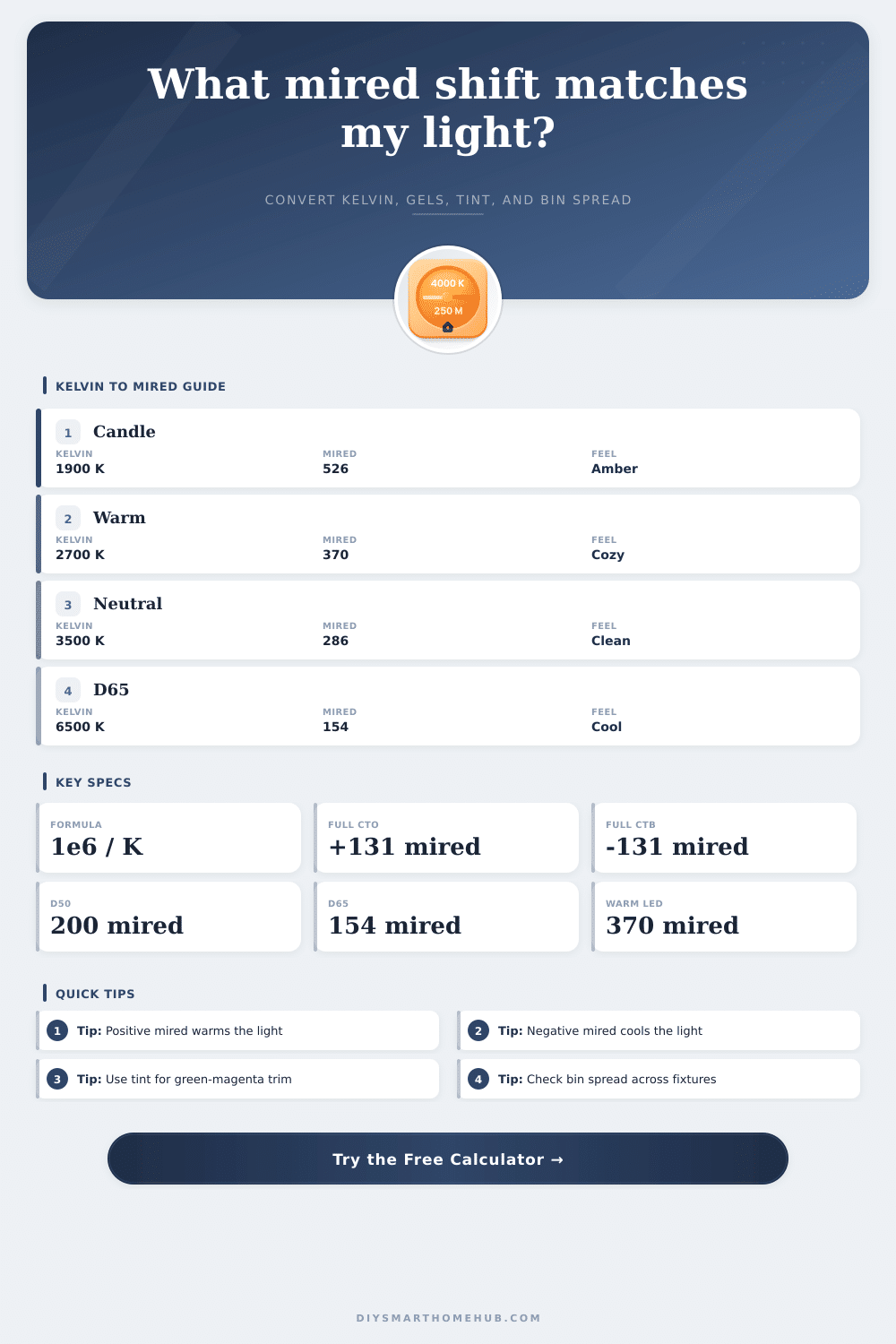
| Warm household LED | 2700 K | 370 | Living room lamps, relaxed evening scenes |
| Soft white LED | 3000 K | 333 | Dining, entry, bedrooms, mixed practical light |
| Gallery neutral | 3500 K | 286 | Art walls, closets, makeup mirrors, balanced warm-neutral light |
| Office cool white | 4000 K | 250 | Kitchen, laundry, workbench, task lighting |
| CIE D50 reference | 5000 K | 200 | Print viewing, craft color matching, proofing desk |
| Studio flash or D56 | 5600 K | 179 | Photo lights, video daylight, camera white balance |
| CIE D65 daylight | 6500 K | 154 | Screen reference, cool daylight scene, inspection task |
Filter Gel Mired Shift Reference
| Gel Correction Name | Approx Mired Shift | Direction | Example Use |
|---|---|---|---|
| Full CTO | +131 mired | Warmer | Daylight source toward tungsten warmth |
| Half CTO | +81 mired | Warmer | Daylight source toward warm neutral |
| Quarter CTO | +40 mired | Warmer | D65 toward D50 or cool LED toward neutral |
| Eighth CTO | +20 mired | Warmer | Small smart-light trim without a big color move |
| Full CTB | -131 mired | Cooler | Tungsten source toward daylight |
| Half CTB | -69 mired | Cooler | Warm LED toward clean neutral task light |
| Quarter CTB | -35 mired | Cooler | Soft white toward 3500 to 4000 K |
| Eighth CTB | -18 mired | Cooler | Fine cooling trim for mixed fixtures |
Warm and Cool Delta Examples
| Source to Target | Kelvin Delta | Mired Delta | Correction Read |
|---|---|---|---|
| 2700 K to 3000 K | +300 K | -37 mired | Slight cooler move; around quarter CTB strength |
| 3000 K to 4000 K | +1000 K | -83 mired | Clear cool shift; near half CTB strength |
| 5600 K to 5000 K | -600 K | +21 mired | Small warm shift; near eighth CTO strength |
| 6500 K to 5000 K | -1500 K | +46 mired | Noticeable warm correction; near quarter CTO |
| 5600 K to 3200 K | -2400 K | +134 mired | Large warm shift; near full CTO strength |
| 3200 K to 5600 K | +2400 K | -134 mired | Large cool shift; near full CTB strength |
LED Bin Tolerance Planning Grid
| Target CCT | +/- 50 K Spread | +/- 100 K Spread | Fixture Planning Note |
|---|---|---|---|
| 2700 K | 14 mired | 27 mired | Warm scenes show bin mismatch quickly on adjacent walls |
| 3000 K | 11 mired | 22 mired | Good binning matters for multi-lamp rooms |
| 4000 K | 6 mired | 13 mired | Task lights tolerate slightly wider Kelvin bins |
| 5000 K | 4 mired | 8 mired | Small mired changes can still matter for proofing |
| 6500 K | 2 mired | 5 mired | Kelvin tolerances look smaller in mired at cool CCTs |
If you’ve ever flipped the switch in your living room only to realize that something about lighting isn’t right, though you’re not sure what… You’re probably dealing with a blend of different color temperatures. You may also be unfamiliar with how our eyes realy see such changes.
Kelvin (K) represent the unit for measuring light; it’s a linear scale that begins roughly around zero. As a result, there’s a bit of a mathematical trick because switching from 2700 K to 3000 K might look like a massive change on paper but it feels quite small to your brain. Going from 6500 K to 6800 K covers the exact same number range, but it is barely noticeable to your eye.
Why Mireds Are Better Than Kelvin for Lighting
Enter mired values, here to rescue you from color correction hell. A mired is short for micro reciprocal degrees. Basically it reverses the Kelvin scale to where each increment is about as significant to our eyes as the next. When we’re attempting to balance lights and need to correct one from, say, 3200K tungsten to daylight, simply taking away a fixed amount of Kelvin won’t work. It is going to wildly overcompensate or undercompensate based on where you start. Calculating in mireds ensures that the adjustment matches what you see.
Which is why the tool up top does the conversion for you, no calculator needed, just stand there holding a light bulb and a ladder. You type in your current light temperature and the temperature you want. It then tells you exactly how many mireds to adjust it by using units that match human vision.
Mireds can be thought of in terms of steps (not miles). Adding a full CTO gel warms up the light by approximately 131 mireds; removing a full CTB cools it down by the same amount. That’s the symmetry that makes the metric so useful for cinematographers and lighting designers.
For instance, if you’re shooting a warm candle lit scene at around 526 mireds, then want to transition into an office environment with a more neutral look (at 250 mireds), you’ll know just how many cooling steps it takes. You won’t have to guess if half a filter might be enough. These common adjustments are spelled out in the converter’s reference tables. They help you see at a glance that going from 2700 K to 3000 K is only a slight adjustment (roughly 37 mireds), while going from 3000 K to 4000 K is a much larger correction (over 80 mireds).
But there’s one more wrinkle when it comes to actual real world lighting: color temperature is just one factor, but LED fixtures is grouped with tolerance. Depending on which batch they came from, two 3000 K-rated bulbs could end up being anywhere from plus or minus 100 Kelvin. That doesn’t sound like much in Kelvin terms. But mixed-brand means mixed-bins, which can make your ceiling look patchy in color terms.
The converter solves for this by allowing you to specify how many fixtures you have and what bin tolerances they’re at. It’ll estimate the worst-case scenario and let you know whether you’ll have a uniform look or something that looks off. This is important because, in big rooms, things need to be consistent different than necessarily accurate.
Tint correction aside, you’ll also want to think about color temperature. The warm-cool axis isn’t related to green-magenta shifts. Those go in another direction entirely (perpendicular). So it’s possible to have a perfectly balanced light in terms of mireds and still have that green-magenta shift going on that casts the light in an unsatisfying way. Both axes need to be checked for good lighting design. Set the temperature with your smart bulb setting or gel and then tweak the tint so that neutral gray appears…well, gray! Again, it’s a subtle detail but can make all the difference between flat and flattering light.
Apps typically round to steps of 50 or 100 K when you set a smart home scene, so you’ll almost never get exactly on Kelvin. That’s OK. You’re just trying to be close enough that it doesn’t jump out at your eyes as being wrong. Use the converter to find the closest step size with the least error. If you still have less than ten mireds left, you’re likely good. More than that and it could feel wrong.
And lastly, lighting isn’t as much about numbers as it is about comfort. How do we make a space feel alert? Is it inviting? And you don’t know why? When you think in terms of mireds rather then Kelvin, you match your adjustments to what you’re actualy seeing. No more fighting with the math. Start shaping the mood. Next time your room feels “off,” don’t just check the setting, check the shift.