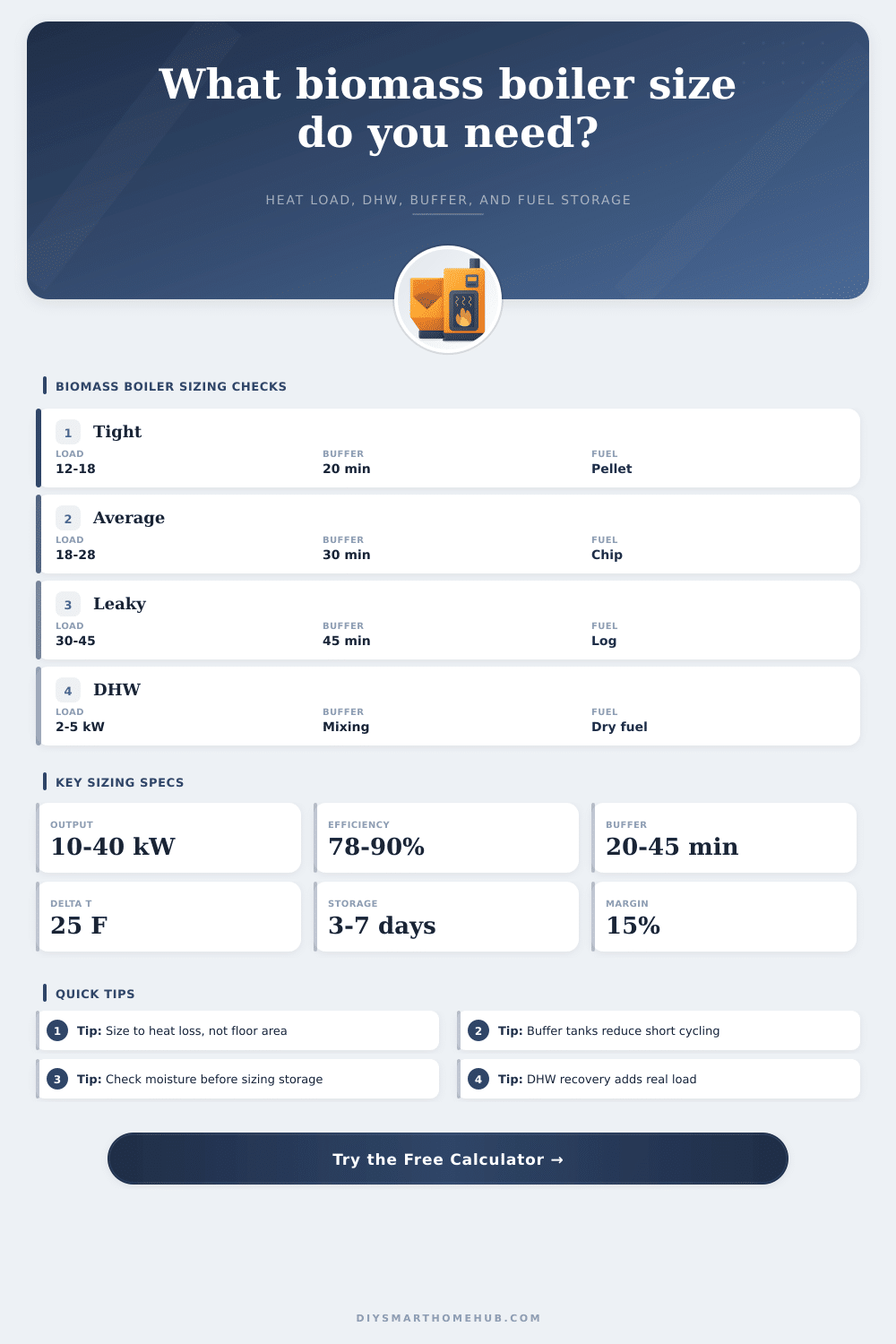
Biomass Boiler Size Calculator
Estimate design heat load, domestic hot water recovery, boiler output, nominal input, buffer tank volume, and short-term fuel storage for a biomass hydronic system.
| Fuel / Boiler Match | Typical Energy | Bulk Density | Best Sizing Note |
|---|---|---|---|
| Pellet boiler | 4.7-5.0 kWh/kg fuel | 38-42 lb/ft³ | Good modulation; storage volume stays compact. |
| Log gasification boiler | 3.7-4.2 kWh/kg dry wood | 18-28 lb/ft³ stacked | Usually needs larger buffer for batch firing. |
| Dry chip boiler | 3.4-4.0 kWh/kg chips | 14-20 lb/ft³ | Check auger feed rate against peak input. |
| Higher-moisture chips | 2.4-3.1 kWh/kg chips | 17-24 lb/ft³ | Lower usable energy means more mass and volume. |
| Wood briquettes | 4.8-5.2 kWh/kg fuel | 34-45 lb/ft³ | Dense fuel; verify boiler feed compatibility. |
| Agricultural pellets | 4.0-4.6 kWh/kg fuel | 34-40 lb/ft³ | Ash and clinker behavior can limit derating. |
| Envelope Condition | Heat Loss Guide | Metric Equivalent | Use When |
|---|---|---|---|
| Passive or near-passive | 5-10 BTU/h per ft² | 16-32 W/m² | Very airtight, high insulation, low glazing loss. |
| Modern tight build | 12-18 BTU/h per ft² | 38-57 W/m² | Good windows, air sealing, insulated attic and walls. |
| Average existing home | 20-30 BTU/h per ft² | 63-95 W/m² | Mixed upgrades with normal infiltration. |
| Leaky older building | 35-50 BTU/h per ft² | 110-158 W/m² | Drafty shell, limited insulation, high design delta. |
| DHW Assumption | Imperial Formula | Metric Formula | Calculator Use |
|---|---|---|---|
| Daily hot water energy | gal x 8.34 x ΔT / 3412 | L x 4.186 x ΔC / 3600 | Converts daily DHW load into kWh. |
| Recovery load | kWh / recovery hours | same in kW | Adds hot water demand to space heating. |
| Infiltration load | 1.08 x CFM x ΔF | 0.33 x L/s x ΔC | Uses building volume and air changes per hour. |
| Buffer tank volume | BTU/h x min / 500 x ΔF | kW x min x 14.34 / ΔC | Sizes water volume for minimum burn time. |
| Building Scenario | Area | Typical Output | Secondary Sizing Focus |
|---|---|---|---|
| Compact tight cottage | 1,000-1,400 ft² | 8-15 kW | Avoid oversizing; use modulation or buffer. |
| Average family home | 1,600-2,400 ft² | 18-32 kW | DHW recovery and normal infiltration. |
| Older farmhouse | 2,000-3,000 ft² | 30-55 kW | Air leakage and design temperature delta. |
| Shop or radiant slab | 800-2,000 ft² | 12-35 kW | Water temperature swing and long cycles. |
Biomass boilers are different from gas furnaces. When you size your biomass boiler you are signing up for fuel chain inside your back yard or basement. You can’t afford to be wrong about this. The consequences is annoying (and immediate). Oversizing means the unit will short cycle, no good because it rob the fire of air and creates more heat than you can store.
People tend to look at quantity of their fuel. They neglect the fact that you need to burn that fuel efficienty. Why burn a few logs every 20 minutes only to shut down for three hours? Once those parameters are entered (including your building’s characteristics), this calculator will crunch the numbers for you (above).
How to Choose the Right Size Boiler
Rather than requiring you to try and make up coefficients and conversions, it begin with one question: What is your heat loss rate? That’s important because a 1,000 square foot passive house may require smaller heating capacity then a 2,000 square foot drafty Victorian with single pane windows. Next, what temperature difference do you want between inside and out during the coldest outdoor weather? And finally, how many BTUs of infiltration occur as outside air leaks in (or is forced in through mechanical ventilation)? These values is plugged into the equation along with more to calculate the real thermal load that the system needs to be able to handle at its worst moment in winter.
The bulk of discussion around sizing biomass is usually around domestic hot water recovery. That’s because it’s so huge. A normal family of four runs a load of laundry, does dishes, and takes couple of showers. This produces an enormous surge in demand far beyond what space heating ever comes close to touching. The boiler has to ramp up accordingly if you don’t wish to wait hours (instead of all day) for hot water to arrive.
This means the calculator add the recovery load to the space heating load. This ensures there is enough capacity to do both jobs so you aren’t standing in a cold shower or freezing to death while trying to heat your house. After that, it multiplies by a seasonally appropriate efficiency rate and a safety factor to get the nominal input power needed from whatever fuel you select.
The theory and reality of fuel storage: Pellets are dense and uniform, storing easy and automatically in a small footprint; boilers modulate well according to load. They must be fired in batches, typically requiring a bigger buffer tank to hold some heat while they’re loading, preventing over-firing when a relatively small window opens up. Because moisture content greatly affects both energy density and storage volume, chips is all over the map, so to speak. This chart on the page breaks it down by fuel type; usable energy and bulk density will determine your storage capacity to match. For example, a wet pile of chips may take double the space than a dry pile of pellets to deliver equivalent heat.
The buffer tank acts as a kind of thermal battery. When the house require heat, the boiler fires and pumps water into it. By providing enough water mass to absorb this additional heat until it’s needed further down the line, the buffer tank prevents short cycling. The bigger the temperature change in the buffer, the smaller volume tank we need. There is a limit to the amount of variation your radiators or radiant floors will tolerate though. To help balance the choice between storage space and equipment cost, the tool calculate the gallons required given your desired burn time and temperature range.
The sticker price on the boiler is only part of the story: the real size question also involve the comfort factor (pellets vs. Shovelling chips) as well as other practicalities (how much space you have in your storage shed). Often those “real world” considerations is the determining factors more than the theoretical efficiency numbers. While the calculator gives you a sound starting point from an engineering perspective, your own lifestyle choices and climate conditions will then adjust things into the proper range.
A well sized system keeps you warm, runs clean, lasts long and doesn’t become a second job. You don’t want a system that requires constant attention to keep it going; you want a system that works for you. Finding that sweet spot where you get to enjoy the heat of renewables while avoiding life in a fire department, is what the sizing process should of been all about.