Parallel Battery Voltage Calculator
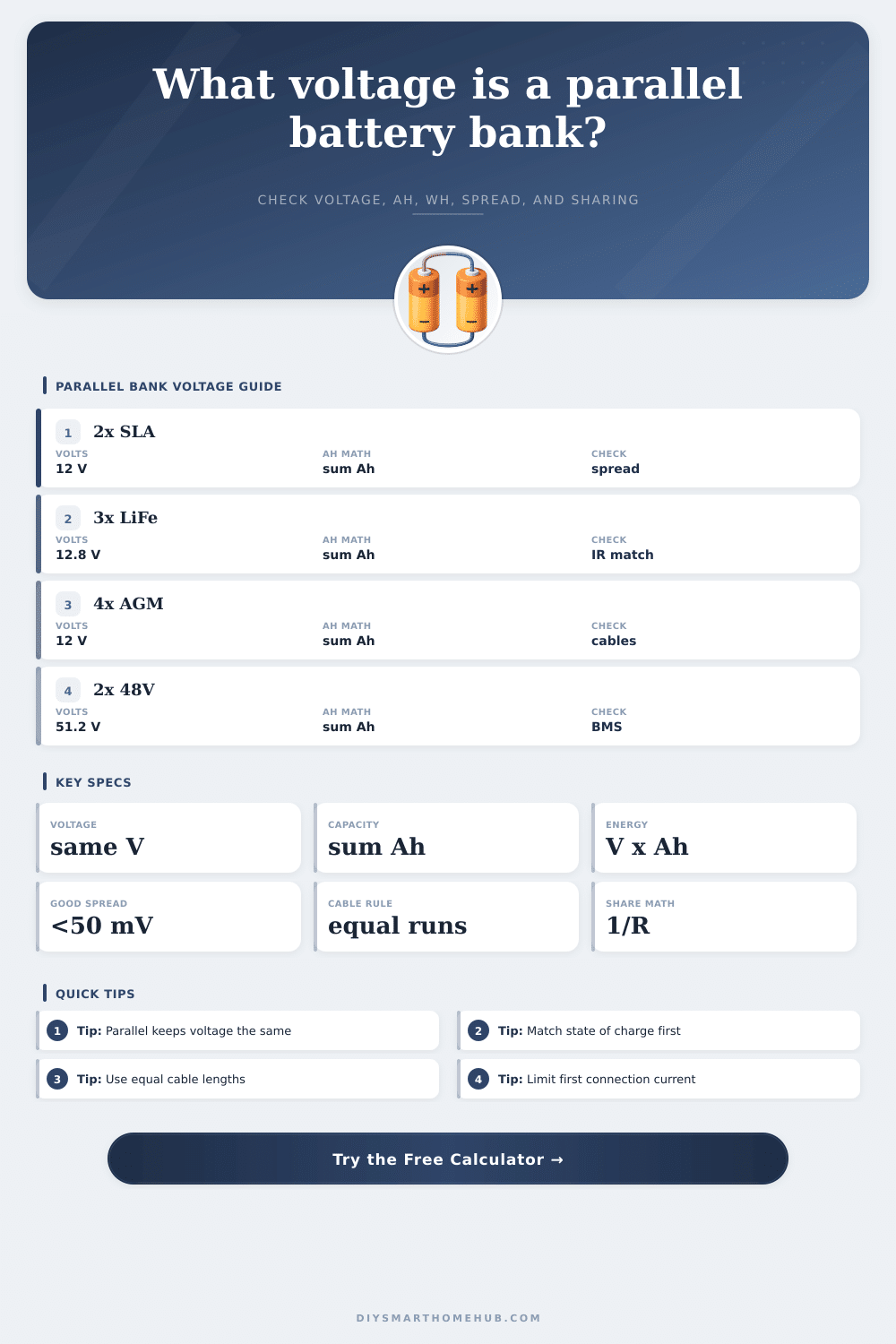
Estimate what happens when equal-voltage batteries are connected in parallel: bank voltage stays nominal, amp-hours add, watt-hours add, and voltage mismatch drives balancing current through internal and cable resistance.
This is a planning calculator. Confirm battery data sheets, BMS limits, fuse ratings, and field measurements before connecting batteries.
Batteries in parallel must share the same nominal voltage. Parallel does not create 24V from two 12V batteries.
Equivalent Ah equals capacity per battery multiplied by the number of matched parallel batteries.
Lower-resistance branches carry more current, so equal cable length and connection geometry matter.
The voltage difference before connection estimates the first balancing current between batteries.
| Battery type | Nominal voltage | Typical internal resistance | Parallel note |
|---|---|---|---|
| Small sealed lead acid | 12 V | 20 to 80 mOhm | Match age and rested voltage before connecting. |
| AGM deep cycle | 12 V | 4 to 20 mOhm | Short equal cables help avoid one battery doing more work. |
| LiFePO4 drop-in | 12.8 V | 2 to 12 mOhm | BMS state and manufacturer parallel limits matter. |
| Rack lithium module | 48 to 51.2 V | 1 to 8 mOhm | Use matched modules with compatible BMS communication where required. |
| Copper size | Ohms per 1000 ft | 2 ft round trip | Use in parallel banks |
|---|---|---|---|
| 12 AWG | 1.588 ohm | 3.18 mOhm | Small standby loads and short leads. |
| 8 AWG | 0.628 ohm | 1.26 mOhm | Moderate inverter or DC distribution branches. |
| 4 AWG | 0.249 ohm | 0.50 mOhm | Higher-current 12V and 24V lithium banks. |
| 2/0 AWG | 0.0779 ohm | 0.16 mOhm | Large inverter banks where cable drop must be small. |
| Rested voltage spread | 12V lead-acid signal | 12.8V LiFePO4 signal | Practical response |
|---|---|---|---|
| 0 to 25 mV | Very close match | Very close match | Usually a low-stress connection if batteries are healthy. |
| 25 to 75 mV | Moderate state difference | May hide more SOC difference on a flat curve | Use a current-limited pre-balance or charge to the same setpoint. |
| 75 to 200 mV | Meaningful mismatch | Likely mismatch away from the flat middle zone | Do not hard-parallel until voltage is brought closer. |
| Over 200 mV | High equalization surge risk | High equalization surge risk | Treat as not ready for direct parallel connection. |
| Example bank | Parallel voltage | Capacity result | Watch item |
|---|---|---|---|
| 2 x 12V 9Ah SLA | 12 V nominal | 18 Ah, 216 Wh | Age and rested voltage spread. |
| 2 x 12.8V 100Ah LiFePO4 | 12.8 V nominal | 200 Ah, 2560 Wh | BMS current limit and pre-charge. |
| 4 x 12V 100Ah AGM | 12 V nominal | 400 Ah, 4800 Wh | Diagonal or busbar takeoff for sharing. |
| 2 x 51.2V 100Ah modules | 51.2 V nominal | 200 Ah, 10240 Wh | Module firmware and communication rules. |
When you wire batteries in parallel, it add to the overall capacity without altering voltage level. Connecting two 12-volt batteries together double the runtime for your van or inverter setup. It seems obvious, right? The math is easy.
But then there is issue of charge history, rate of aging, and internal resistance. In reality, batteries aren’t perfect and don’t always act like we’d expect. If you plug in two mismatched batteries, the higher voltage battery will sends its current into the lower voltage battery. If that voltage difference is great and their internal resistances is low, that equalization surge can be huge. Internal resistances for lithium batteries tend to be realy low. You might think that a few hundred millivolts of difference is nothing, because it looks so small on a multimeter. That’s enough to cause amps to flow around your terminals while you haven’t turned on your load yet.
How to Connect Batteries Safely in Parallel
The calculator take all those numbers when you input battery voltage and profiles. From there, you’ll know whether the spark was harmless or a warning sign. For accurate results, you’ll want to measure that spread of voltage on resting batteries. Do this by measuring both batteries after they’ve been sitting unloaded for several hours without charging or loading.
One might be twelve point seven four volts while the other is at twelve point seven zero. The gap is forty millivolts. It is small enough that you would never notice it. However, you would notice when a small current move from high to low until the voltages matches because of low resistance in one or the other. The goal is typically less than fifty millivolts between any batteries in a bank prior to connecting them. If yours is greater, then you’ll want to charge each one to the same setpoint or allow them to balance up on their own prior to trying to make them connected. Melted terminals result if you try to force a parallel with too big of a voltage mismatch.
And then there’s the matter of cable length, which is important to batteries themselves. Current always takes the path of least resistance. If you have long, thin wire on one battery and short, thick ones on another, that first battery will be carrying most of the current. That’s not good because it puts extra stress on the stronger branch while leaving the weaker one underused. According to the reference table, the longer the run of cable, the greater its resistance become (with gauge affecting the resistance). Equal length runs or a busbar setup distribute the load equally between both batteries. Again, a little thing, but something worth considering when looking at longevity.
The chemical reaction has what we call “internal resistance.” Internal resistance is sort of like friction. Lead-acid batteries gets worse internally as they age. They’re not able to take and give charge as freely anymore. So when you put an old and a new battery together in parallel, you have the new battery doing all the heavy lifting while the old battery falls behind. The imbalance causes it to cycle which makes it die sooner. It’s not helping carry the load, it’s being carried along. This tool would of help you foresee that based off the milli-ohm values listed in your datasheets.
You need to create a solid parallel bank. Maintaining symmetry is key in building a good bank. Match the length of wire, the age of the units and the voltages. Do this and your system will be quiet and run smoothly. Don’t do it and you’ll have blown fuses and other voltage mystery drops that never seem to go away. It’s about having power down the road, not only today.