Deep Cycle Battery Amp Hour Calculator
Estimate deep-cycle battery amp hours from load watts, runtime, system voltage, inverter efficiency, depth of discharge, Peukert adjustment, and the number of parallel batteries required.
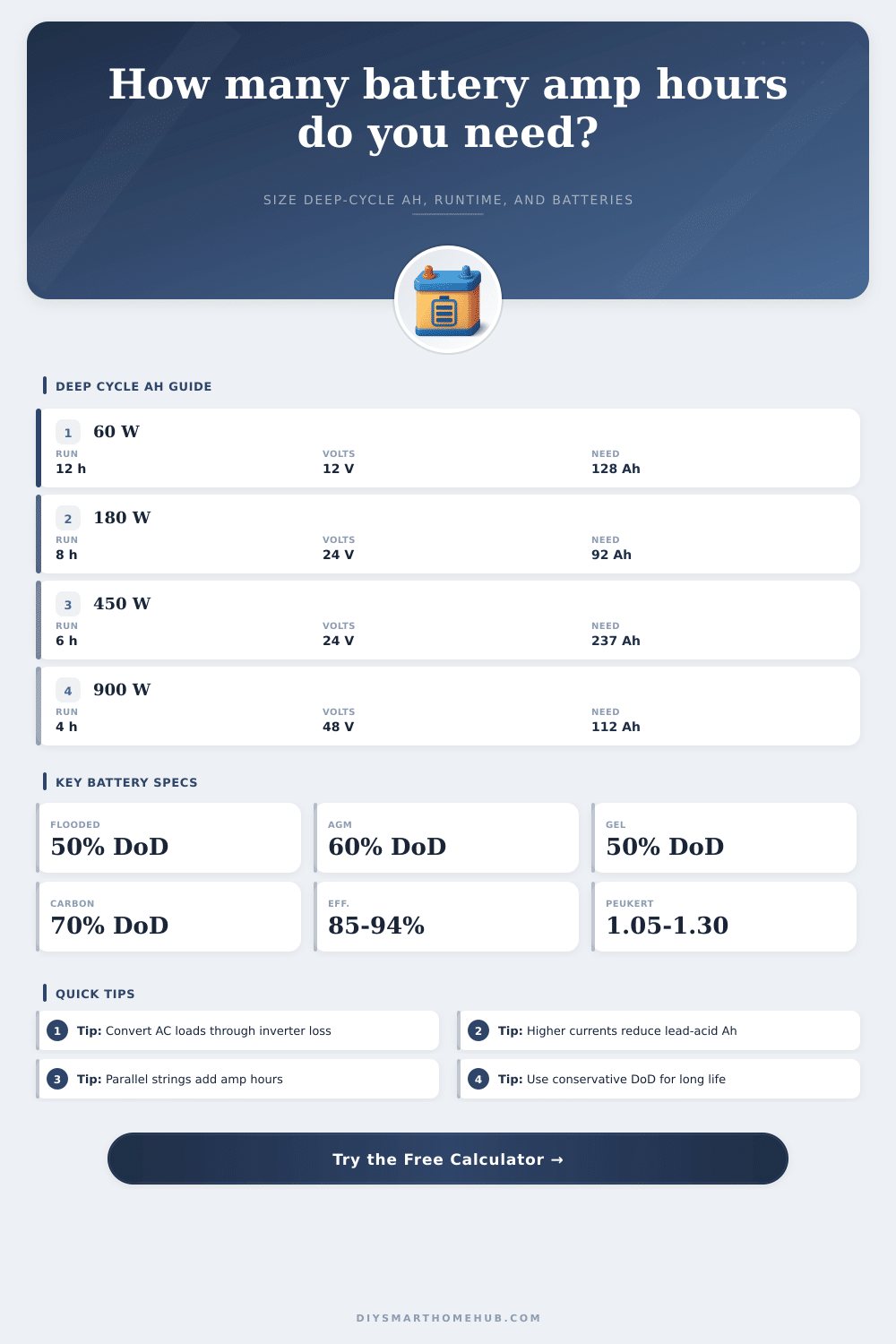
| Battery type | Planning DoD | Peukert range | Use this when |
|---|---|---|---|
| Flooded deep-cycle lead-acid | 45% to 55% | 1.15 to 1.30 | Vented banks, golf carts, RV house batteries, and serviceable batteries. |
| AGM deep-cycle | 50% to 65% | 1.08 to 1.18 | Sealed backup banks and inverter loads where low maintenance matters. |
| Gel deep-cycle | 45% to 55% | 1.10 to 1.20 | Low-current standby loads that need sealed batteries and gentle cycling. |
| Carbon-enhanced lead-acid | 60% to 75% | 1.06 to 1.15 | Partial-state cycling and faster charge-discharge service. |
| Flooded traction cell | 55% to 70% | 1.16 to 1.28 | Industrial, marine, and large off-grid banks with planned maintenance. |
| LiFePO4 deep-cycle | 75% to 90% | 1.00 to 1.05 | Deep-cycle packs with BMS limits and flatter voltage under load. |
| Load profile | Typical watts | Runtime target | Battery sizing cue |
|---|---|---|---|
| Router, modem, smart hub | 25 W to 80 W | 8 h to 24 h | Small loads are often voltage-drop and idle-draw sensitive. |
| Camera NVR and PoE switch | 80 W to 250 W | 6 h to 24 h | Use true PoE draw, not only camera nameplate current. |
| Refrigerator backup | 100 W to 250 W average | 6 h to 18 h | Model compressor duty cycle and inverter idle draw together. |
| RV overnight house load | 150 W to 500 W | 8 h to 14 h | Fans, lights, pump bursts, and inverter standby can dominate Ah. |
| Workbench UPS | 300 W to 1000 W | 1 h to 6 h | High current needs Peukert correction and cable-current review. |
| System voltage | Best range | Current at 1000 W DC | Planning note |
|---|---|---|---|
| 12 V | Small mobile banks | 83.3 A | Current rises fast; use short cable runs and fewer heavy loads. |
| 24 V | Medium inverter banks | 41.7 A | Good balance for cabins, RVs, and modest backup circuits. |
| 36 V | Mobility and trolling systems | 27.8 A | Common where matched battery sets are already used. |
| 48 V | Large inverter banks | 20.8 A | Lower current helps with efficiency and conductor sizing. |
| Scenario | Input example | Core formula | Output to check |
|---|---|---|---|
| Direct DC load | 80 W, 12 h, 12 V | Wh = W x h | Set inverter efficiency to 100% and idle to 0 W. |
| AC inverter load | 300 W, 8 h, 24 V | DC W = AC W / eff + idle | Use DC-side watts for Ah sizing. |
| Lead-acid high current | 900 W, 4 h, 12 V | Peukert factor raises Ah | Check discharge rate per parallel string. |
| Parallel battery bank | 24 V from 12 V blocks | Strings = Ah need / battery Ah | Each 24 V string uses two 12 V batteries. |
If you have ever lost power when camping or had your back-up system kick in and then cut out during a grid outage, you’ve been confused. That’s rarely due to bad batteries. Almost always it’s about bad math. Amp hours aren’t like gallons of gas. They is deep cycle batteries that look simple on the label but turn out to be pretty complicated in practice. Drawing power doesn’t happen at a consistent rate no matter how hard you step on the pedal. In fact, how fast you draw power alter how much energy you get to use. Ignoring this physics lesson can cost you sleep and money.
To calculate amp-hours, most people simply divide their wattage requirement (load) by system’s voltage. Multiply that number by hours and presto… You know how many amp-hour batteries you need. Sounds easy, right? But there are three big efficiency thieves you’re not accounting for with simple math. The inverter loses some juice, the Peukert effect steals more, and you also has to account for your personal tolerance for deep discharging.
Why Simple Math Is Wrong For Batteries
If you’re running AC appliances through an inverter, you’re being taxed for converting energy into a different form. For example, a typical one will only be 90% efficient, which means 10% of your battery is wasted before ever reaching the refrigerator or coffee maker. Then there’s the inverter’s idle draw (that little), constant siphon of current the inverter take while it remains on. That tiny draw over a dozen hours equal a large bite out of your available capacity.
The calculator does all this: it combines efficiency losses, duty cycles, and load averages into one required amp-hour number. And makes you face facts about part-time loads (like your fridge’s compressor running just 35% of the time). What if you guess wrong by modeling the peak watts as constant? You double-sized your battery bank and have no idea why it isn’t meeting your needs. What if you guess too small? You die in the dark.
Use the real duty cycle. The calculator averages out those high peaks to something much more reasonable for sizing. The chemical makeup and depth of discharge limits is where things get interesting. Lead acid batteries (flooded or sealed as gel or AGM) should not be fully discharged. Doing so dramatically shortens battery life. Running it down every day will kill it. If you can limit yourself to using 50% or 60% of rated capacity, you’ll dramatically extend its life.
With lithium iron phosphate (LiFePO4), you can go further and not suffer the same penalty. But it’s an expensive up front cost. So part of this is figuring out what you want to optimize for, longevity over five years or wallet space today? The calculator asks how deep you want to discharge it, or your target DoD. It uses a Peukert exponent to account for the fact that lead-acid cells will give you less total energy when drained fast.
But many people also overlook voltage drop and cable sizing, which can hurt your performance just as much as an oversized load. Thick cables (expensive and harder to deal with) is necessary for high current loads in a twelve volt system. Going up to twenty-four or forty-eight volts decreases the current demand for equal wattage, resulting in lower losses and the ability to use thinner wire. Sometimes building a higher voltage bank is less expensive then purchasing large gauge copper. This is laid out clearly in the reference tables on the page illustrating how current draw is affected by system choice.
But at the end of the day, a battery purchase isn’t simply a matter of meeting some arbitrary spec. It’s balancing the chemistry of the device itself against the reality of how you use it. Is it running a screaming well pump or quiet router? Do you have aging batteries and/or cold days where you might need extra reserve capacity? Size to match your needs and get the inputs right, accounting for the efficiency loss, and your power will be there when you really need it.
You should of accounted for the moddern losses. The charger can absorbs too much power if not careful. It’s actualy hard to find the right size when you have different than expected loads based off your usage. Using wrong amount of furnitures will also affect things. It would of been better to check calculations again.
If a armchair is in the way, make sure it’s comfortabley placed. When you recieve the battery, check for any dissapears parts or damage. You might need more than two adult-sized sofa space to store everything. A luxurius setup requires careful planning.