Ni MH Battery Charge Time Calculator
Estimate NiMH recharge time from cell capacity, series cells, charge current, C-rate, efficiency overhead, delta-V reserve, and safe trickle current.
Calculation breakdown
| Cell format | Typical capacity | Gentle current | Normal use |
|---|---|---|---|
| AAA NiMH | 600-1000 mAh | 60-100 mA | Remotes, sensors, small controls |
| AA NiMH | 1900-2500 mAh | 190-250 mA | Keypads, locks, handheld devices |
| Sub-C NiMH | 3000-5000 mAh | 300-500 mA | Tool packs and hobby packs |
| C NiMH | 3500-6000 mAh | 350-600 mA | Larger portable equipment |
| D NiMH | 8000-10000 mAh | 800-1000 mA | Emergency lighting and high runtime packs |
| C-rate | Current formula | Typical time before reserve | Charger expectation |
|---|---|---|---|
| 0.05 C | Capacity Ah x 0.05 | 24-30 hours | Maintenance or very gentle top-up |
| 0.10 C | Capacity Ah x 0.10 | 12-15 hours | Classic slow NiMH charger range |
| 0.30 C | Capacity Ah x 0.30 | 4-5 hours | Smart charger recommended |
| 0.50 C | Capacity Ah x 0.50 | 2.5-3.5 hours | Smart charger with temperature awareness |
| 1.00 C | Capacity Ah x 1.00 | 1.2-1.6 hours | Fast charger and suitable cells only |
| Series cells | Nominal pack voltage | Near-full charge voltage | Common pack example |
|---|---|---|---|
| 1S | 1.2 V | 1.45 V | Single AA or AAA cell |
| 2S | 2.4 V | 2.9 V | Compact remotes and small sensors |
| 3S | 3.6 V | 4.35 V | Cordless phone pack |
| 4S | 4.8 V | 5.8 V | Handheld device battery pack |
| 6S | 7.2 V | 8.7 V | RC and hobby receiver pack |
| 10S | 12.0 V | 14.5 V | 12 V nominal NiMH assembly |
| Scenario | Capacity and pack | Charge current | Estimated charge window |
|---|---|---|---|
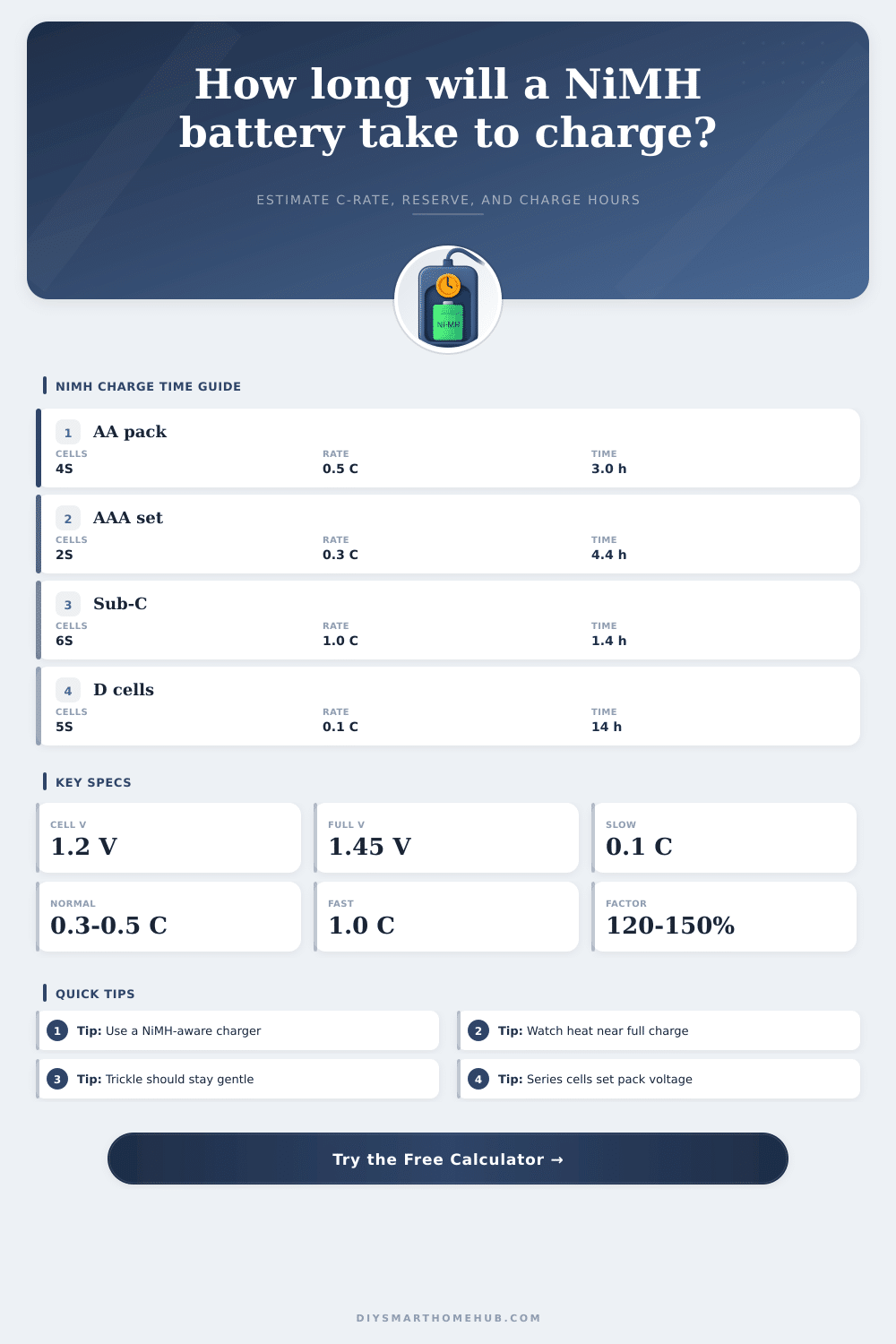
| 4 AA remote pack | 2000 mAh, 4S1P | 1000 mA, 0.50 C | About 3 hours from 20% to full |
| 2 AAA sensor set | 800 mAh, 2S1P | 250 mA, 0.31 C | About 4.3 hours from low to full |
| 6 Sub-C hobby pack | 4200 mAh, 6S1P | 4200 mA, 1.00 C | About 1.4 hours with fast termination |
| 5 D-cell light pack | 9000 mAh, 5S1P | 900 mA, 0.10 C | About 14 hours for a full slow charge |
At 0.3 C and higher, use a NiMH charger that watches negative delta-V and temperature rise; a plain timer is easier to misjudge.
If the pack remains on the charger, compare trickle current with cell capacity. C/40 is a conservative long-term planning limit.
Sometimes the AA battery in your remote is charged, and other times it’s dead. That’s part of why people trust nickel-metal hydride cells for our day-to-day activities. They’re just reliable. But making them fully powered again isn’t a free-for-all. You can’t plug it in to whatever port happens to exist. These packs has their own requirements, not those of an ordinary lithium setup, nor even a regular old alkaline battery.
Push it too fast and you’ll heat up the cells and blow off energy. Push it too slow and you might as well leave it in the drawer. That’s when the real planning comes in: finding the sweet spot between. To do that math for you, enter your cell capacity and charger current into the calculator up top. No need to guess anymore; we’ll take care of how those variables works together for you.
How to Charge NiMH Batteries Safely
You begin with the cells themselves. A tiny AAA button cell have far less energy storage capacity than an AA high-capacity cell. Therefore, when charged with the same amount of current, it takes longer to reach a full charge relative to its size. That’s where C-rate comes into play. C-rate represents the rate at which a battery charges compared to its entire capacity. If you’re charging at 0.5 C, then you’re topping off half of the battery’s capacity per hour. On paper, it should of fill it out in two hours before any losses in efficiency come into play.
In reality, there is friction in form of real world physics. The efficiency part of that equation is the reason for the friction. Nickel-metal hydride batteries aren’t ideal storage containers; they don’t hold all the energy fed them without converting some of it into heat as they swap out chemicals. So in order to top off a battery completely, the charger has to shove more electricity into it than it can physically contain. To allow for this, the charger pushes double or even triple the amount of power (hence the name).
This allows you to pad what’s on paper with an allowance of around 120 to 150 percent to account for inefficiency. On the tool, this is represented with a slider that lets you set this as a percentage, typically anywhere from 120-150% over the theoretical charge. Otherwise, you’ll believe the pack is fully charged and instead be at 90% capacity. Small things matter if you’re relying on consistent runtimes from your device.
Here’s another subtle but significant player: temperature. Yes, that fast charging creates heat and NiMH cells don’t operate as well at higher temperatures. So smart chargers monitor the cell voltage, and when a cell is almost fully charged (as indicated by a very small decrease in voltage), they stops the primary charge process. This is called a negative delta-V and tells the charger “okay time to stop”. This avoids gassing and overheating of cells. The battery calculator accounts for the topping off phase. That way you’re not leaving the pack on a high current all day long.
If you use a non-smart charger that doesn’t sense this but instead uses a timer then you’ll need to adjust downward on the time estimate so you don’t damage cells over time with repeated charges. The other half of this equation is what happens when the battery has charged. Constantly leaving your NiMH pack connected to a standard charging circuit will shorten its life. Trickle current settings address that problem. They reduce the supply to a gentle maintenance current once the primary task has been completed. Typically this is about one-fortieth of the battery’s capacity. It prevents overworking the battery while ensuring it remains topped off. For backup systems and emergency lights that might go weeks between uses, that low-level feed extends life.
People generally use them only for speed. How quickly do I recharge to 100%). They neglect longevity. For the sake of rapid charging, what happens to the health of the pack in the long run? Sure, it’s nice to charge quickly but sustained charges keeps it alive longer. The rate table on that page explains which cells is built to take what kind of current. Why does that tiny sensor battery not like being pushed too hard while that big ole’ D-cell pack won’t mind as much?
Knowing those limitations will help lead you toward keeping something going versus just using it for quick fixes. What goes in comes out, right? Taking care of the batteries will pay off when it gets dark out there or when your gear realy needs to be up and running.