Soffit Vent Calculator
Calculate attic net free area, intake and exhaust balance, soffit vent strip length, and blocked-area derating from attic floor area using the 1/150 and 1/300 ventilation rules.
📌Real attic presets
Presets set realistic attic area, code ratio, intake split, vent strip type, available eave length, blockage, and exhaust NFA for quick comparison.
⚙Soffit vent sizing inputs
Soffit vent result
Adjust the attic area, rule, vent strip rating, and blockage factor to calculate intake length and exhaust balance.
🔍Vent/spec comparison grid
📊Reference tables
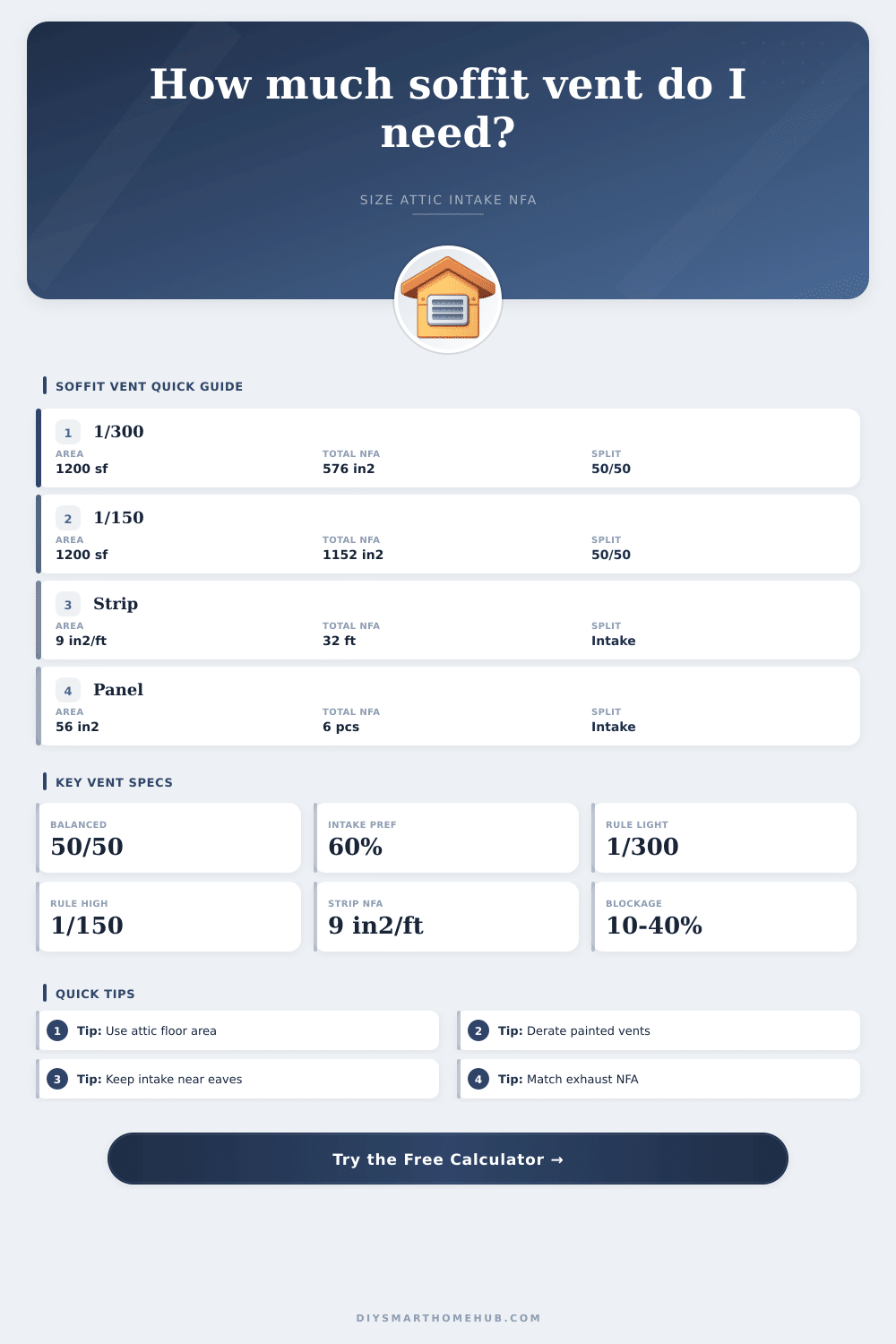
1/150 and 1/300 NFA rules
| Attic area | 1/300 total | 1/150 total | 50% intake |
|---|---|---|---|
| 800 sq ft | 384 in2 | 768 in2 | 192 or 384 in2 |
| 1,200 sq ft | 576 in2 | 1,152 in2 | 288 or 576 in2 |
| 1,800 sq ft | 864 in2 | 1,728 in2 | 432 or 864 in2 |
| 2,600 sq ft | 1,248 in2 | 2,496 in2 | 624 or 1,248 in2 |
Soffit vent NFA reference
| Vent type | Catalog NFA | 20% blocked | Planning note |
|---|---|---|---|
| Narrow continuous strip | 5 in2/ft | 4.0 in2/ft | Needs long clear eaves. |
| Perforated aluminum strip | 9 in2/ft | 7.2 in2/ft | Common retrofit baseline. |
| Vinyl continuous strip | 10 in2/ft | 8.0 in2/ft | Good balanced-attic default. |
| Wide continuous strip | 18 in2/ft | 14.4 in2/ft | Helpful where eave length is short. |
| Rectangular panel vent | 56 in2 each | 44.8 in2 each | Count each panel as one unit. |
Blocked-area factors
| Condition | Factor | Formula | Use when |
|---|---|---|---|
| Clear intake path | 0% | NFA x 1.00 | New vent and clear baffles. |
| Screen or dust | 10% | NFA x 0.90 | Light screen resistance. |
| Painted perforations | 20% | NFA x 0.80 | Older aluminum or vinyl panels. |
| Insulation contact | 30% | NFA x 0.70 | Some rafter bays partly blocked. |
| Heavy restriction | 40-50% | NFA x 0.60-0.50 | Shallow eaves or clogged slots. |
Preset benchmarks
| Scenario | Rule | Intake target | Typical result |
|---|---|---|---|
| Ranch 1,200 | 1/300 | 317 in2 | About 39 ft at 9 in2/ft with 10% blocked. |
| Cape kneewalls | 1/150 | 490 in2 | Short eaves often need wider strip or panels. |
| Two-story 1,800 | 1/300 | 518 in2 | Continuous soffit works when clear length is available. |
| Large 2,600 | 1/300 | 686 in2 | Wide strip reduces the required linear footage. |
💡Soffit sizing tip boxes
A soffit vent does not help if insulation, blocking, or a narrow rafter bay stops air from reaching the attic. Use the blocked-area factor to derate uncertain paths.
The intake target and exhaust target should be close enough that ridge or roof vents do not pull makeup air from conditioned leaks instead of the soffits.
Attic ventilation is a crucial processes for any home. Attic ventilation will help to keep the insulation within the attic dry and will help prevent the formation of ice dam on attics during the winter months. Additionally, attic ventilation will help to even out the temperatures within the upper floors of the home.
If the attic vent paths are block or too small in diameter, then the attic ventilation system will not be able to function according to the building code. It is essential to make sure that the intake and exhaust vent are balanced to ensure the effective functioning of the attic ventilation system. The soffit vent calculator will help you calculate the balance between the intake and exhaust vents.
How to Use the Soffit Vent Calculator
To use the calculator, you will need to input the floor areas of the attic, the ventilation rule, the percentage of attic air you would like to enter through the eaves, and the type of vent you would like to use. The calculator will provide an indication of the net free area that you need. Additionally, the calculator will show you how many new intake lengths or vent panels is needed for your attic if you already have some installed.
This calculator also provides insight into whether or not your exhaust vents are keeping up with your intake vents. There are two rule for attic ventilation that can be used when calculating attic ventilation needs. The 1/300 rule is often used for new homes with ridge vents.
The 1/150 rule allow for more attic ventilation and is a safer rule to use if you are looking to provide more ventilation for your attic or if the building code requires this level of ventilation. These two rules can be switched in the calculator to provide an estimation of how the length of the attic vents would need to change to accommodate one rule compared to other. Another consideration for attic ventilation is the intake share.
The intake share will determine the percentage of the total net free area that is used by the intake vents. This can be set to 55 or 60% of the total net free area of the attic. A higher intake share will prevent ridge and roof vents from working to pull air through ceiling leak.
With a higher intake share for the intake vents, the soffit vent calculator will indicate a higher target number for intake vents and a lower target for exhaust vents. This will allow you to see if your exhaust vents as they are currently set will meets the target for exhaust vents. Another consideration that can be entered into the soffit vent calculator is the blocked-area factor.
This refers to how the various attic vents may not be able to release as much air as the specification indicate. This can happen due to insulation, paint, and other obstructions within the vent. For instance, you may need to adjust the rating of an old aluminum attic vent for a 20% blocked-area factor.
If the eave is very shallow or if there are heavy screens in the attic, the blocked area factor may need to be 40% of the catalog number for that specific attic vent. The soffit vent calculator will adjust the specifications of the attic vents for you to show the length of the strips or the number of panel vents that are necessary to allow the attic to properly ventilate. The length of the eaves of the attic may seem like an important feature for attic ventilation; however, not every foot of eave length will be used for attic ventilation.
The eaves may be located above the garage or the porch, or they may be located near a knee wall or bay that is filled with insulation. These section of the eaves will not allow for proper ventilation due to the insulation. The soffit vent calculator will only calculate the length of the eaves that you input into the calculator, ensuring that the length required for the attic to properly vent is based off the available length of eaves.
When using the soffit vent calculator, you can decide what type of vents to use in the attic. For instance, a wide strip vent will require less length than a narrow slot vent. However, the width of the strip may not match the trim details of your attic.
Panel vents are useful for retrofitted attics. However, you must appropriately space these vents throughout the attic to ensure proper ventilation to each bay of the rafters. The calculator will provide a count for the number of panel vents or the length of the strip vents that are required to properly ventilate the attic.
The last output of the calculator is whether or not the intake and exhaust vents is balanced. If there is a significant difference between the intake and exhaust vents, it will tell you which part of the attic ventilation system require more attention. For instance, if the intake is much greater than the exhaust, you can see that you do not need to add more ridge vents because that is not the problem.
Finally, the soffit vent calculator will remove the need for you to calculate this data manually. You can consider the eave length that you have, the condition of your attic vents, and whether or not your exhaust vents will match the intake vents. By entering these three factors into the soffit vent calculator, you can be certain that your attic will have proper ventilation.