Mini Split Load Calculator
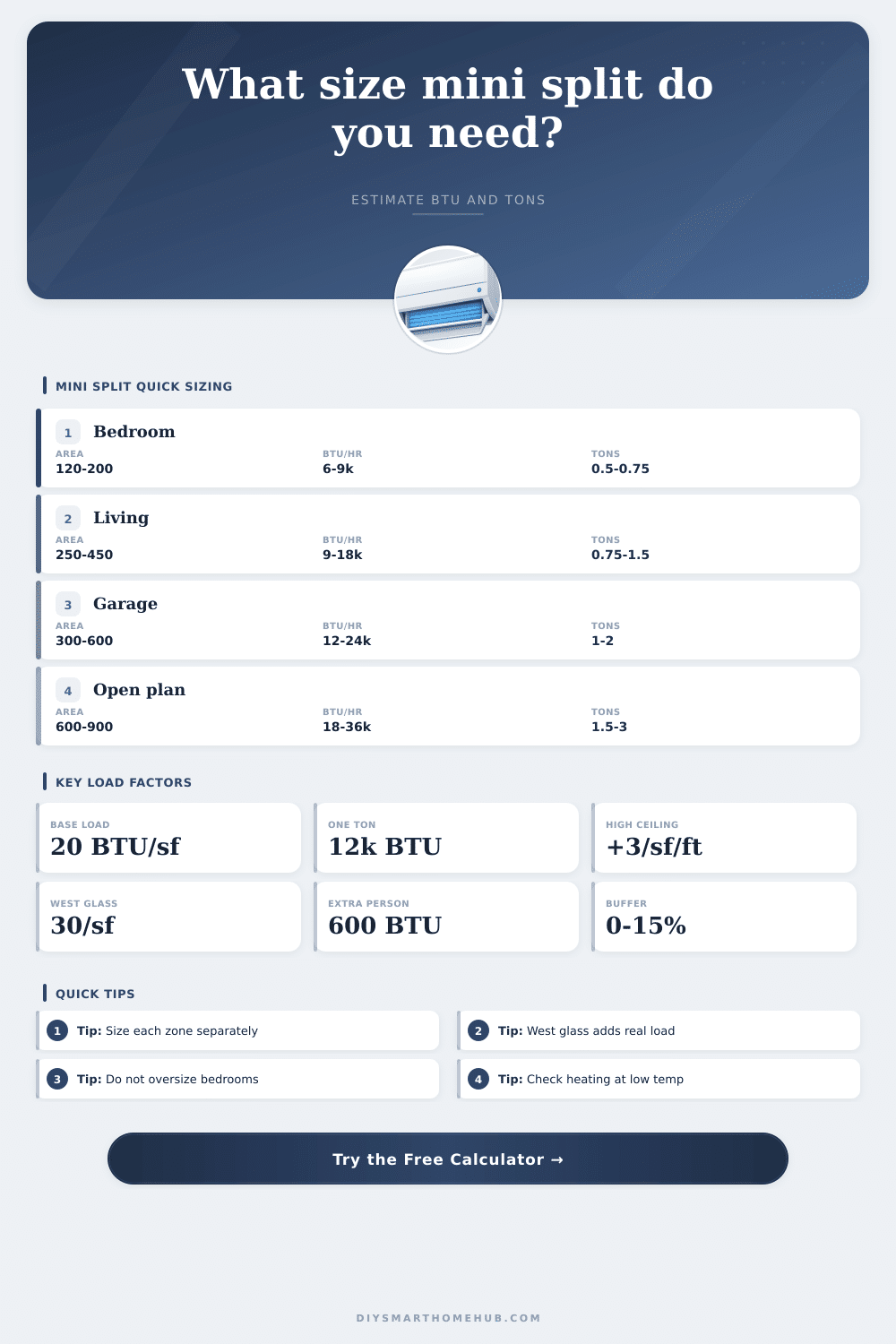
Estimate cooling load from room area, ceiling height, insulation, climate, windows, people, equipment heat, and sizing buffer.
⚙Real Room Presets
🌡Load Inputs
Calculation Breakdown
This calculator estimates a single-zone cooling load. Final equipment selection should also verify manufacturer heating capacity at your outdoor design temperature.
📊Mini-Split Spec Comparison Grid
📐Standard Mini-Split Capacity Table
| Nominal Size | Tonnage | Typical Zone Range | Best Fit |
|---|---|---|---|
| 6,000 BTU/h | 0.5 ton | 100-250 ft² / 9-23 m² | Small bedroom, office, tight low-load zone |
| 9,000 BTU/h | 0.75 ton | 180-400 ft² / 17-37 m² | Bedroom, den, compact living area |
| 12,000 BTU/h | 1.0 ton | 300-550 ft² / 28-51 m² | Primary room, small open plan, bonus room |
| 18,000 BTU/h | 1.5 ton | 500-800 ft² / 46-74 m² | Large living room, apartment zone, garage |
| 24,000 BTU/h | 2.0 ton | 700-1,100 ft² / 65-102 m² | Open plan, workshop, glass-heavy room |
| 36,000 BTU/h | 3.0 ton | 1,000-1,600 ft² / 93-149 m² | Large open zone or multi-zone outdoor unit |
☀Cooling Load Adjustment Reference
| Factor | Low Condition | Typical Condition | High Condition |
|---|---|---|---|
| Base area load | 16-18 BTU/ft² for efficient shaded rooms | 20 BTU/ft² common planning baseline | 24+ BTU/ft² for difficult rooms |
| Ceiling height | 8 ft baseline | Add about 3 BTU/ft² per ft over 8 ft | Vaulted rooms may need zoning review |
| Window solar gain | 0-12 BTU/h per ft² shaded glass | 18-24 BTU/h per ft² east/south glass | 30 BTU/h per ft² hot west glass |
| Occupants | First two people included in base load | Add 600 BTU/h for each extra person | Gathering spaces need higher people load |
🏠Envelope And Climate Multipliers
| Condition | Multiplier | Use When | Load Effect |
|---|---|---|---|
| Excellent insulation | 0.90× | New tight envelope, low leakage, upgraded windows | Reduces base room load |
| Average insulation | 1.12× | Mixed upgrades, typical older home leakage | Raises base room load |
| Hot humid climate | 1.17× | Long cooling season with latent moisture load | Raises sensible planning load |
| Very hot desert | 1.22× | Extreme outdoor design temperatures and strong sun | Highest climate adjustment |
🔍Indoor Unit Type Comparison
| Indoor Unit Type | Common Capacity | Air Pattern | Good Application |
|---|---|---|---|
| Wall-mounted head | 6k-24k BTU/h | Strong throw from one wall | Bedrooms, offices, living rooms |
| Floor console | 9k-18k BTU/h | Low wall discharge, gentle mixing | Knee walls, rooms without high wall space |
| Ceiling cassette | 12k-36k BTU/h | Multi-direction ceiling airflow | Open rooms needing centered distribution |
| Slim ducted | 9k-24k BTU/h | Short duct runs to nearby rooms | Hidden installs and small room groups |
| Multi-zone outdoor unit | 18k-48k BTU/h | Several indoor heads on one condenser | Separate bedrooms or mixed exposures |
📋Common Room Load Examples
| Scenario | Area / Height | Likely Load Range | Nominal Size Often Checked |
|---|---|---|---|
| 12×14 shaded bedroom | 168 ft² / 8 ft | 4,500-7,000 BTU/h | 6k or 9k head |
| Home office with computers | 180 ft² / 8 ft | 7,000-10,000 BTU/h | 9k head |
| Large living room | 420 ft² / 9 ft | 12,000-18,000 BTU/h | 12k or 18k head |
| Sunny garage zone | 400 ft² / 9 ft | 15,000-24,000 BTU/h | 18k or 24k head |
| Open plan apartment | 800 ft² / 8 ft | 22,000-36,000 BTU/h | 24k or 36k class |
ℹSizing Tips
The sizing process for an mini split system require the consideration of many differents factors. While the dimension of the room are one of the factors to consider, there are many others that should also be took into account. Such factors include, but are not limited to, the dimension of the room, the height of the ceiling within the room, the direction that the windows within the room face, the quality of the insulation within the room, and the amount of heat that its occupants and electronic device produce within the room.
These factors is used within the calculator to provide an estimate of the size of the mini split system that is required for the room. Each of these factor can have an impact upon the calculations that the calculator performs. Many individual consider the square footage of the room as the factor that determines the size of the mini split system that is required for that room.
How to Size a Mini Split System
While this factor is one of the more important factor to consider, it is often insufficient to determine the exact size of the mini split system that is required. For instance, the number of square feet of the room is not a consideration of the heat that enter the room through the windows. Windows that face west will allow more heat to enter the room during the afternoon, while those that face north will allow less heat to enter the room.
The sizing calculator consider the different direction of the windows because the different direction of the windows creates different amount of heat. Additionally, the height of the ceiling within the room creates an effect upon the calculation of the size of the air conditioner that is required. Ceilings that are higher than eight feet will create more air within the room that must be cooled.
Finally, the quality of the insulation within the room will impact the calculations of the size of the mini split system that is required to cool the room. Rooms with high quality insulation will allow less heat to enter the room than rooms with poorly quality insulation. In addition to these factor, the climate within the region where the room will be installed will also change the way in which the calculation of the sizing of the mini split system are performed.
In areas that have high humidity, the mini split system will need to remove not only heat from the air within the room, but also moisture. In areas that are dry, however, the mini split system will only need to remove heat from the air within the room. The sizing calculator includes multiplier for different climates as a means of accounting for this difference in the calculations.
Finally, the number of individual within the room and the amount of electronic equipment within the room will also impact the calculations of the size of the mini split system. The mini split system include a base setting for the number of individual in the room, as well as for the amount of electronic equipment within the room. Any additional individual or electronic equipment will also increase the amount of heat that the mini split system must dissipate, requiring an increase in its capacity.
The sizing calculator will provide an estimate of the design cooling load that is required to cool the room that is to be cooled by the mini split system. This number will be provide in BTUs per hour. In addition to this value, the calculator will also provide the equivalent tonnage of the mini split system that would be required, as well as the nearest nominal size of air conditioner that would satisfy these requirement.
This nominal size is the value that is to be use in determining the specific mini split system that is to be utilized. Mini split system manufacturer create mini split systems of only standard size. Going too large in the determination of the size of the mini split system for the room can also be detrimental to the performance of the mini split system.
If the mini split system is too large for the room that is to be cooled, the mini split system will short cycle. Short cycling of a mini split system lead to the mini split system becoming less efficient in relation to the cooling of the room, as well as reducing the mini split system’s effectiveness in relation to control the humidity within the room. Finally, the sizing calculator can also provide an estimate of the amount of air that the mini split system will circulate within the room.
In some instance, the use of a room by the mini split system may increase the amount of heat that must be dissipate by the mini split system. For instance, if the mini split system is to be use within a room that contains many computer, as compared to a room that contains no computer, the number of computer will increase the heat load of the room. Similarly, if the mini split system is to be use in a living area that also include the kitchen, the cooking that occur within that kitchen will increase the amount of heat that is release into the area that must be cooled by the mini split system.
Because these use of the mini split system are not consider by the sizing calculator, however, the mini split system may be increased in size according to the way in which the room is to be use. In addition to consider the size of the mini split system that is required to cool the room, it is also important to consider the heating performance of the mini split system. As with air conditioning, the heat pump portion of the mini split system may lose heating power as the outdoor temperature decrease into the winter month.
Thus, it is also important to ensure that the mini split system will be able to provide the amount of heat that is required for the room during the winter month. While the sizing calculator will provide estimate for the cooling load of the mini split system, the heating performance of the mini split system is a separate calculation that the mini split system buyer is to make and verify. The sizing calculator is a helpful tool, but the result that the calculator provides is only a planning number for the size of the mini split system that is to be purchase.
Based off the calculation of the sizing calculator, different model of mini split systems can be purchase. For these model, the heating capacity of the mini split system can be verify, and the indoor unit type can be ensure to be appropriate to the layout of the room that is to be cooled. Following these step will ensure that the mini split system that is purchase will have a better chance of function efficient and quietley.