Smart Irrigation Watering Time Calculator
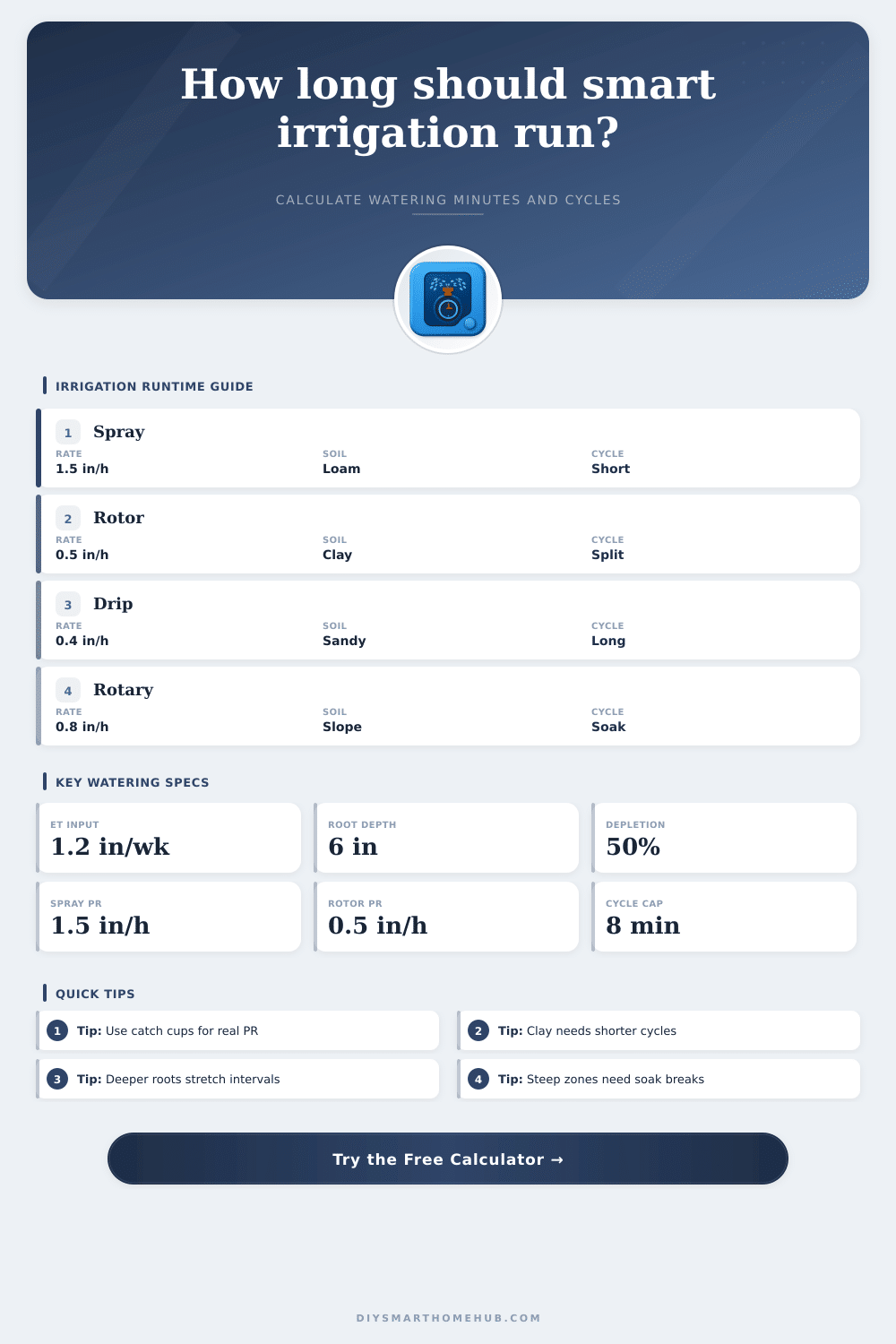
Estimate sprinkler, rotor, drip, and smart-controller watering minutes from precipitation rate, weekly ET, soil water storage, root depth, allowed depletion, slope runoff pressure, and cycle-soak limits.
📌Real Irrigation Zone Presets
Loaded preset: Cool Lawn Spray. This baseline models a small turf zone with fixed sprays, loam soil, shallow roots, and modest slope.
⚙Watering Time Inputs
📊Irrigation / Controller Spec Comparison Grid
📘Reference Tables
Soil Water and Intake
| Soil | Available water | Intake | Runtime behavior |
|---|
Sprinkler Precipitation Rates
| Emitter | Typical PR | Efficiency | Cycle note |
|---|
Smart Controller Cycle Logic
| Controller mode | ET use | Cycle cap | Best fit |
|---|---|---|---|
| Basic timer | Manual ET input | Fixed minutes | Flat spray zones |
| Seasonal adjust | Monthly factor | User split | Known schedules |
| ET smart | Daily weather ET | Auto cycle-soak | Mixed landscapes |
| Soil sensor | Moisture threshold | Sensor blocked | Deep root zones |
| Flow-aware | ET plus flow check | Zone runtime | Large zones |
Preset Benchmarks
| Preset | Runtime | Cycles | Events |
|---|
A smart irrigation watering time calculator is an device that can help a person to determine how often and for how long the irrigation system should run. Many individuals in the past used to manually turn on the irrigation system and watched for puddles or dry spots in the treated area to adjust the system accordingly. Such a manual irrigation system was acceptable in the past when water was relatively inexpensive to purchase and use, but is often ineffective due to the difference in soil types, slopes, and types of sprinklers that may be deployed in an irrigation system.
By including these different variables within a smart irrigation watering time calculator, an individual can more accurately calculate how the irrigation system should be scheduled according to both the soil’s ability to absorb water as well as the needs of the plants within that area. To calculate the amount of time that the irrigation system should be deployed during any given week, a smart irrigation watering time calculator require several data inputs from the irrigation system. First, the amount of evapotranspiration (ET) that will occur during that particular week is required.
How a Smart Watering Calculator Works
Second, the root depth of the plants within that area, as well as the type of soil in which those plants are growing, is required to determine how much water can be held by the ground within that designated area. Third, the allowed depletion level within that area is required to establish a comfort zone between the amount of water that the soil can hold when it is saturated with water, as well as the amount of water that is required to be held in the soil to prevent any stress to the plants that grow within that area. Based off these three data inputs, the irrigation system can determine how many watering events is required each week, as well as the depth of each event.
The precipitation rate that is established for the area is another critical element in determining how long the irrigation system’s heads should run to deliver the calculated depth of water. In many cases, the irrigation system utilizes fixed spray heads that will deliver water at a faster rate than rotors or drip system. Furthermore, the smart irrigation watering time calculator also takes into account the slope of the land in which the irrigation system is established as well as the intake of the soil.
In cases where the area features soils with high water holding capacity, such as loam soil, it may suggest that the irrigation system should run for the full calculated time during a single event. In contrast, soils with high slopes and low intakes, such as clay soil on a slope, will suggest to the smart irrigation watering time calculator that the system should divide the total number of minutes that the irrigation system should run into separate events with soak periods in between to prevent the watering of the plants with too much water at once. In addition to the parameters that are established for most irrigation systems, a smart irrigation watering time calculator also factors in the distribution efficiency of the nozzles that are deployed within the irrigation system.
Nozzles that feature higher rates of distribution efficiency will allow for the watering of the plants with less water than those nozzles with lower distribution efficiencies. For instance, a nozzle that has a distribution efficiency of 70% will require less water to water the same area than a nozzle with only 60% distribution efficiency. Thus, it is important to include such a calculation within the smart irrigation watering time calculator prior to converting the calculated depth of water to the number of minutes that the irrigation system should run.
The benefits of using such a smart irrigation watering time calculator can include a reduction in the amount of water that is wasted during the operation of the irrigation system. The soil types within each area that is to be irrigated are not often uniform, and thus a smart irrigation watering time calculator accounts for this possibility of variation within the soil types within each area that is programmed into the irrigation system. Soil types that contain fine particles that allow for rapid drainage of water, such as sand, hold very little water.
Thus, sandy soils require watering more frequent but with less water than soils that hold more water. In contrast, soils that contain clay particles that hold more water but allow water to move at slower rates require that irrigation events be established according to a cycle-and-soak pattern to allow the water to infiltrate into the soil but to prevent the water from remaining on the surface. Using the same program for sandy soil and clay soil will result in either runoff of water in areas with clay soil, or the plants in sandy soil will not receive enough water.
Finally, many yards contain additional complications beyond those accounted for in the calculations of the smart irrigation watering time calculator. For instance, areas with tree canopies may experience different rates of evapotranspiration than the remainder of the yard. Additionally, paths that are compacted may impact the amount of water that infiltrates into the soil.
Finally, any water that is applied to the yard may be distributed unevenly if there is wind in the area. Thus, during the first irrigation cycle after establishing an irrigation system using the smart irrigation watering time calculator, a person should observe how the irrigation system is functioning within the yard. Any adjustments to the slope or depletion settings may be required after such an observation period.
By using a smart irrigation watering time calculator, a controller for the irrigation system will no longer have to be set to irrigate on a calendar basis. For instance, using a controller that irrigates on three days each week will result in the system watering the landscape after rainfall events, as well as during periods of high heat when evaporation is rapid. By integrating the smart irrigation watering time calculator into the irrigation system, however, the controller will adjust the number of events and the length of each event based upon the current ET and the amount of water that is store within the root zone.
Thus, the irrigation system will automatically adjust according to the weather conditions. This automatic adjustment will help to lower the water bills for the property, as well as reduce the development of diseases of the plants that result from excessive wetting of the foliage. The same logic that is used for calculating the watering events for the lawn can also be utilized for calculating the watering events for drip zones that are used to irrigate shrubs and vegetable beds.
Drip irrigation systems typically have a lower precipitation rate but higher distribution efficiency than spray irrigation systems. Thus, drip zones will require more minutes of operation than spray.