Electric Kettle Power Consumption Calculator
Estimate kettle electricity use from real heating physics: water volume, temperature rise, wattage, efficiency, keep-warm draw, standby draw, and repeat boils.
Estimated Kettle Consumption
| Water Amount | Typical Use | Energy at 20→100°C | Approx Heat Time at 1500 W |
|---|---|---|---|
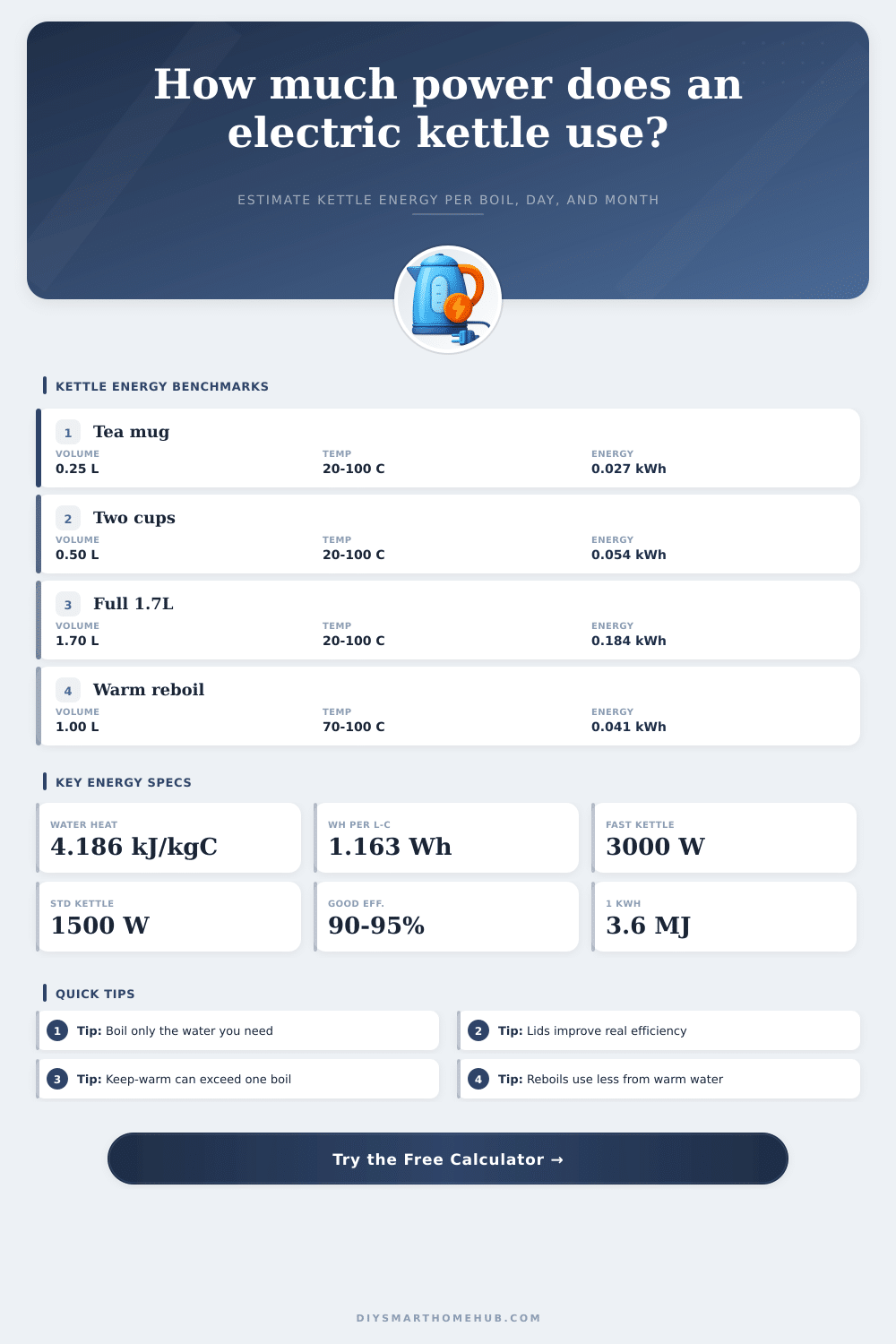
| 0.25 L | One tea mug | 0.027 kWh at 86% appliance efficiency | About 1.1 minutes |
| 0.50 L | Two mugs or small pot | 0.054 kWh at 86% appliance efficiency | About 2.2 minutes |
| 1.00 L | Large flask or several cups | 0.108 kWh at 86% appliance efficiency | About 4.3 minutes |
| 1.70 L | Full common family kettle | 0.184 kWh at 86% appliance efficiency | About 7.4 minutes |
| Kettle Class | Typical Wattage | Typical Capacity | Efficiency Use Note |
|---|---|---|---|
| Travel compact | 600–1000 W | 0.4–0.8 L | Lower wattage changes time more than total kWh. |
| Standard household | 1500–1800 W | 1.5–1.7 L | Common efficiency is roughly 85–92% for normal fills. |
| Fast high-wattage | 2200–3000 W | 1.5–1.8 L | Finishes sooner, but energy depends mainly on water volume. |
| Insulated keep-warm | 700–1500 W heat | 1.0–2.0 L | Low standby heat can matter over many hours. |
| Temperature Rise | Pure Water Energy per Liter | At 90% Kettle Efficiency | Typical Scenario |
|---|---|---|---|
| 20°C to 100°C | 0.093 kWh/L | 0.103 kWh/L | Cold tap to full boil |
| 10°C to 100°C | 0.105 kWh/L | 0.116 kWh/L | Very cold winter water |
| 20°C to 85°C | 0.076 kWh/L | 0.084 kWh/L | Coffee or green tea target |
| 70°C to 100°C | 0.035 kWh/L | 0.039 kWh/L | Warm reboil |
| Daily Pattern | Input Assumption | Boil Energy Only | Result Meaning |
|---|---|---|---|
| Solo tea | 0.25 L, 3 boils, 20→100°C | About 0.078 kWh/day at 90% | Small fills keep daily energy low. |
| Couple breakfast | 0.50 L, 2 boils, 20→100°C | About 0.103 kWh/day at 90% | Two half-liter boils equal one liter total. |
| Family round | 1.50 L, 4 boils, 20→100°C | About 0.620 kWh/day at 90% | Volume dominates total consumption. |
| Office run | 1.70 L, 8 boils, 20→100°C | About 1.405 kWh/day at 90% | Shared kitchens add up quickly. |
An electric kettle is an electrical appliance that heats water. Many peoples use electric kettles every day. Using an electric kettle inefficiently can significantly increase the electricity bill of a household.
The cost of boil water in an electric kettle depends on the volume, frequency, and the temperature at which the water is heated in the electric kettle. The volume of water in the electric kettle is one of the primary factor affecting the energy consumption of the electric kettle. Energy is consumed when boiling water, and the higher the volume of water, the more energy that is consumed to heat it to the boiling point.
How to Save Electricity When Using an Electric Kettle
It takes more energy to boil a large volume of water than a small volume of water. Furthermore, energy is consumed to heat the water from its starting temperature to the boiling point of water. It takes more energy to heat water from room temperature to the boiling point of water than to heat water from a starting temperature close to the boiling point of water.
By using water that is already warm, a person can save electricity because it would took less electricity to heat warm water to the boiling point of water than it would to heat cold water to the boiling point. Another factor that determine the cost of using an electric kettle is the wattage of the electric kettle. Generally, the higher the wattage of an electric kettle, the faster the water will boil.
However, the wattage of an electric kettle does not significantly impact the amount of electricity that an electric kettle will use. For instance, although a 3000-watt electric kettle will take less time to boil water than a 1500-watt electric kettle, both electric kettles will use the same amount of energy to heat the same volume of water. The 3000-watt electric kettle will use energy at a higher rate for a shorter period than the 1500-watt electric kettle.
Electric kettles that have a keep-warm function can significantly impact the electricity bill of a household. An electric kettle with a keep-warm function will use electricity to maintain the temperature of the water even after the water has boiled. The continuous use of electricity for this function can cost more electricity than several uses of the electric kettle for boiling water.
People often dont account for this use of electricity when they calculate the cost of using an electric kettle. Furthermore, electric kettles with a digital display may also use electricity when in a stand-by mode even when not in use. Although this amount of electricity may be small when used individually, it can add up over time.
The way in which an electric kettle is used will ultimately determine the cost of electricity that an individual will incur. An individual who boils only the amount of water that they need for drink will use less electricity with their electric kettle than an individual who routinely fills their electric kettle to the maximum mark. The target temperature to which the water is heated is another factor that will impact the cost of electricity that an individual will pay for using their electric kettle.
Not all drink require the water to be boiled to a temperature of 100 degrees Celsius. For instance, green tea requires the water to be heated to a temperature that is lower than 100 degrees Celsius. By adjusting the temperature setting on the electric kettle to a temperature that is lower than the boiling point of water, the electric kettle can reduce the amount of electricity that is used.
Efficiency is another factor that can impact how an electric kettle use electricity. With electric kettles, some electricity is lost to heating the water to the boiling point. Some electric kettles will lose more heat to the surroundings than others.
Because it is difficult to measure the efficiency of electric kettles, an efficiency field has been included in the calculator to account for the difference in losses of electric kettles of different efficiencies. The tables within the calculator show how changes in the volume of water and the frequency with which the electric kettle is used can impact the cost of electricity bills of a household. These tables allow for the comparison of the electric kettle use of an individual to that of a family.
It is possible that an office that shares one electric kettle may find that the electricity bill is very high due to the high frequency with which the electric kettle is used and the high volume of water that must be boiled for the employees of that office. Finally, the information within the calculator can be used to decide what type of electric kettle to purchase. Electric kettles that heat water at a faster rate save an individual the time that it would of taken to heat the water but do not necessarily save electricity.
Electric kettles that have a keep-warm function may save electricity for an individual if the individual uses that function but do not save electricity if that function is not used correctly. Electric kettles that have no digital displays will use less electricity than electric kettles that have digital displays because the electric kettles with digital displays will use electricity while in stand-by mode. However, the amount of electricity saved is small.
The purchasing of an electric kettle with any of these features depends upon the priorities of an individual regarding the features of an electric kettle.