Window AC Power Consumption Calculator
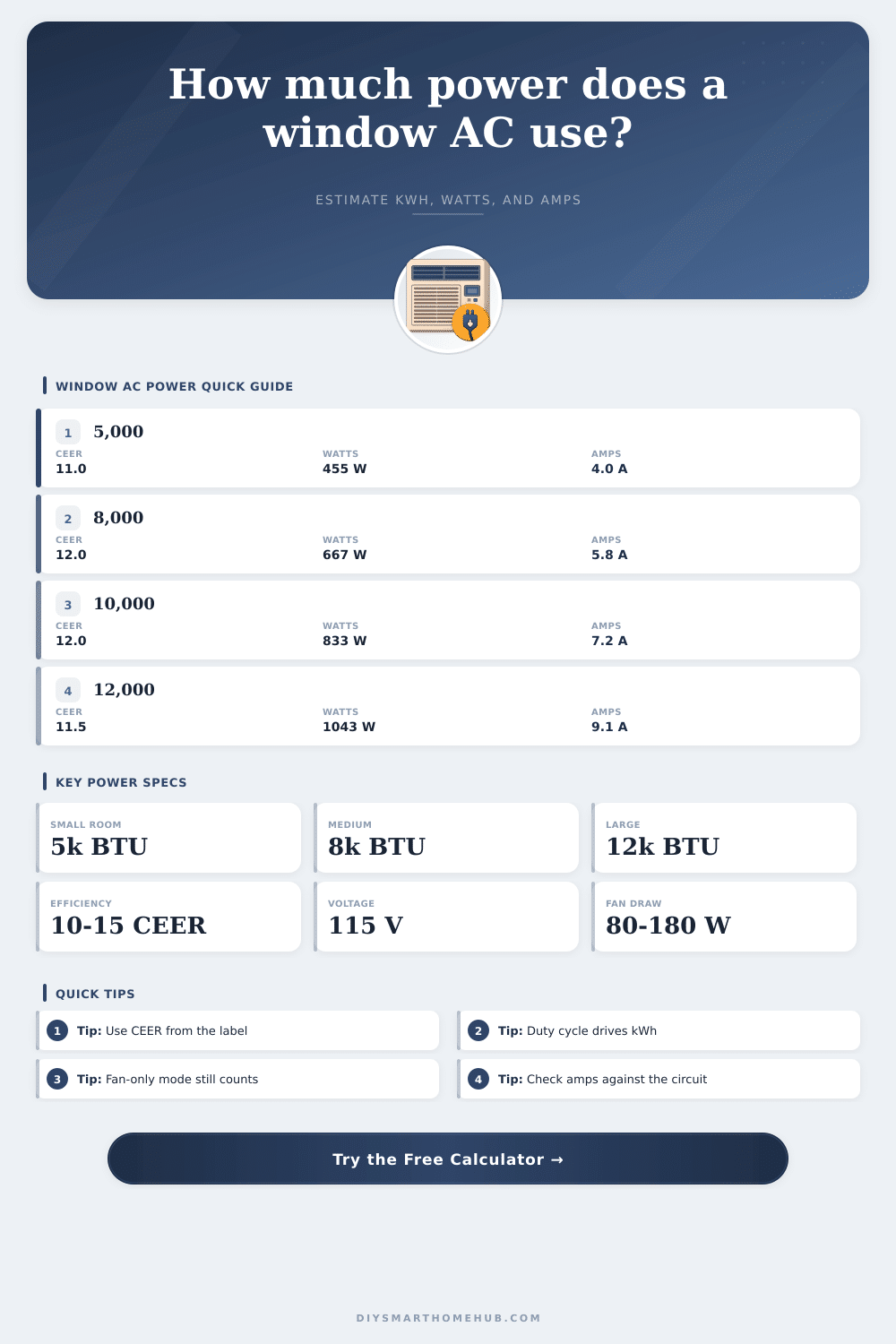
Estimate window air conditioner kWh, running watts, average load, and current from BTU capacity, CEER or EER, compressor duty cycle, and fan-only use.
Window AC Power Results
| Window AC Size | Typical Room Area | Full-Cooling Watts at CEER 12 | 115 V Current |
|---|---|---|---|
| 5,000 BTU/h | 100-150 sq ft | 417 W | 3.6 A |
| 6,000 BTU/h | 150-250 sq ft | 500 W | 4.3 A |
| 8,000 BTU/h | 250-350 sq ft | 667 W | 5.8 A |
| 10,000 BTU/h | 350-450 sq ft | 833 W | 7.2 A |
| 12,000 BTU/h | 450-550 sq ft | 1,000 W | 8.7 A |
| 14,000 BTU/h | 550-700 sq ft | 1,167 W | 10.1 A |
| Daily Cooling Pattern | Cooling Window | Duty Cycle | What It Represents |
|---|---|---|---|
| Mild evening | 4-6 h/day | 30-45% | Setpoint reached quickly, compressor cycles off often. |
| Normal bedroom | 6-9 h/day | 45-60% | Common overnight use in a closed room. |
| Hot apartment | 8-12 h/day | 60-80% | Longer compressor run time from solar gain or warm walls. |
| Undersized unit | 10-16 h/day | 80-100% | Unit struggles and may run nearly continuously. |
| Efficiency Rating | 5,000 BTU Watts | 8,000 BTU Watts | 12,000 BTU Watts |
|---|---|---|---|
| 9.8 CEER or EER | 510 W | 816 W | 1,224 W |
| 10.9 CEER or EER | 459 W | 734 W | 1,101 W |
| 12.0 CEER or EER | 417 W | 667 W | 1,000 W |
| 14.0 CEER or EER | 357 W | 571 W | 857 W |
| Example Setup | Assumption | Daily kWh | Monthly kWh |
|---|---|---|---|
| 5,000 BTU bedroom | 6 h, 45%, CEER 11 | 1.23 | 37 |
| 8,000 BTU studio | 8 h, 55%, CEER 12 | 3.03 | 91 |
| 10,000 BTU living room | 10 h, 65%, CEER 12 | 5.52 | 166 |
| 12,000 BTU hot room | 12 h, 80%, CEER 11.5 | 10.13 | 304 |
Understanding the cost of an window air conditioner requires understanding the variable that impact that cost. The variables to consider include the BTU rating, the efficiency rating of the air conditioner, and the duty cycle of the air conditioner. While the BTU rating indicate the amount of heat that the air conditioner can remove from a room, it does not indicate how much electricity the air conditioner will use to remove that amount of heat.
The efficiency rating, such as the EER or the CEER indicates how efficiently the air conditioner is at moving heat out of the room, and the more higher the efficiency rating is, the lower the electrical cost of that air conditioner. The duty cycle of the air conditioner can also impact the electrical costs. Air conditioner compressor unit dont run at all of the time.
What Affects the Cost to Run a Window Air Conditioner
Instead, when the air conditioner reaches the desired temperature in the room, the compressor units automatically shut off, and the fan that circulates the air within the room is the only component that is running. The duty cycle of an air conditioner is the percentage of time that the compressor are running. The duty cycle increases with thin walls and window that face the sun, because the air conditioner must compensate for the amount of heat that enter the room.
The duty cycle decreases in rooms that are well insulated against outside temperatures. Using the calculator, you can analyze the impact of some of these variables on the electrical usage of the air conditioner. For example, you can adjust the duty cycle and the efficiency rating to see how the duty cycle impact the kilowatt-hours of the air conditioner.
In addition to adjusting the duty cycle, you should also consider the impact of the fan only mode of the air conditioner. While the fan only mode use less electricity than the air conditioner when the compressor is running, it does still use some of that electricity. The hardware component of the air conditioner can also impact the electrical costs of the air conditioner.
Air conditioner model that use inverter technology have components that differs from traditional air conditioners. For instance, the compressor units in air conditioner models that use inverter technology can adjust their speed. Additionally, models that use inverter technology have a more higher CEER rating, and the power draw of the air conditioner is also more stable when using these model.
One factor to consider in addition to the CEER is the average load. The average load is the cost of the air conditioner over a 24 hour period, and it takes into account both the time that the air conditioner compressor is running and the time that it sit silent. One factor to consider when selecting the air conditioner that will be placed in a room is to ensure that the air conditioner will be the correct size for that room.
If the air conditioner is undersized for the room, the duty cycle will be 100%. Air conditioners that are undersized will run the compressor at all times to attempt to reach the desired room temperature, making those model the more expensive to operate. To avoid high cost, ensure that the air conditioner that is purchased have a high efficiency rating and a manageable duty cycle.
Additionally, by inputting the BTU and efficiency ratings into the calculator, you can estimate the electrical costs of the air conditioner, and the user can plan the budget for that air conditioner.