Energy Audit Calculator
Estimate annual kWh, monthly load, energy intensity, reduction target, and the load categories most likely to deserve attention.
Audit Results
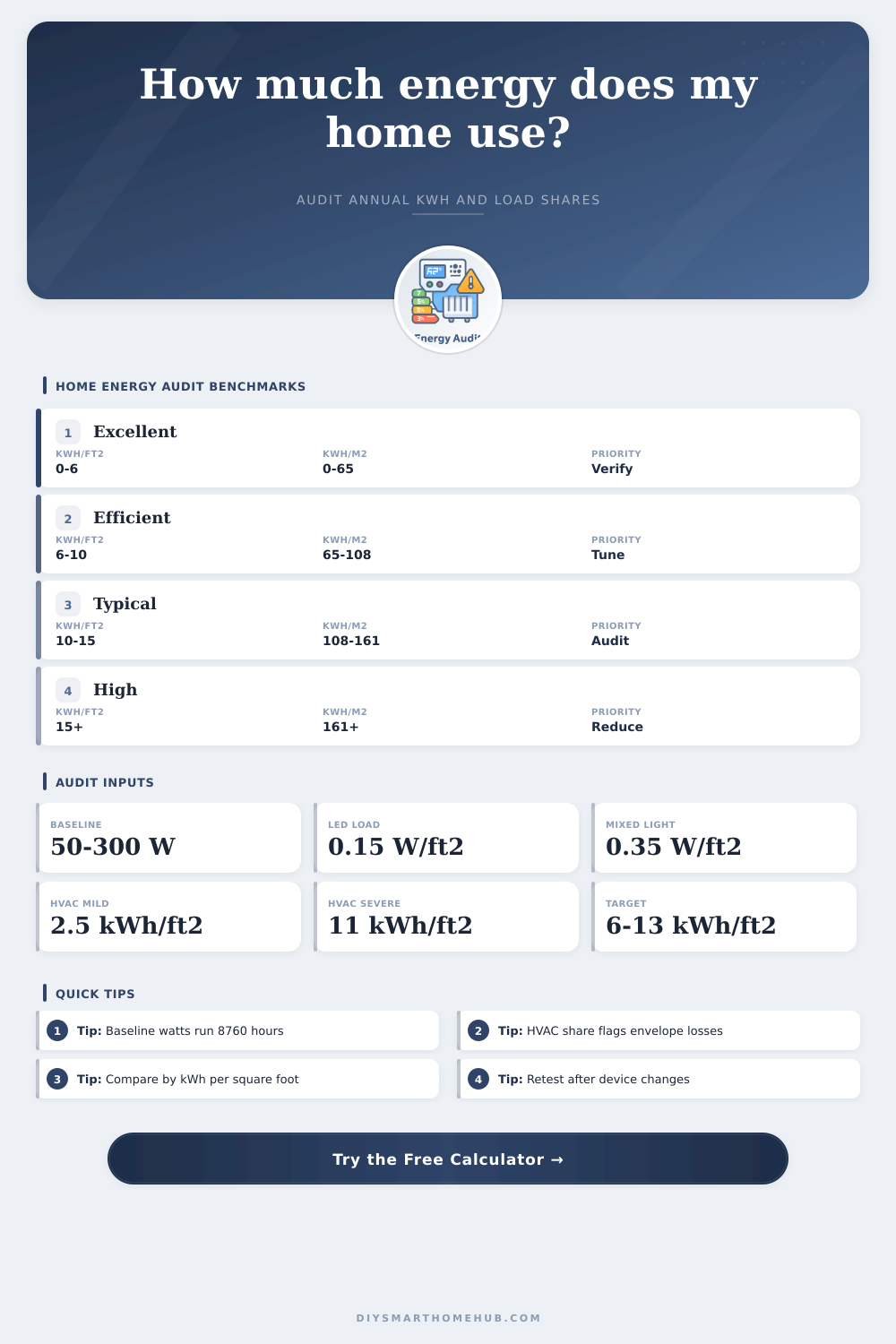
| Audit band | Annual kWh/ft² | Annual kWh/m² | Interpretation |
|---|---|---|---|
| Excellent | 0 to 6 | 0 to 65 | Low electric intensity; verify comfort and hidden fuel loads. |
| Efficient | 6 to 10 | 65 to 108 | Good performance for many modern mixed-fuel homes. |
| Typical | 10 to 15 | 108 to 161 | Common range; category shares reveal useful audit targets. |
| High use | 15 to 22 | 161 to 237 | High electric load, often HVAC, appliance, or baseline driven. |
| Very high | Over 22 | Over 237 | Check major electric heat, pool equipment, pumps, or always-on loads. |
| Model factor | Low profile | Typical profile | High profile |
|---|---|---|---|
| HVAC climate index | 2.5 kWh/ft²/yr | 5.0 kWh/ft²/yr | 11.0 kWh/ft²/yr |
| Lighting density | 0.15 W/ft² LED | 0.35 W/ft² mixed | 0.85 W/ft² legacy |
| Plug allowance | 250 kWh/person/yr | 420 kWh/person/yr | 680 kWh/person/yr |
| Appliance allowance | 1600 kWh/year | 2600 kWh/year | 6200 kWh/year |
| Always-on watts | Daily kWh | Annual kWh | Common audit meaning |
|---|---|---|---|
| 50 W | 1.2 | 438 | Very lean standby load for router, controls, and small electronics. |
| 100 W | 2.4 | 876 | Common low baseline for connected homes. |
| 200 W | 4.8 | 1752 | Multiple network, AV, refrigeration, or automation loads. |
| 300 W | 7.2 | 2628 | High standby load; worth measuring circuit by circuit. |
| Home scenario | Area | Typical annual kWh | Likely largest category |
|---|---|---|---|
| Small LED apartment | 600 ft² | 3500 to 5500 | Baseline and appliances |
| Mixed-fuel family home | 1800 ft² | 12000 to 22000 | HVAC and appliances |
| All-electric home | 2000 ft² | 18000 to 32000 | Electric heat or water heat |
| Large cold-climate home | 3000 ft² | 28000 to 45000 | HVAC and envelope losses |
Many peoples view the electricity bill and often feel guilt when the electricity bill is more higher than that of the expected amount of the household. The electricity bill displays the total number of kilowatt hours (kWh) that the household use during that period, but that total number of kilowatt hours do not explain why the electricity bill for that household is so high. The total number of kilowatt hours does not factor in whether or not the house is energy efficient, or whether the climate in which the house is located requires the house to use more energy than other.
To understand the reason for the electricity bill for an household, the household should examine the energy intensity instead of merely looking at the total number of kilowatt hours that the household produces. Energy intensity is calculated by dividing the total number of kilowatt hours by the square footage of the house. A large amount of square footage may use more kilowatt hours than a smaller house, but the energy efficiency per square foot could be greater for the larger home.
How to Do a Home Energy Audit
Furthermore, focusing on energy intensity allow the household to compare there energy intensity to a standard figure for the area, and allows them to determine if the house has issues like a leaky envelope and the use of numerous electronic within the home. One of the challenges in performing an energy audit for the home is that there are many different behaviors of the household that contribute to the energy that the home uses. Energy use include factors like the use of HVAC systems during the different seasons of the year, the use of appliances during the year, and the baseline load of the home.
Many individual focus on the light bulbs within the home, but baseline load is actualy one of the biggest contributor to the energy that is used by the home. The baseline load of the home is the number of devices that are always on in the home, like a router, a DVR, or power bricks for electronic devices. These devices that are always on create a baseline load for the home that contribute to the energy cost for the year.
Furthermore, calculators are available online that can calculate the cost of these devices based on their standby watts, and these calculators will reveal that baseline load is one of the major contributors to energy use by the home. The building envelope of the home is the exterior of the home, and is one of the main factor in energy efficiency. The building envelope includes the windows of the home, the insulation in the attic, and the exterior of the home.
If the building envelope is not energy efficient, the HVAC system will have to work harder to keep the interior of the home at a comfortable temperature. Furthermore, if the building envelope is leaky, the home will lose more energy in one of the most severe winter or summers of the climate in which the home is located, than it would in a mild climate. Understanding how much energy goes into the HVAC system can help the household decide whether to purchase an efficient heat pump for the home, or to seal the envelope of the windows of the home.
Another area of the home that use energy without the knowledge of the inhabitants of the home is the use of various appliances. Some appliances requires more energy than others. For instance, refrigerators will be constantly in use, but people will only use toaster ovens for short periods of time.
Furthermore, the number of individuals in the home also correlates to the increase in energy use by the home. The more individuals that live in the home, the more energy will be used in that home. Thus, an increase in the number of individuals in the home will lead to a linear increase in the energy use of that home.
Finally, another challenge for many individuals is to try to fix every issue with the home at the same time. For instance, an individual may purchase LED bulb for the home while the attic of the home is venting heat out of the home, or while the freezer in the home is not efficiently storing the food in the refrigerator. A proper energy audit would allow an individual to determine which issues should be fixed for the home, and which areas of the home consume the most energy.
Furthermore, reference table can be used to determine the grade of the energy intensity of the home, and determining the grade for the energy intensity will provide an individual with a goal for energy efficiency of the home. For instance, if the energy intensity of the home is within the high-use category for the area of the home, the individual will have to investigate the area that use the most energy of the home before attempting to implement any changes to the home that may involve the spending of money. An energy audit will allow an individual to regain control of the energy costs of their home.
For instance, by performing an energy audit of the home, an individual can use the information to determine the peak kilowatt (kW) usage of the home, which can allow an individual to recognize that the AC unit of the home is too old to efficiently circulate air within the home. Furthermore, viewing the home as a system can lead individual to determine which aspects of the system are most important to fix. For instance, if the building envelope of the home is made up of well-insulated panels, then other energy upgrade will have a greater impact on the energy efficiency of the home.
Once an individual establishes a baseline for the energy use of the home, they can experiment with the energy use of their home. For instance, they can work to reduce the baseline load of the home, they can experiment with the energy efficiency of a single appliance in the home, or they can adjust the thermostat setting of the home by two degree. These changes will have an impact on the energy intensity of the home.
Thus, through performing an energy audit of the home, an individual can move from a state of mystery regarding their energy use of their home, to a state of efficiency.