⚡ Home Appliance Power Consumption Calculator
Add multiple appliances to calculate total daily, monthly & annual energy usage
| Appliance Name | Category | Watts (W) | Hours/Day | Qty | Remove |
|---|
| Appliance | Typical Watts | Avg. Hours/Day | kWh/Month | MJ/Month |
|---|---|---|---|---|
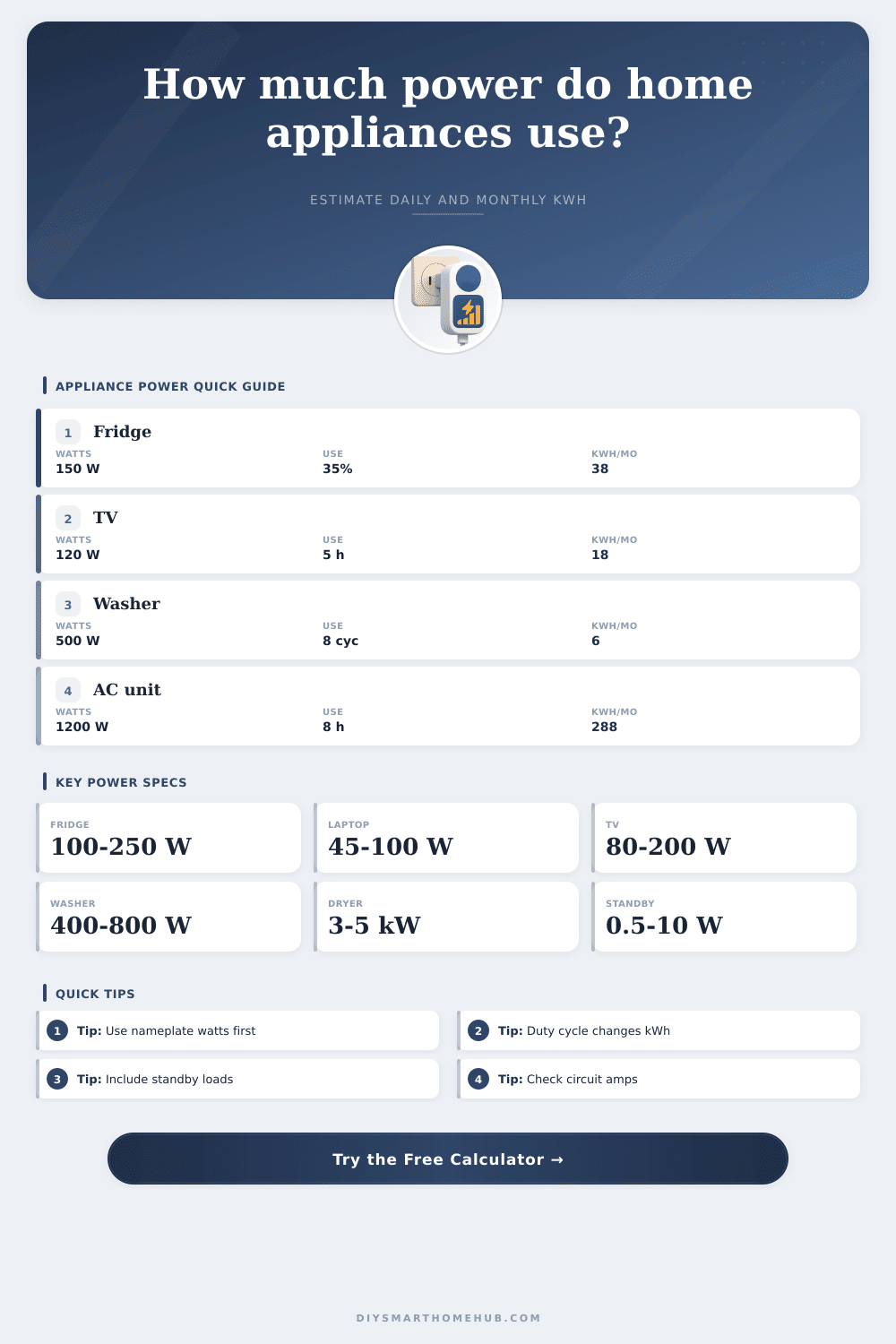
| Refrigerator (side-by-side) | 150 W | 24 | 108 | 388.8 |
| Central Air Conditioner | 3,500 W | 8 | 840 | 3,024 |
| Window AC Unit | 1,440 W | 8 | 345.6 | 1,244 |
| Electric Water Heater | 4,500 W | 3 | 405 | 1,458 |
| Electric Oven/Range | 2,400 W | 1 | 72 | 259.2 |
| Microwave Oven | 1,000 W | 0.5 | 15 | 54 |
| Dishwasher | 1,200 W | 1 | 36 | 129.6 |
| Clothes Washer | 500 W | 1 | 15 | 54 |
| Electric Dryer | 5,000 W | 1 | 150 | 540 |
| LED TV 55 inch | 80 W | 5 | 12 | 43.2 |
| Desktop Computer | 200 W | 8 | 48 | 172.8 |
| Laptop Computer | 50 W | 8 | 12 | 43.2 |
| LED Light Bulb (60W equiv) | 9 W | 6 | 1.62 | 5.8 |
| Electric Space Heater | 1,500 W | 8 | 360 | 1,296 |
| Hair Dryer | 1,875 W | 0.25 | 14.1 | 50.7 |
| From | To kWh | To MJ | To BTU |
|---|---|---|---|
| 1 Watt-hour | 0.001 kWh | 0.0036 MJ | 3.412 BTU |
| 1 kWh | 1.000 kWh | 3.600 MJ | 3,412 BTU |
| 100 Wh/day | 3.0 kWh/mo | 10.8 MJ/mo | 10,236 BTU/mo |
| 500 Wh/day | 15 kWh/mo | 54 MJ/mo | 51,180 BTU/mo |
| 1,000 Wh/day | 30 kWh/mo | 108 MJ/mo | 102,360 BTU/mo |
| 5,000 Wh/day | 150 kWh/mo | 540 MJ/mo | 511,800 BTU/mo |
| Home Size | Avg kWh/Month | Avg MJ/Month | Notes |
|---|---|---|---|
| Studio / 1-Bed Apt | 300–500 kWh | 1,080–1,800 MJ | Minimal appliances |
| 2-Bed Apartment | 500–750 kWh | 1,800–2,700 MJ | No central AC |
| Small House (1,000 sqft) | 750–1,000 kWh | 2,700–3,600 MJ | Window AC units |
| Medium House (1,500 sqft) | 1,000–1,500 kWh | 3,600–5,400 MJ | Central HVAC |
| Large House (2,500 sqft) | 1,500–2,500 kWh | 5,400–9,000 MJ | Full appliances |
| US Average (all homes) | ~886 kWh | ~3,190 MJ | EIA 2022 data |
1 kilowatt-hour (kWh) equals 1,000 watts running for exactly 1 hour. A 100W bulb left on for 10 hours uses 1 kWh. Multiply device wattage by hours used, then divide by 1,000 to find daily kWh.
Most electronics consume 5–10% of their rated power even when "off" in standby mode. Smart power strips can eliminate phantom loads. TVs, game consoles, and cable boxes are the biggest standby offenders in most homes.
To understand the electric bills that is sent to every household, you must understand how the appliances in that household use electricity. Electric bills shows the total amount of electricity that the appliances in the household used, and that total amount of electricity is measured in units of kilowatt-hour. Many people assume that appliances with a high amount of size use a large amount of electricity, but both the wattage of the appliance and the amount of time that the appliance is running actualy determine the amount of electricity that an appliance uses.
Each of these factor must be considered in order to calculate the total amount of energy that the appliance use. The amount of time that an appliance is actually running is referred to as it’s duty cycle. The duty cycle is the amount of time that the appliance is running compared to the total amount of time that pass.
How Home Appliances Use Electricity
Appliances with high wattage (amount of power the appliance uses) often have a low duty cycle, meaning that they are not constantly running. For instance, a refrigerator may contain high wattage, but the refrigerator only runs if the temperature of the refrigerator rises. Thus, the refrigerator could only run for twenty minutes during each hour.
An appliance with a lower duty cycle will use less electricity than an appliance that runs for sixty minutes during each hour. By plugging these numbers into an electricity calculator, you can determine the amount of kilowatt-hours that each appliance use, which will prevent any manual error in calculating how much energy each appliance uses. In addition to the energy that appliances use to perform their function, appliances also often use some standby power.
Standby power, also known as phantom load, is the electricity that the appliance uses when it isnt actually performing its main function. Appliances such as televisions and game consoles uses standby power in order to remain ready to recieve a signal from a remote control. Each appliance may use a small amount of electricity in this mode, but many appliances will add up to a significant drain on the household electric bills.
In understanding how the electricity that is purchased flow through the wiring in the home, there are two factor to consider: voltage and current. The voltage of electricity that is provided to the home is often 120 volts at standard outlets in the US, but some appliances use 240 volts, such as electric dryers. Appliances use electricity when they are turned on by pulling the current that is provided to the wires in the walls of the home.
If you attempt to turn too many appliances on at once, the current that the appliances pull will be too high for the wires in the walls, which will cause the circuit breaker in the appliances to trip. By understanding the voltage and current in the home, a person can understand why certain appliances cannot be used at the same time. In comparing appliances, it is possible to compare the total amount of energy that the appliances use over time.
Appliances with high wattage may use alot of energy, but if they are used for a very short period of time, they may use less energy than appliances with lower wattage that are used for long periods of time. For instance, a vacuum may have a high wattage, but is often used for short periods of time. A network router may have a low wattage, but is used for long periods of time (24 hours per day).
Thus, each appliance may have a significantly different amount of energy that it use over time. To lower the electric bill in the home, you should target appliances with both high wattage as well as high duty cycles for improvements in energy efficiency. Finally, a buffer should be planned into the estimation of the amount of energy that is used in the home.
A buffer is an amount of energy that can be added to the estimated energy use in the home to account for energy use variations. Different factors can cause energy use variations, such as using the air conditioner during a hot month in the year, leaving the refrigerator door open, etc. By planning for a buffer for these potential variations, the budget for electricity in the home will be ensured to be accuracy. Thus, by tracking the active (peak) use of appliances and the standby power of electronics in the home, it is possible to manage the amount of electricity that is consumed in the home.