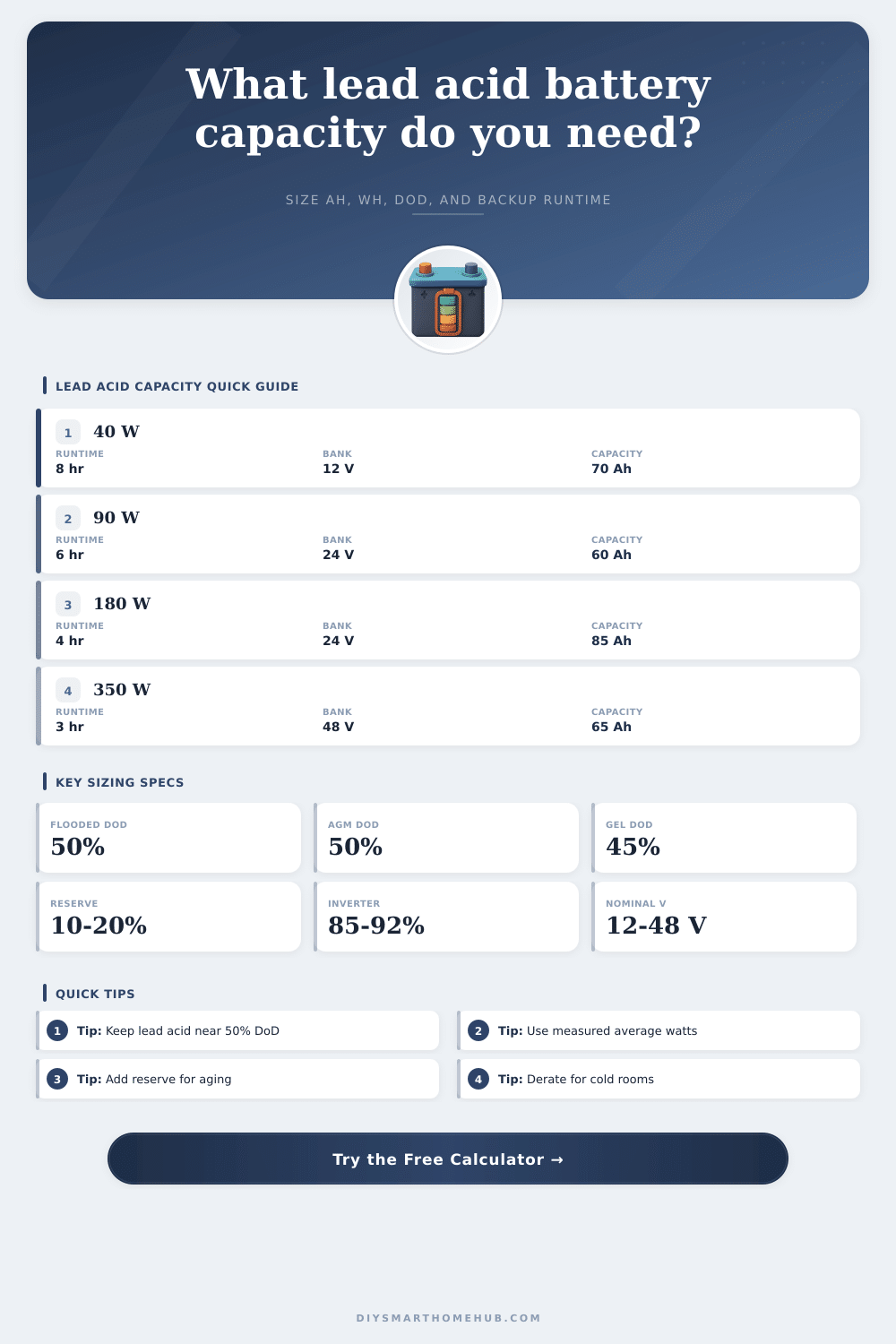
Lead Acid Battery Capacity Calculator
Estimate the rated amp-hours, watt-hours, battery count, and realistic backup runtime for flooded, AGM, gel, and sealed lead acid battery banks.
1.Choose a real backup scenario
2.Enter load and battery details
3.Capacity results
4.Lead acid sizing spec grid
5.Recommended lead acid depth of discharge
| Battery type | Typical cyclic DoD | Best use case | Sizing note |
|---|---|---|---|
| Flooded deep cycle | 50% | Ventilated utility room, serviceable bank | Check electrolyte and ventilation requirements. |
| AGM deep cycle | 50% | Indoor UPS, telecom, network backup | Good high-current behavior, maintenance free. |
| Gel deep cycle | 40-50% | Low-current standby and slow discharge | Avoid aggressive charge rates and deep cycling. |
| Sealed lead acid standby | 30-50% | Alarm panels, small UPS packs, access control | Often rated for float service more than daily cycling. |
| Lead carbon | 60-70% | Partial state of charge and frequent cycling | Can tolerate deeper cycling than standard lead acid. |
6.Nominal voltage and battery layout reference
| Bank voltage | 12 V batteries in series | Current at 240 W | Practical smart home fit |
|---|---|---|---|
| 12 V | 1 per string | 20.0 A before losses | Small router, hub, alarm, and LED loads. |
| 24 V | 2 per string | 10.0 A before losses | NVR, PoE switch, gate control, medium UPS. |
| 36 V | 3 per string | 6.7 A before losses | Specialized DC systems and some mobility packs. |
| 48 V | 4 per string | 5.0 A before losses | Larger inverter systems and whole-network backup. |
7.Temperature capacity derating guide
| Battery temperature | Approx usable capacity | What to adjust | Reason |
|---|---|---|---|
| 77 F / 25 C | 100% | Use normal sizing | Lead acid ratings are commonly referenced near room temperature. |
| 50 F / 10 C | 85-90% | Add reserve or reduce DoD | Cold electrolyte raises internal resistance. |
| 32 F / 0 C | 75-80% | Increase Ah about 25% | Capacity falls noticeably near freezing. |
| 14 F / -10 C | 60-70% | Increase Ah about 40% | Cold banks sag more under inverter load. |
| 95 F / 35 C | Near 100% | Add aging reserve | Warmth may not lower capacity now, but accelerates aging. |
8.Common smart home backup examples
| Load group | Typical watts | Runtime target | Lead acid sizing pattern |
|---|---|---|---|
| Router, ONT, mesh node | 25-45 W | 8-12 hours | Often fits one 12 V 75-100 Ah AGM battery. |
| Hub, alarm panel, sensors | 10-30 W | 12-24 hours | Small SLA or AGM banks can work if DoD stays conservative. |
| PoE switch and 4 cameras | 70-140 W | 4-8 hours | 24 V bank reduces current and cabling stress. |
| Network rack and modem | 150-300 W | 2-4 hours | Use 24 V or 48 V to keep inverter current reasonable. |
| Core home loads | 300-700 W | 1-3 hours | Multiple parallel strings may be required with lead acid. |
9.Capacity formula reference
| Step | Formula | Example | Meaning |
|---|---|---|---|
| Load energy | Watts x hours | 90 W x 6 h = 540 Wh | Energy the devices consume before conversion losses. |
| DC energy | Load Wh / efficiency | 540 / 0.88 = 614 Wh | Battery-side energy needed for inverter or DC converter loss. |
| Usable target | DC Wh x reserve | 614 x 1.15 = 706 Wh | Energy goal after adding reserve and aging margin. |
| Rated capacity | Usable Wh / DoD / volts | 706 / 0.50 / 24 = 59 Ah | Nominal Ah capacity needed at the selected bank voltage. |
10.Practical lead acid sizing notes
When planning a battery backup systems, one of the first consideration is the battery capacity. The capacity listed on the battery isnt the amount of energy the battery can deliver. Many believe that the battery will hold an energy indicated on the battery label.
However, using the full capacity of a battery will permanent damage the battery. The depth of discharge is the measurement of how much energy the battery will use before being recharged. For lead acid batteries, you have to limit the amount of energy the battery use to ensure the battery lasts longer.
How to plan a battery backup system
An expert can use five percent of the total capacity of a lead acid battery. Using more than fifty percent of the batterys capacity will shorten the batterys lifespan. Additionally, using all of the batterys capacity will damage the batteries internal plate.
Another consideration when using a lead acid battery is the chemistry of the battery and how it should be maintained. If using a flooded lead acid battery, you will have to add distilled water to the battery. Additionally, the lead acid battery will release gases while in use, so you will have to store it in a well ventilated area.
For AGM and gel batteries, distilled water does not have to be added, and there is no need to ventilate the battery. However, the batteries will have limitation regarding how quickly the battery can be charged and the depth of how far the battery can be cycle. For lead carbon batteries, there are limitations to how far the battery can be cycled, just like lead acid batteries.
Energy will be lost in a few different ways in your battery backup system. If an inverter is used to power device with the energy from the battery, some of the energy will be lost to heat. Most inverters is only 85 to 90% efficient.
This means 10 to 15% of the energy from the battery will be lost to heat. Another percentage of the energy will be lost due to the age of the battery. The longer a battery is used, the less energy it will contain than a new battery.
A battery that is three years old will have less energy then one that is new. The voltage of your battery backup system will play a majorly role in the efficiency of the system. A 12-volt battery backup system is easy to use.
However, it will have to use more current to power the device that will be turned on. Using high amounts of current will lead to energy lost to heat. High amounts of current will also lead to the need for thicker wire.
If you use a 24-volt or a 48-volt battery backup system, the same amount of power can be used with less current. Using a higher voltage will allow for less energy lost to heat, leading to thinner wires in the system. The systems temperature will also affect the battery backup systems energy output.
Lead acid batteries work best at a standard room temperature. At colder temperature, the chemical reactions within the batteries slow down. This lead to the batteries having high internal resistance.
High internal resistance within lead acid batteries will lead to the batteries releasing less energy when placed in a cold environment as compared to a warm environment. If the lead acid battery backup system is to be placed in a cold location, the battery bank will have to be larger to provide the same amount of energy output. To create the best system, the individual will have to calculate the needs of the system based off the actual wattage of the device.
The actual wattage will be less than the maximum wattage of the device. The wattage of the devices must be measured to obtain an accurate reading of the wattage that will be used in the system. The energy needed for the devices has to be calculated.
Additionally, the energy that will be lost due to the inverter and the energy lost due to the age of the battery also have to be accounted for. By accounting for all of these factor, the individual will ensure that the battery backup system will provide the power that is calculated for the system.