Water Softener Flow Rate Calculator
Compare simultaneous fixture demand against resin media limits, tank geometry, empty bed contact time, and valve size so you can see whether a softener will keep up at peak household flow.
📋Preset flow scenarios
Each preset loads a realistic household demand pattern, media type, and softener package so you can compare a modest one-bath setup against rain-shower suites, iron-bearing wells, and larger three-bath homes.
⚙Flow model inputs
Softener flow verdict
Run the calculator to compare fixture demand with the selected resin package, contact time, and valve body.
Flow breakdown
📊Live hydraulic snapshot
These cards show the part of the system that matters most once demand rises: the per-cubic-foot flow window, the tank geometry being pushed, the valve ceiling, and the resulting contact time.
📖Reference tables
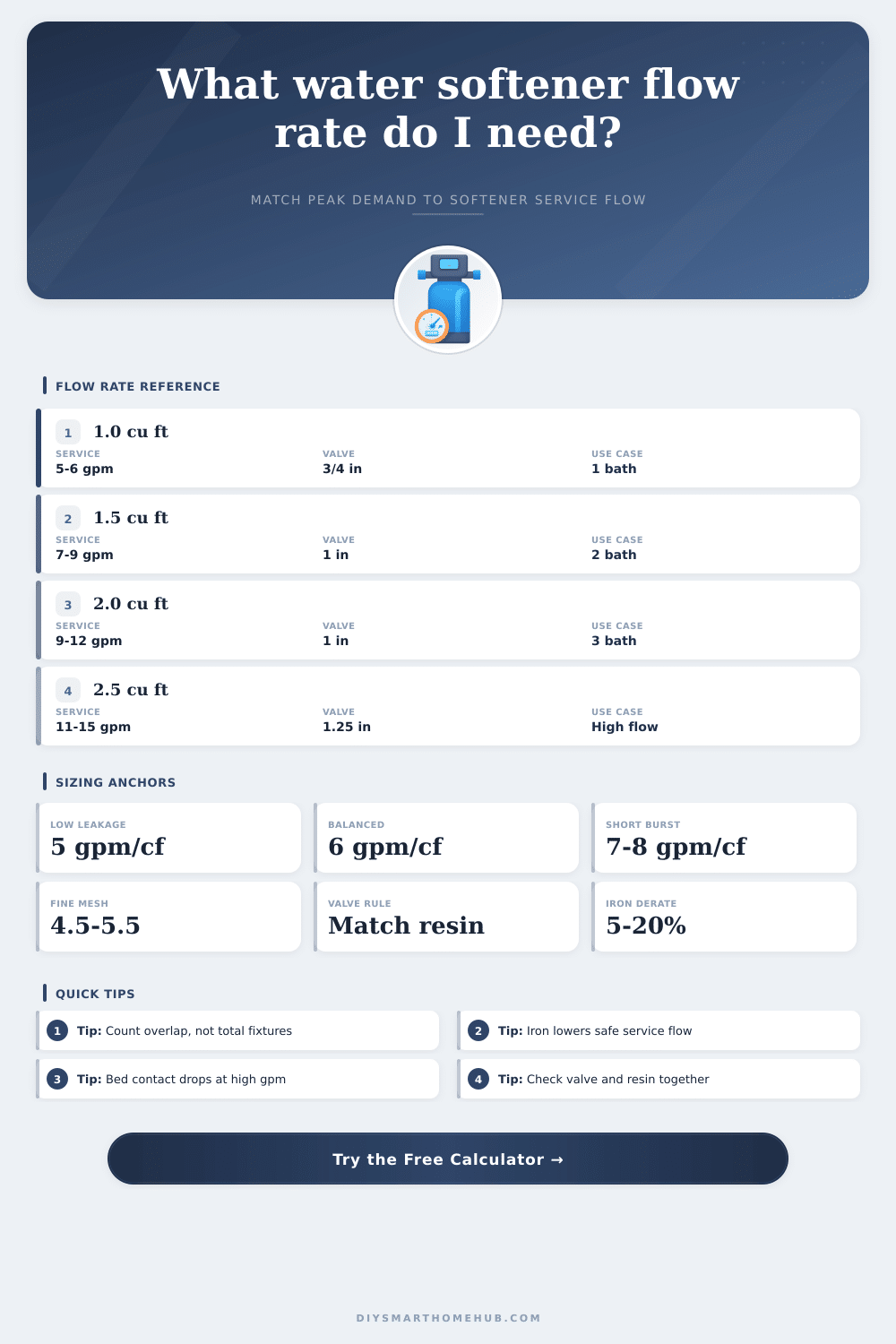
Media profile flow guide
| Media | Low leak | Balanced | Short burst |
|---|---|---|---|
| Standard 8% resin | 5.0 gpm/cf | 6.0 gpm/cf | 7.0 gpm/cf |
| Fine mesh resin | 4.5 gpm/cf | 5.3 gpm/cf | 6.0 gpm/cf |
| 10% crosslink resin | 5.5 gpm/cf | 6.5 gpm/cf | 7.5 gpm/cf |
| High-flow layered bed | 6.0 gpm/cf | 7.0 gpm/cf | 8.0 gpm/cf |
| Upflow high-efficiency | 5.2 gpm/cf | 6.2 gpm/cf | 7.2 gpm/cf |
Typical fixture flow assumptions
| Fixture | Flow | Metric | Note |
|---|---|---|---|
| Eco shower | 1.5 GPM | 5.7 L/min | Low-use shower head |
| Standard shower | 2.0 to 2.2 | 7.6 to 8.3 | Common modern shower |
| Rain shower | 2.5 to 3.0 | 9.5 to 11.4 | High-demand fixture |
| Bathroom faucet | 0.5 to 0.8 | 1.9 to 3.0 | Small but additive |
| Dishwasher or washer fill | 0.8 to 1.5 | 3.0 to 5.7 | Can overlap showers |
| Tub filler or spray zone | 4.0 to 6.0 | 15.1 to 22.7 | Short but heavy draw |
Common tank packages and balanced service flow
| Package | Resin | Diameter | Bed area | Balanced flow | Typical fit |
|---|---|---|---|---|---|
| 8 x 44 | 0.75 cu ft | 8 in | 0.35 sq ft | 4 to 5 GPM | One-bath, low overlap |
| 9 x 48 | 1.0 cu ft | 9 in | 0.44 sq ft | 5 to 6 GPM | Compact homes |
| 10 x 44 | 1.25 cu ft | 10 in | 0.55 sq ft | 6 to 7.5 GPM | Small family load |
| 10 x 54 | 1.5 cu ft | 10 in | 0.55 sq ft | 7 to 9 GPM | Two-bath homes |
| 12 x 52 | 2.0 cu ft | 12 in | 0.79 sq ft | 9 to 12 GPM | Three-bath homes |
| 13 x 54 | 2.5 cu ft | 13 in | 0.92 sq ft | 11 to 15 GPM | High-flow families |
| 14 x 65 | 3.0 cu ft | 14 in | 1.07 sq ft | 13 to 18 GPM | Large or spa-heavy homes |
Home snapshots
| Home profile | Peak demand | Suggested package | Why it lands there |
|---|---|---|---|
| One-bath condo | 3.0 to 4.5 GPM | 0.75 to 1.0 cu ft | Single shower plus light branch overlap rarely needs a larger bed. |
| Two-bath family home | 6.0 to 8.5 GPM | 1.5 cu ft | Two showers and one appliance push many 1.0 cu ft systems to their limit. |
| Iron-bearing well ranch | 6.5 to 8.0 GPM | 1.5 to 2.0 cu ft | Iron derating lowers the comfortable service window even before fixtures increase. |
| Three-bath morning rush | 8.5 to 11.5 GPM | 2.0 to 2.5 cu ft | Bed velocity and valve capacity both become real constraints at this point. |
| Rain shower plus tub | 11.0 to 15.0 GPM | 2.5 to 3.0 cu ft | High-demand fixtures need both resin area and a larger valve body. |
| Main house plus ADU | 10.0 to 13.0 GPM | 2.5 to 3.0 cu ft | Separate occupied spaces raise both overlap odds and total branch count. |
💡Practical notes
Flow rating is not just a resin number
A softener can have enough resin volume on paper but still feel weak at the tap if the valve body is too small or the bed velocity is pushed too hard. This calculator checks all three limits together.
Iron changes the safe service window
When iron is present, the resin needs more contact and cleaner regeneration to stay consistent. That is why the calculator derates service flow as iron rises instead of assuming a clean municipal-water rating.
Water softeners work by stopping mineral buildup in the plumbing system. They do that by means of ion change, during minerals as calcium and magnesium switch with sodium. Like this you receive soft water.
High mineral content in water can cause deposits in pipes, that limits the flow and lowers the pressure over time. Scale from hard water reduces the water flow and grows the need of repairs. It also cover taps, showerheads and devices.
How Water Softeners Work
Big flow rates are important. Softeners point it in gallons each minute (GPM) during use. Usually it falls between 2 and 4 GPM.
For instance, typical kitchen faucet have around 2.2 GPM in 60 psi. Family softeners, that handle 7-10 GPM, keep steady pressure during peak use. For large families you well choose model with flow rates over the maximum need, so 10-12 GPM.
Like this you has always soft water, even during showering in high periods. The SpringWellSS system distinctly surpasses with 20 GPM.
Plumbing also matters. Pipe diameter in the plumbing system, as 3/4 inches against 1 inch, decide the maximum flow. Softeners can cause some drop according to the flow rates.
The Kenmore 350 32,000 grain softener ensures soft water flowing during it keep home water pressure high. This system has proof of NSF International for reduce hard minerals, scale buildup and iron in water.
Water moves differently through those systems. Softeners can be upflow-type, where water pushes upward, or downflow, where it goes down. During normal service it operates downflow.
Hard water enters the mineral tank and pass through bed of spherical beads. Those plastic beads usually are made up of polystyrene and bear sodium ions. They exchange calcium and magnesium for sodium.
Upflow advantage comes during regeneration. Then brine enters of the bottom of the resin tank and flows upward through the bed. Like this contaiminants pushd in the opposite to the enter direction, so the pure resin does not kontaminatges.