18650 Battery Bank Calculator
Build an 18650 pack layout from target voltage, usable energy, cell capacity, discharge depth, reserve, load current, peak current, and BMS rating.
Calculation breakdown
| Pack Class | Series Count | Nominal Voltage | Full Voltage | Typical Use |
|---|---|---|---|---|
| 1S lithium-ion | 1S | 3.6 to 3.7 V | 4.2 V | USB bank cores, tiny sensors, flashlights. |
| 3S lithium-ion | 3S | 10.8 to 11.1 V | 12.6 V | Router backup packs and 12 V converter inputs. |
| 4S lithium-ion | 4S | 14.4 to 14.8 V | 16.8 V | 12 V class DC equipment with buck regulation. |
| 7S lithium-ion | 7S | 25.2 to 25.9 V | 29.4 V | 24 V class portable power stations and UPS shelves. |
| 10S lithium-ion | 10S | 36.0 to 37.0 V | 42.0 V | 36 V class e-bike and scooter modules. |
| 13S lithium-ion | 13S | 46.8 to 48.1 V | 54.6 V | 48 V class packs where equipment supports Li-ion voltage. |
| Step | Formula | Why It Matters | Output |
|---|---|---|---|
| Series count | ceil(target V / cell V) | Sets nominal and full pack voltage. | S count and charger voltage. |
| Gross Wh target | usable Wh x reserve / DoD / efficiency | Converts usable energy into required cell energy. | Minimum nominal Wh. |
| Target Ah | gross Wh / pack V | Translates energy target into pack amp-hours. | Required Ah. |
| Parallel groups | ceil(target Ah / cell Ah) | Selects enough cell groups to meet capacity. | P count. |
| Cell count | S x P | Final number of 18650 cells in the pack. | Total cells. |
| Pack current | load W / pack V | Checks continuous and peak current stress. | BMS and cell current check. |
| Cell Type | Common Capacity | Continuous Current | Best Fit | BMS Note |
|---|---|---|---|---|
| High-energy 18650 | 3200 to 3500 mAh | 4 to 8 A | Low-current backup and long runtime banks. | Use more parallel cells for peak loads. |
| Balanced 18650 | 2800 to 3200 mAh | 8 to 12 A | Router, camera, and small UPS packs. | Moderate BMS ratings usually fit well. |
| High-drain 18650 | 2000 to 2600 mAh | 15 to 25 A | Tools, motors, and higher surge applications. | BMS and nickel links need real surge margin. |
| Reclaimed mixed cells | Varies by test | Use tested limit | Low-risk stationary projects after grading. | Derate heavily and avoid high-current packs. |
| Scenario | Target Wh | Likely Layout | Cell Count | Design Focus |
|---|---|---|---|---|
| Router backup | 80 Wh usable | 3S3P with 3000 mAh cells | 9 cells | Small current and easy charging. |
| Camera mini UPS | 150 Wh usable | 3S5P with 3000 mAh cells | 15 cells | Longer runtime at low DC load. |
| PoE shelf | 280 Wh usable | 4S7P with 3200 mAh cells | 28 cells | More parallel groups for current sharing. |
| Power station core | 600 Wh usable | 7S8P with 3500 mAh cells | 56 cells | Higher voltage lowers pack current. |
| E-bike module | 650 Wh usable | 10S6P with 3500 mAh cells | 60 cells | BMS peak and cell current dominate. |
Start with usable Wh, then use voltage and cell capacity to determine S and P. A pack can have enough Ah and still fail the peak-current check.
Use the same number of matched cells in each group, then select a BMS for the exact series count, full voltage, continuous amps, and surge amps.
You are building a battery bank. When you build a battery bank, it’s tempting to just stack as many cells as necessary to reach the desired voltage. Nope. The secret sauce is matching current delivery with energy density, and that’s why size (not raw number of cell) is so important. If you pull out two dozen random 18650s, wire ’em together, and expect it to work … well, you’ll probably succeed once, maybe even twice, but it won’t last long, and it won’t perform well under a load since it hasn’t accounted for your particular needs when discharging.
The above calculator take all the math off your plate, turning those abstract goals (“I need 1,000 usable watt-hours“) into a concrete set of series/parallel configs. The correct answer is no, not if you know what energy you realy need (after taking into account inefficiencies). The tool takes this into consideration and then multiplies it based off efficiency and depth of discharge losses. This is important since lithium cell aren’t perfect. They don’t discharge all the way to zero volts without damage, and they don’t deliver 100 percent of rated capacity at the end of a charge cycle.
Why Battery Bank Design Is Important
You’re buying reserve battery capacity as insurance against voltage sag while waiting for your UPS or router to kick in during a blackout. That little bit of extra gets multiplied into longevity rather than early cell death.
Now we get to the part about voltage selection, also known as how many of those things in series you’re going to put together. You choose your desired target voltage, then the system rounds it up to the next whole number of cells in series. Why does it round up? Because you don’t want half a cell in series and if you fall below that, you’re showing less voltage to the equipment than it was expecting.
After the series string has been determined, there are parallel groups. That’s where capacity comes into play. Need more amp-hours? Add another parallel branch. Essentially this distribute the current load among several cells, not just one. This provides an advantage by keeping them from getting too hot while increasing their cycle life dramaticly.
This is where most DIY projects fail, the BMS rating. A Battery Management System isn’t just a safety switch; it’s the brain that monitors balance. Your Balance rating are not optional. You cannot exceed what the BMS can handle. If you do, it will trip out or overheat, making it useless right when you need it.
The tool does this based on your surge needs, eliminating guesswork. Then it makes sure your everyday use fall within the Continuous Rating and your startup spike doesn’t exceed the Peak Capacity. Wasting money on high drain cells in a low current backup, and high capacity cells in a motorized tool is a waste because they won’t be able to discharge quickly enough and you could experience thermal runaway.
There is also a level of cell matching that reality require, but spreadsheets do not always account for. For example you want all those in parallel to be at the same health and resistance. If you mix new fresh cells with older more worn out ones then one will be weaker and drain quicker while pulling down the effective capacity of the entire pack.
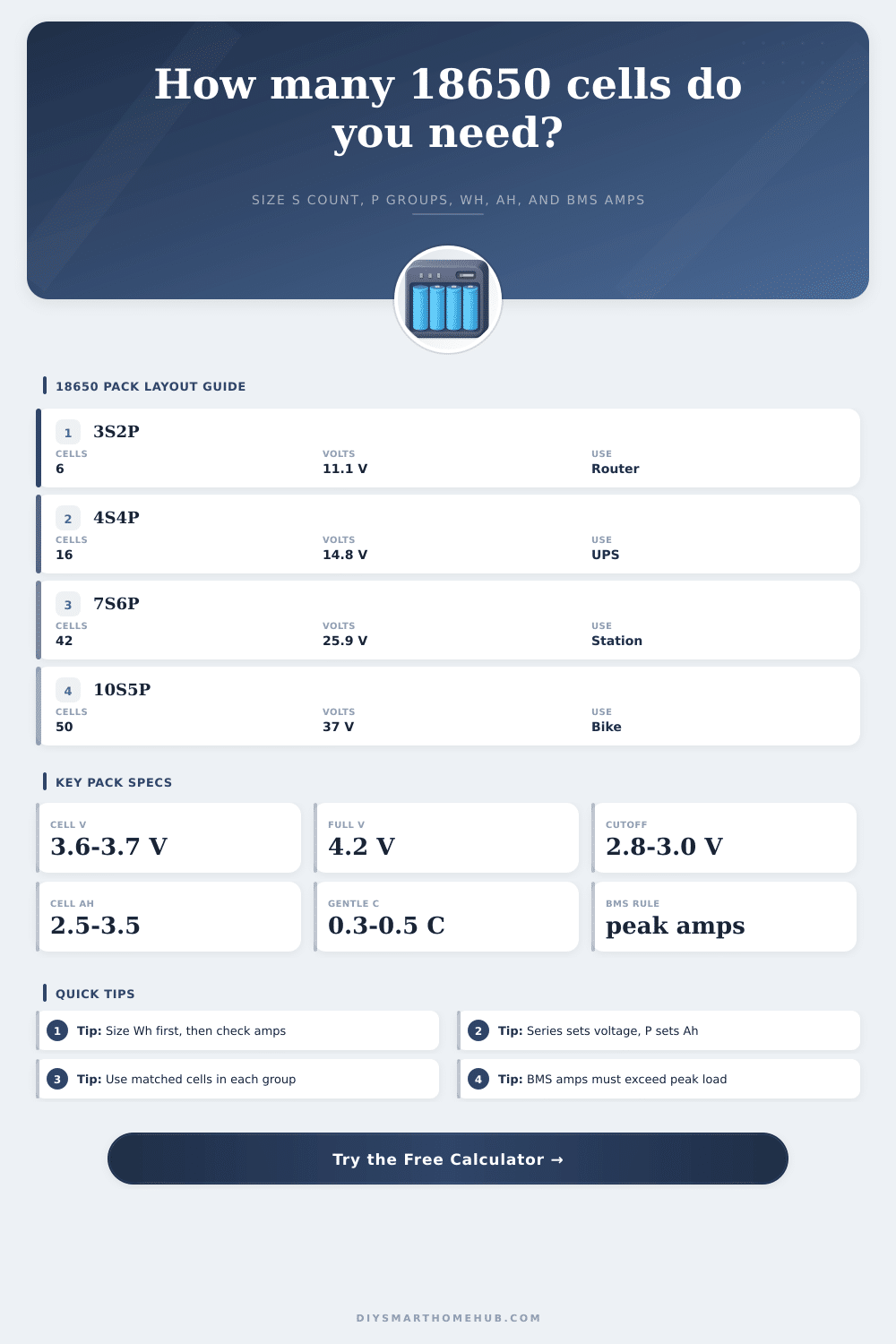
It gets laid out nicely in the reference table on the page where it shows typical setups such as 3S for router backups or 10S for an e-bike. Those are not random numbers; they are standard voltages that match the converters and chargers already available.
In conclusion, batteries are more than individual cylinders; they’re systems. Your brain fills in the blanks because you understand why this size fits that purpose. A battery bank calculator provide the bones, but understanding the logic behind the sizing provides the substance. Don’t fall into the trap of creating an imposing unit that works poorly. Design for reliability, not capacity.
Design for what goes into it: how much energy do I want to store? Then figure out the voltage and current needs of that requirement and build around that. Let the math tell you what size to make it. Protect the cells from each other with good cell balancing. Use the energy as your starting point, then worry about the current and voltage later.
If you get the ratios correct, you have a predictable power source on your hands, not a ticking time bomb. That’s how you make reliable storage out of loose furnitures.