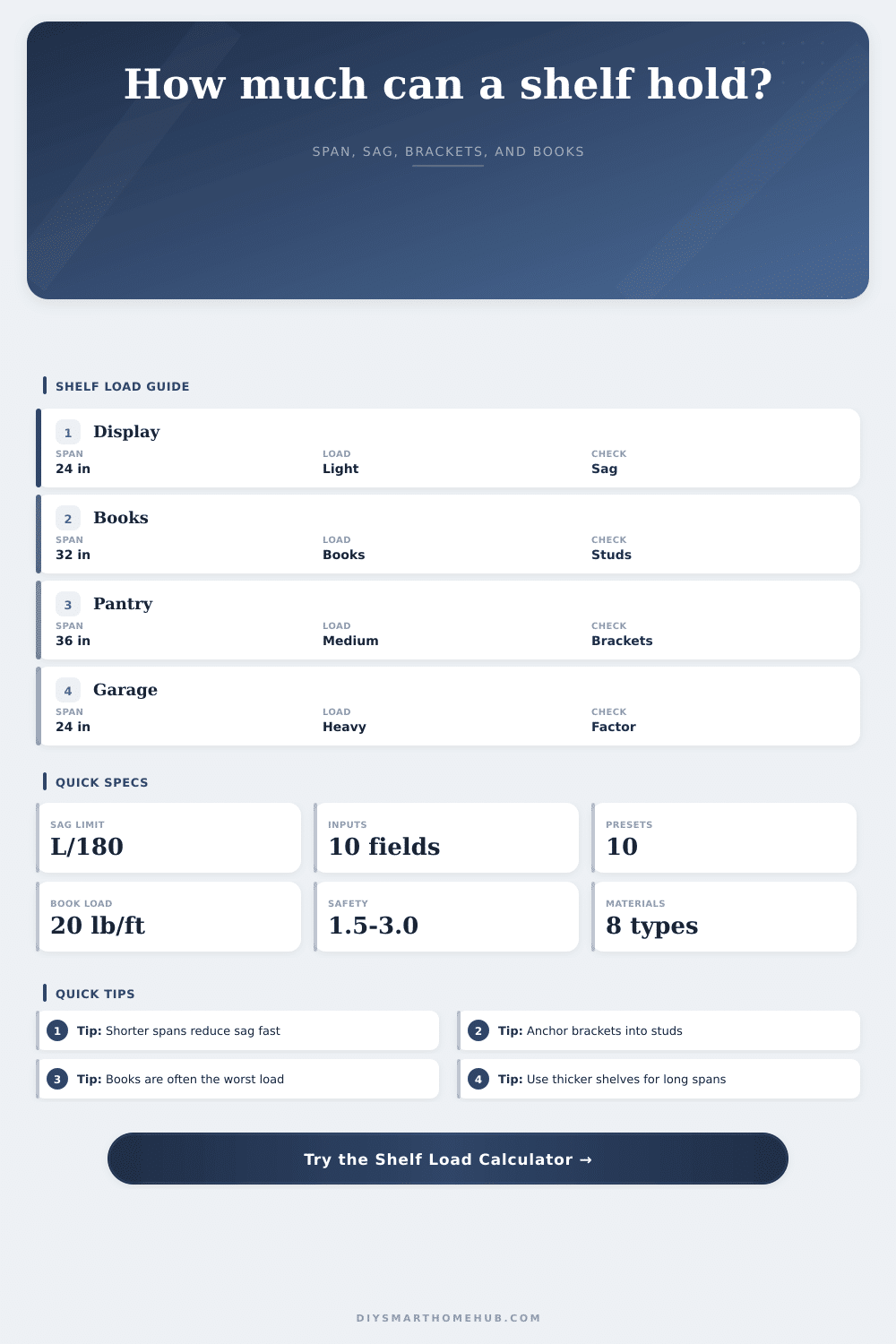
Built-In Shelf Load Calculator
Estimate shelf sag, uniform load capacity, bracket demand, stud demand, and book weight from shelf span, material stiffness, thickness, and safety factor.
Longest estimated gap between load-bearing supports.
Uses shelf depth x thickness cubed divided by 12.
Common visual sag limit for shelving checks.
Uniform load estimate before safety factor check.
Material Modulus Reference
| Material | E estimate | Density | Use note |
|---|---|---|---|
| Cabinet plywood | 1,300,000 psi | 34 lb/ft³ | Balanced |
| Baltic birch | 1,500,000 psi | 43 lb/ft³ | Stiff ply |
| MDF | 600,000 psi | 48 lb/ft³ | Sag watch |
| Particle board | 450,000 psi | 42 lb/ft³ | Short spans |
| Pine board | 1,200,000 psi | 28 lb/ft³ | Solid wood |
| Oak board | 1,700,000 psi | 47 lb/ft³ | Stiff wood |
Typical Load Types
| Load type | Planning load | Metric | Main limiter |
|---|---|---|---|
| Light display | 8 lb/ft | 11.9 kg/m | Sag usually low |
| Mixed household | 15 lb/ft | 22.3 kg/m | Fasteners |
| Books | 20 lb/ft | 29.8 kg/m | Sag and studs |
| Dense books | 28 lb/ft | 41.7 kg/m | Sag control |
| Pantry goods | 25 lb/ft | 37.2 kg/m | Bracket rating |
| Garage bins | 35 lb/ft | 52.1 kg/m | Support count |
Span Sensitivity Guide
| Change | What it affects | Formula effect | Practical meaning |
|---|---|---|---|
| Shorten span | Sag | L to the 4th | Small span cuts help a lot |
| Increase thickness | Stiffness | h to the 3rd | Thicker shelves work hard |
| Add front rail | Section stiffness | I multiplier | Reduces visible sag |
| Add supports | Bracket load | Load divided | Also shortens effective span |
| Raise safety factor | Allowable load | Capacity divided | More conservative result |
Common Built-In Checks
| Project | Common size | Typical load | Watch item |
|---|---|---|---|
| Living room display | 30 x 10 in | 8-15 lb/ft | Level line |
| Library shelf | 36 x 12 in | 20-28 lb/ft | Sag limit |
| Pantry shelf | 42 x 14 in | 20-25 lb/ft | Bracket rating |
| Closet shelf | 72 x 12 in | 12-18 lb/ft | Middle support |
| Garage shelf | 48 x 16 in | 30-35 lb/ft | Stud anchoring |
A new bookshelf you’ve constructed sags in the center as you add one of your old encyclopedias to the stack. The wood doesn’t break, it’s simply wrong. That sinking feeling is what we call the difference between form and function: more critical on built-ins than on stand-alone pieces of furnitures. A set of built-in is a structural pledge, and maintaining such pledges requires engineering thought, not merely carpentry.
Wood bend. Another word for that is deflection. How much it bends depends mainly off two things: Thickness and span (the distance between supports). And span has an absolutely severe mathematical impact on how much shelf bend. Not a little bit more, but dramatically more. Deflection is proportional to the length to the fourth power. So if you add twenty percent to the length, the shelf will sag a lot more.
Why Bookshelves Sag and How to Fix It
Adding a single additional bracket halfway through a long run can do far more to prevent sagging than simply doubling the thickness of the wood. That’s where the math comes in. The calculator above takes care of it for you when you input your dimensions so you don’t have to wade through beam formulas.
Respect the cube law. The moment of inertia, stiffness, is controlled by thickness cubed. So even though three-quarters-inch thick plywood is thicker than 3/8-inch, going up to an inch add a lot of rigidity because thickness is cubed. It’s a big gain in performance for a little change in material. A good way to get some of that added stiffness if you’re stuck with thin plywood is adding a solid wood front rail or face frame. It will multiply that stiffness as if you had added a full inch of thickness without the extra bulk. This is a classic carpenter trick that only works because geometry is on your side.
The first part of all of this is material choice. Certain types bend easily, others resist bending well. For example, softwoods such as pine is more flexible and will show sag sooner, while hardwoods (oak, maple) are stiffer and resist that downward curve better for the same dimensions. Engineered woods such as MDF is stiff but without the “grain” that provides strength and toughness to natural wood, so the same sized piece may need supports or smaller spans before it looks straight. This chart on the page makes clear what is happening: Modulus of elasticity differs from one type of material to another. Pick the one that fits your sense of beauty and your wallet, but understand that you have to adjust the span accordingly to accommodate its stiffness.
The real world doesn’t load evenly. Shelf design are especially tough with books. They’re dense. They’re heavy. And people line them up right in the middle of the span, where it’s most vulnerable. A linear foot of hardcover books can be twenty or more pounds, converting an ornamental niche into a structural challenge.
Garage bins and pantry goods aren’t much help either, and tend to concentrate their weight at the front edge, where they’ll increase the distance from the wall and thereby the stress on those brackets. Plan for worst case, not average. Safety factor goes out the window if your shelves were designed for lightweight decorations but then filled with textbooks.
The last piece of the puzzle is brackets and attaching them to walls. A solid shelf doesn’t do any good if hardware comes out of the wall. For heavy loads, studs are non-negotiable. Any other time, a bracket sitting on drywall by itself won’t be saved by a stout shelf. The load per support calculation allows you to double-check yourself that the hardware you’re using isn’t being asked to carry too much weight. It’s a sanity check so you don’t get an ugly surprise down the road.
It’s simple enough to build a shelf. To build one that will stand up straight and be proud even when loaded? That takes engineering. A happy beam relies on just the right combination of support, span, and materials. If you can get those things correct, the shelf itself becomes a thing out of sight. It stays in the background of your space, there to hold everything together without protest.
The shelf won’t sway.