Cooking Moisture Load Calculator
Estimate how many pounds of water vapor cooking adds, how much the range hood removes as air changes, the room humidity rise in grains per pound, and the dehumidifier pints needed to return to target RH.
Cooking Moisture Results
| Cooking method | Room moisture share | Best input to use | Humidity note |
|---|---|---|---|
| Open boiling pot | 100% | Pints boiled off | Highest direct vapor load into the kitchen air. |
| Lidded simmer | 45% | Visible boil-off estimate | Lids return condensate to the pot and cut room moisture. |
| Steaming basket | 85% | Water loss from steamer | Short but concentrated vapor bursts can spike RH quickly. |
| Soup or stock simmer | 70% | Pot level drop | Long duration makes exhaust air changes matter more. |
| Canning or large kettle | 100% | Total water boiled away | Use the largest connected room volume if doors are open. |
| Pressure cooker | 25% | Release steam estimate | Most water stays sealed until the vent release period. |
| Saute or stir fry | 20% | Ingredient water loss | Lower vapor load, but a hood still helps capture steam. |
| Oven roast or bake | 35% | Food moisture loss | Moisture is slower and may spread beyond the hood area. |
| Example room volume | 100 CFM for 0.5 hr | 200 CFM for 0.5 hr | 300 CFM for 1 hr |
|---|---|---|---|
| 1000 ft3 compact kitchen | 3.0 ACH | 6.0 ACH | 18.0 ACH |
| 1800 ft3 standard kitchen | 1.7 ACH | 3.3 ACH | 10.0 ACH |
| 3000 ft3 open plan | 1.0 ACH | 2.0 ACH | 6.0 ACH |
| 5000 ft3 great room | 0.6 ACH | 1.2 ACH | 3.6 ACH |
| Indoor condition | Comfort RH range | Grain cue at 72 F | Calculator use |
|---|---|---|---|
| Dry winter kitchen | 30% to 40% | 35 to 47 gr/lb | Some cooking moisture may be acceptable. |
| Balanced indoor air | 40% to 50% | 47 to 59 gr/lb | Common target range for this calculator. |
| Humid home | 50% to 60% | 59 to 71 gr/lb | Small cooking loads can exceed target RH. |
| Condensation risk | Above 60% | Above 71 gr/lb | Ventilation or pint removal is usually needed. |
This calculator estimates moisture balance at standard pressure. Real readings vary with outdoor air, infiltration, air mixing, sensor placement, and how much steam the hood captures at the pan.
The other thing that happens is water: water evaporates as you cook. When you simmer soup or boil pasta, a lot of water gets into the air. And this is exactly what a humidifier does in your house. Except this isn’t dissapearing; the steam doesn’t go away. It just makes the air more saturated (increasing the relative humidity) and then condenses on cold surfaces. It can form on things like windows, cabinet doors, or the inner surface of walls if you’re not careful. How much water you put into the kitchen air impact how you control your comfort (and avoid mold).
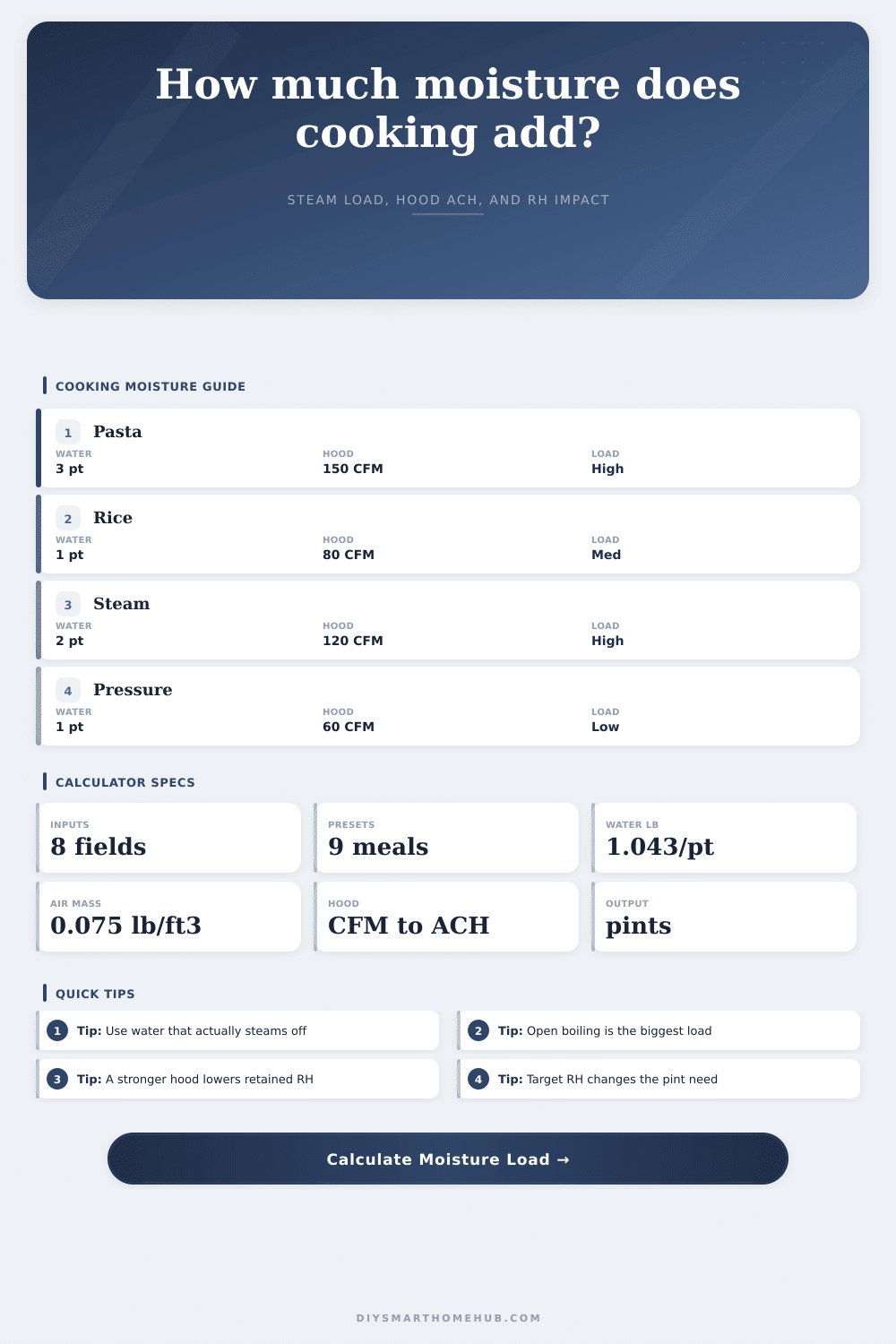
So all you have to do is plug in your cooking time and your room size and let the calculator do the math. You won’t have to deal with conversions, coefficients, or guessing. The first thing it does is figure out how much moisture you’re putting into the air. For example, when you boil three pints of water to cook some pasta, the water is no longer water; it’s vapor. A pint of water weigh roughly 1.043 pounds. So you’re introducing more than three pounds of moisture to the air. That’s quite a payload for an average-sized kitchen.
Why Cooking Adds Moisture to Your Home
The calculator will calculate how many grains of moisture are being added to every pound of dry air based off that number. Grains is used as a unit of measurement in humidity engineering because they don’t change with temperature. Relative humidity (expressed as a percentage) changes with heat, whereas grains don’t.
Your range hood might not be enough. Air needs to move through ventilation systems. Does yours? How many hours did you cooked? What is the cubic feet per minute rating of your hood? Those variables goes into the calculator. And it figures out how many times an hour the air in the room change. Even if your hood has a very high CFM (cubic feet per minute) number on the box, that doesn’t mean anything if the ductwork is long, or if it’s clogged up with grease. You want to know about its delivered airflow, not its rated airflow.
If your hood pulls 150 cubic feet per minute of air, it isn’t catching all of the steam. Some of it gets stuck around the sides; some gets released later. The different methods shown in the reference table release different percentages of their water content into the room. Open boiling lets nearly all of it go; lidded pots keep most of it trapped within. That difference matter when making plans.
And what happens after you stop cooking? Can your house stand the rest of it? To find out, the calculator shows how many pints a dehumidifier has to sucks out to get down to your desired humidity level. Say you begin with a room at 45 percent relative humidity, and then spend an hour cooking; now you’re up to 60 percent. It’s heavy, sticky air. High humidity promote mildew and dust mites. On top of that, if the outdoors is still damp, such as in the spring or fall, that added steam may lead to condensation danger. A few pints of water here and there can make all the difference between feeling comfy and risking some damage.
The second reason many people don’t consider is how large the space is. A tiny enclosed kitchen gets full very quickly. An open concept living space have more air, which reduces the moisture but also spreads the damp throughout the home. Simply opening the windows in the kitchen and not the living room won’t cut it. The rooms mix air and the moisture levels balance out. This is where the volume of the room become important. How much dry air is there to soak up all that steam without raising the relative humidity?
This means moisture exists as weight. Understanding it as weight. Rather than just something you’re thinking about, explains why ventilation alone isn’t sufficient. There’s only so much water air can carry, and that capacity vary by temperature. Hotter air can carries more (until it meets a cold surface like a window, at which point it drops its load). Condensation results, followed by mold.
By understanding the load before it manifests, you can change your behavior. Run the range hood for longer; use lids when cooking; or estimate your load and buy a dehumidifier that matches your cooking habits. It transforms a non-physical issue into a quantifiable one (which is far easier to manage).
You should of used this earlier. And that makes all the difference in maintaining a dry wall and clear air. The steam exists, but now you know precisely where it goes.