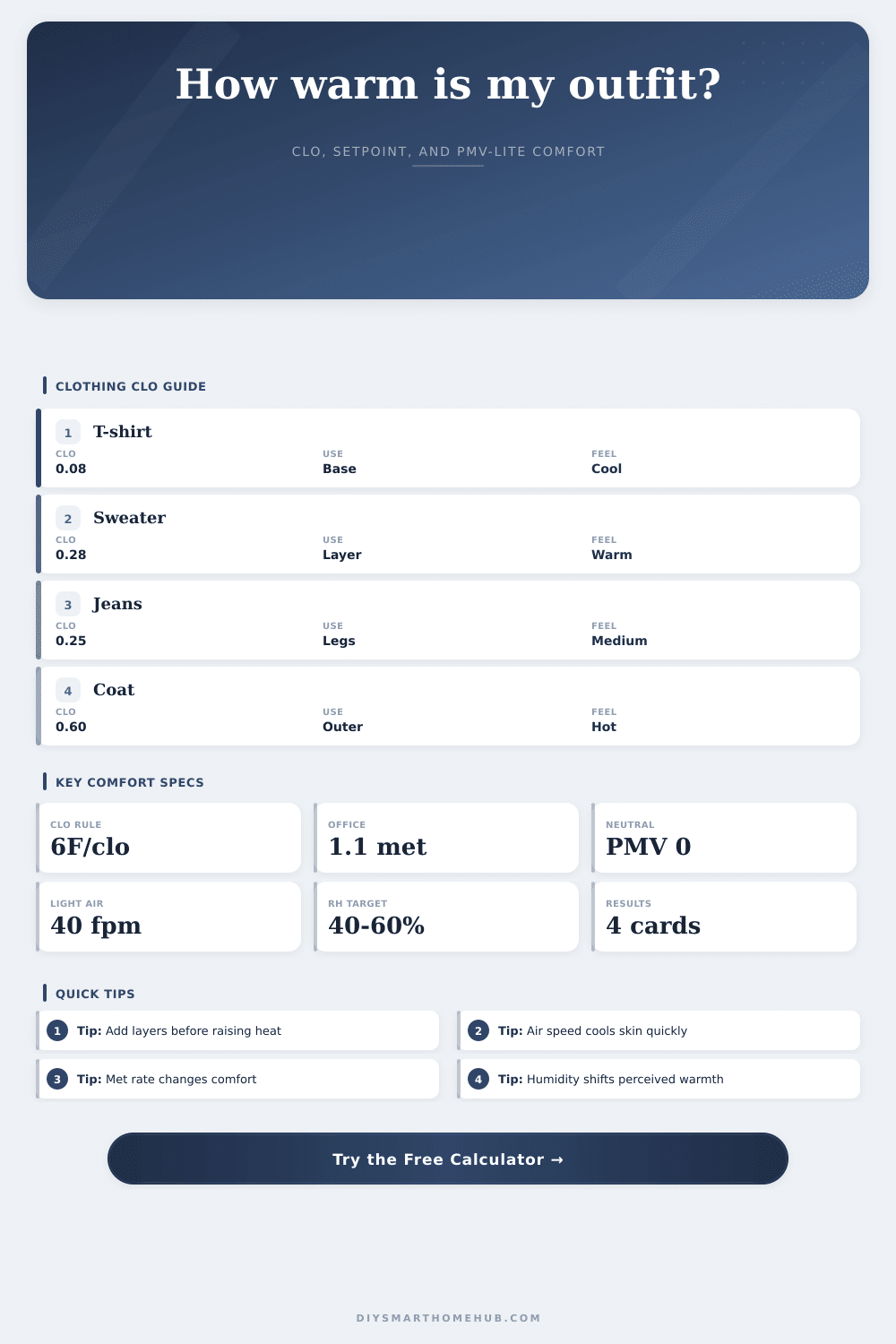
Clothing Insulation Comfort Calculator
Estimate total clothing clo, comfort setpoint offset, activity adjustment, and a PMV-lite comfort score from garments, room conditions, air speed, humidity, target comfort, and season.
| Garment | Typical clo | Warmth band | Best use |
|---|---|---|---|
| Underwear | 0.04-0.06 | Base | Always counted |
| T-shirt or tank | 0.06-0.08 | Light | Summer or workouts |
| Long sleeve shirt | 0.15-0.20 | Moderate | Desk work |
| Sweater | 0.25-0.35 | Warm | Cool rooms |
| Hoodie or fleece | 0.30-0.40 | Warm | Drafty spaces |
| Indoor coat | 0.50-0.70 | Very warm | Cold rooms |
| Shorts | 0.04-0.08 | Light | Warm rooms |
| Jeans or heavy pants | 0.22-0.28 | Moderate | Everyday indoor |
| Socks and slippers | 0.03-0.11 | Foot warmth | Cold floors |
| Factor | Rule used | Warmer effect | Cooler effect |
|---|---|---|---|
| Clothing insulation | About 6°F per 1.0 clo | Add sweater or blanket | Remove outer layer |
| Activity level | About 3.5°F per met above 1.1 | Resting feels cooler | Chores feel warmer |
| Air speed | Fan cooling rises after 40 fpm | Still air | Fan or draft |
| Humidity | High RH adds warmth | 60%+ RH | Dry winter air |
| Radiant surfaces | Mean radiant shift | Sun or warm wall | Cold window |
| Season expectation | Adaptive shift | Winter tolerance | Summer tolerance |
| Scenario | Typical clo | Typical met | Comfort note |
|---|---|---|---|
| Summer living room | 0.35-0.50 | 1.0-1.2 | Needs warmer air |
| Desk work | 0.65-0.85 | 1.0-1.2 | Neutral baseline |
| Winter reading | 0.90-1.20 | 0.8-1.0 | Allows lower heat |
| Cooking or chores | 0.45-0.75 | 1.8-2.4 | Feels warmer fast |
| Workout space | 0.25-0.40 | 3.0-4.0 | Needs cooler air |
| Sleepwear | 0.45-0.75 | 0.7-0.9 | Blankets dominate |
People often think of their comfort as something only reliant on thermostat. Set it to 70 degrees and bam! You’re good to go right? But maybe you’re shivering while your partner sweating.
If it comes down to one thing, the air flowing around you and clothes on your back have everything to do with it. How warm or cool we feel is treated by most as an afterthought when it comes to our clothing. We assume it’s all up to room temperature.
Why You Feel Hot or Cold
Enter your room dimensions into the calculator above along with your outfit and let the calculator do the work for you. Save yourself from having to guess about whether you realy need that sweater on or not. Is it style or function?
One final note: In thermal engineering terms, we measure how well our clothes insulate in celsius degrees per unit of heat flux, which is known as clo. One clo of insulation is roughly equivalent to wearing a basic business suit; zero point three is a t-shirt and shorts.
Here’s the kicker: Activity creates heat within your body. Clothes trap that heat. So when you’re not being active, you require more clothing insulation to maintain warmth. You produce less internal energy than when you are moving around.
For example, if you’re wearing multiple layers to keep yourself warm while sitting still, you’ll likely overheat if you start vacuuming or chopping vegetables. This is because metabolism generate a lot of heat. To address this, the tool allow users to set their activity level, also known as met rate.
Why does this matter? Because if I were sitting on my couch at 70 degrees Fahrenheit, I’d probably get cold. But if I were vacuuming lightly at the exact same temperature, I’d be fine. Nothing about the room changed. Everything change about the human.
There’s another factor that ruins our comfort indoors far more frequently than temperature: Air movement. On a hot day, a gentle breeze is refreshing; but in a cool room when you’re trying to sit still, it becomes annoying. The calculator has an air speed input, which typically is expressed in feet per minute. The wind chill effect.
The reason why we feel warmer with no air movement than with moving air at the same temperature, strips heat from our bodys skin surface. That’s why fans cool us down in summer, yet are best turned off (or aimed out of the room) in winter.
Another factor is humidity, though its influence is subtler. Humid air will make a moderately comfortable temperature feel oppressively warm, as sweat finds it difficult to evaporate. Cool air will feel crisp and cool, even without a drop in the temperature; if the humidity is low.
You’re also skewed by seasonal expectations. You think 72 degrees feels right in January or July, even though these are different seasons. You also consider other things when deciding whether something is too hot or too cold. Humans acclimate to outdoor conditions.
You’ll adjust to warmer inside temps during winter because you recall how cold it is outdoors. In summer, you’ll adjust to cooler inside air since the contrast to outdoor heat make it feel more refreshing. The seasonal adjustment is accounted for on the calculator. It’s a small tweak that reflects real human behavior.
You’ll probably find that your preferred neutral temp in July is actualy several degrees above your desired neutral temperature in January. That’s why the adaptive comfort model is more realistic than a static setpoint.
How does it work? First, you pick out what clothes you’re wearing. The website will give each piece of clothing a number called a clo value. For example, a hoodie insulates better then a t-shirt, and a pair of jeans insulates better than a pair of shorts. Then it adds up all of those numbers and takes into account how much your clothes may be overlapping (tighter clothes don’t let as much air in between them as loose clothes do). Finally, it uses your total insulation to calculate a comfort score based off the air speed, activity level, and room temperature.
Depending on this score, there are two options: either turn up the heat, or wear some socks. Turning up the heat warms the whole house, while wearing socks just warms yourself. In most cases, one of those solutions is far more efficient than the other.
At the bottom of the page was a reference table of typical clo values for different clothes. This is good because it will teach you that a thick sweater will be much more insulating than a light dress. But you shouldn’t of to memorize them. You just need to know that each layer counts, and that this adds up.
People often make the mistake of clothing themselves based off what the average temperature during the day should be instead of the microclimate within their particular room. A room with cold windows will feel cooler. A room with sunlight will feel warmer then a room in shade. The radiant adjustments let you account for those surface temperature variations.
Ultimately, being thermally comfortable is a matter of balancing heat gain with heat loss. How much heat does your body make? And how quickly do your surroundings and clothing let it escape? If these two figures equal each other, then you’re comfy. But if not, you’re chilly or sweaty.
The brute force method is adjusting the thermostat. The fine tuning option is adjusting your wardrobe. This one’s instant gratification, and free.
Next time you go to click the thermostat up or down, stop for half a second. Look at what you have on. Look around the room. Maybe you’ll realize that rather than changing the thing in the wall, you just need to pull something out of your dresser. That mental switch makes comfort less about fending off Mother Nature and more about creating a personal space.