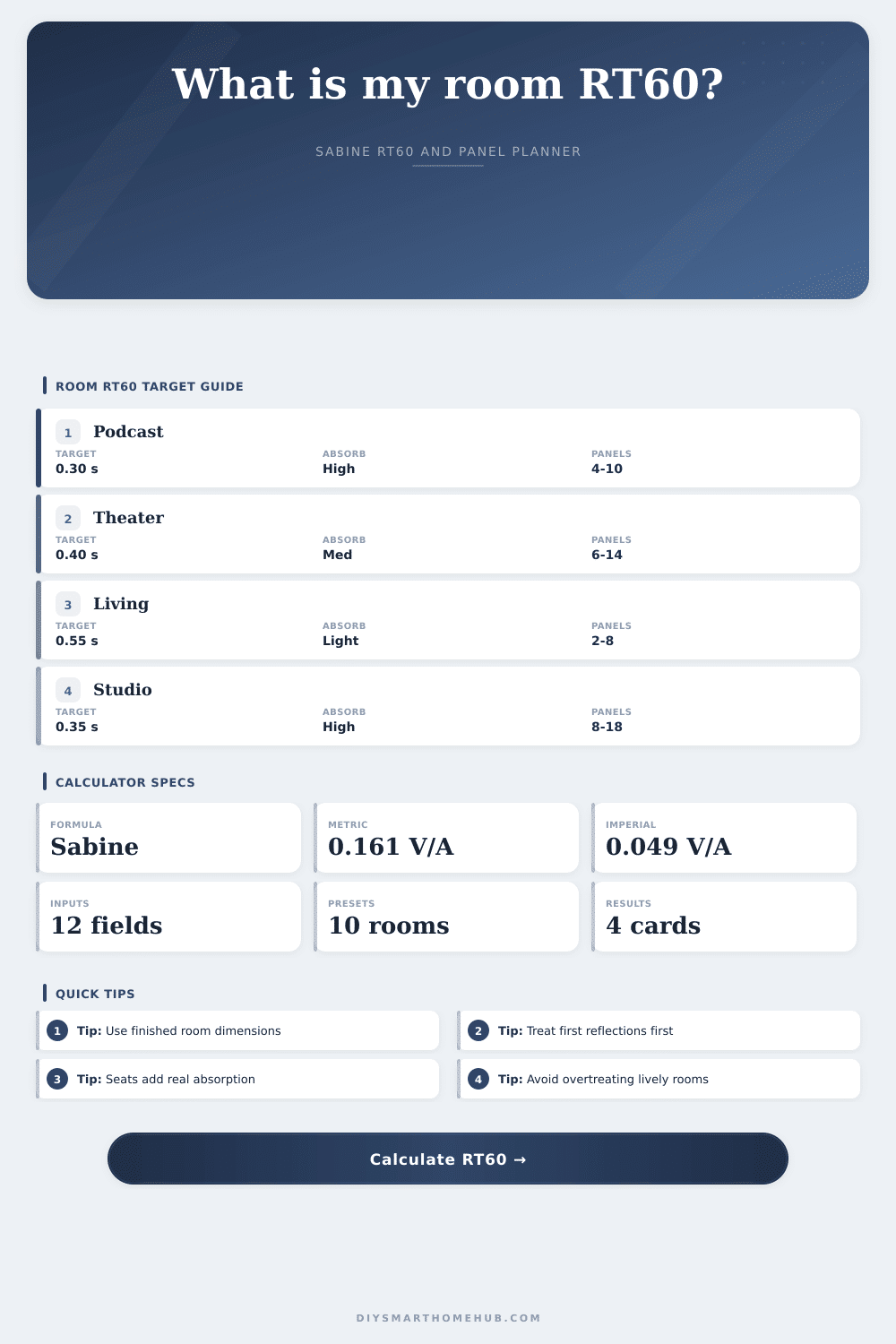
Reverberation Time Calculator
Estimate RT60 with the Sabine formula, total room absorption from surface area times coefficient, the target absorption gap, and the number of acoustic panels needed.
| Surface or finish | Coefficient | Formula use | Planning note |
|---|---|---|---|
| Painted concrete | 0.02 | Area x 0.02 | Very reflective floor or wall finish. |
| Painted drywall | 0.03 | Area x 0.03 | Common baseline for finished rooms. |
| Hardwood or vinyl | 0.06 | Area x 0.06 | Slightly more absorbent than concrete. |
| Carpet with pad | 0.45 | Area x 0.45 | Strong high-frequency floor absorption. |
| Heavy curtain | 0.55 | Area x 0.55 | Works best with folds and air gap. |
| Acoustic tile | 0.70 | Area x 0.70 | Useful for speech rooms and offices. |
| Wall panel | 0.85 | Area x 0.85 | Typical broadband panel assumption. |
| Room type | Typical target | Texture goal | Calculator approach |
|---|---|---|---|
| Podcast or voice booth | 0.20 to 0.35 s | Dry speech | Use a low target and high panel coefficient. |
| Home theater | 0.30 to 0.50 s | Controlled clarity | Balance wall panels with some liveliness. |
| Living room | 0.45 to 0.70 s | Natural comfort | Count furniture, rugs, and curtains. |
| Music practice room | 0.35 to 0.70 s | Controlled but alive | Set target by instrument and room size. |
| Classroom | 0.40 to 0.60 s | Speech clarity | Ceiling tile and rear-wall absorption help. |
| Gym or hall | 0.80 to 1.40 s | Reduced echo | Large surface areas need many sabins. |
| Panel type | Area each | Coefficient | Absorption each |
|---|---|---|---|
| 2 x 2 ft panel | 4 sq ft | 0.80 | 3.2 sabins |
| 2 x 4 ft panel | 8 sq ft | 0.85 | 6.8 sabins |
| 4 x 4 ft cloud | 16 sq ft | 0.90 | 14.4 sabins |
| Deep broadband panel | 8 sq ft | 1.00 | 8.0 sabins |
| Folded curtain area | 20 sq ft | 0.55 | 11.0 sabins |
Too much volume? Most people believe this makes a room sound bad. That is not usualy true.
It is actualy simple: it sounds bad because you cannot make the noise stop! Sound energy collides with hard surfaces, bouncing off them until it dies away. It leaves behind a muddied trail of sound that dulls music and smothers speech. That hanging decay is what we call reverberation time.
How to Stop Echoes in Your Room
Fixing this are never about spending money on fancy equipment. It’s more about the materials and the geometry in the space. This goes back to the work of Wallace Clement Sabine who discovered that volume and absorption works in tandem. If you look at his formula he proves that the larger the room, the greater amount of absorption required to kill the echo.
A small closet will die out fast as it doesn’t have anywhere to go. A gymnasium will keep the noise alive because of its large amount of air and concrete surface.
Once you know the dimensions of your room, the calculator do all the math for you. This would of been the finished inside dimension, not the framing size. Why? Because sound waves travel through the air space.
That’s when most homeowners trip up: picking a target time. Typically podcasts aim for a dead sound (around 0.3 seconds), while living rooms wants some life (around 0.5 to 0.7 seconds). Make a living room too dead and it’ll be like talking on an elevator; make a podcast room too live and your voice swim in reflections.
That’s what the tool connects. It illustrates the gap between your comfort level and what you’re hearing today. And then it computes the absorption gap in sabins.
What’s that? A sabin is simply a unit of sound absorption. The answer lies on the materials used. Painted drywall is like a mirror. It bounces back virtually all sound that hits it. A bit of help comes with carpet, but just on the surface where it’s installed. Wall panels and ceiling clouds really does the heavy lifting here. And that’s clear if you look at the reference table on the page.
This tells us that even a basic broadband panel can absorbs more than.85 of the sound striking its surface. That’s much, much better different than what you’d see from plaster. Panels requires fewer sabins than rugs.
Don’t slap them up willy nilly. “Sound goes in a straight line.” Deal with the first reflection points. Where’s the path from speaker-to-ear with the shortest distance between two adult-sized sofa? That’s a spot where sound bounces off of something else… into your ear again.
This creates a metallic ringing called flutter echo which kill clarity. Absorption here eliminate the problem at its source.
Size and efficiency determines how many panels I need. That’s what the calculator says. Consider it a planning figure rather then a hard-and-fast law. Budget + aesthetics will probably influence your changes.
It’s easy to go overboard: Dead rooms fatigue us as they don’t sound naturaly. Human hearing expects something back. If you absorb all frequencies equally, it can sound hollow. You want to find the right blend of life, but also balance. Instruments need to sound alive in a music practice room. Dialogue needs to stay clear in a home theater.
Those varying requirements is addressed by the presets in the tool. They fill in sensible default values so you can start from there instead of guessing at the baseline before making adjustments.
How much else do you have? There are sofas, heavy curtains, and bookshelves. These are all absorber surfaces! Add this additional surface area plus the matching coefficient into the calculator. This takes into account that your furnitures is helping absorb sound.
If you don’t add this additional surface area, you’ll over-buy panels and end up wasting money. What’s there? Measure it. Add it in. Let the tool tell you what’s still needed.
This stops guessing and starts fixing the real issue. The room will now sound as good as it looks. Not too little or too much, just the right amount of control and space.