DIYSmartHomeHub acoustic treatment planner
Bass Trap Count Calculator
Estimate how many bass traps a room needs from axial room modes, modal problem zones, usable corner height, absorber face area, panel size, and target low-frequency decay improvement.
Recommended traps
0
panels / modules
Corner coverage
0%
of usable height
Absorber face area
0%
of wall surface
Decay improvement
0%
estimated low bass reduction
Status: Enter room and panel details to calculate a bass trap plan.
Calculation breakdown
Length modes
Calculate to see length mode pressure zones and clusters.
Width modes
Calculate to see side-wall modal concentration.
Height modes
Calculate to see floor-ceiling modal pressure.
Axial modes are estimated for length, width, and height dimensions.
Bass trap face area is compared with total wall and ceiling boundary area.
Vertical corners usually give the strongest pressure-zone coverage per panel.
Thicker traps and air gaps improve usefulness around longer wavelengths.
Axial mode examples
| Dimension | 1st mode | 2nd mode | Pressure zones |
|---|---|---|---|
| 10 ft | 56.5 Hz | 113 Hz | Opposite walls |
| 12 ft | 47.1 Hz | 94.2 Hz | Opposite walls |
| 16 ft | 35.3 Hz | 70.6 Hz | Opposite walls |
| 20 ft | 28.3 Hz | 56.5 Hz | Opposite walls |
Trap depth guide
| Type | Depth | Low use | Best placement |
|---|---|---|---|
| Panel | 4 in | 125 Hz up | Reflection plus corner |
| Deep panel | 6 in | 90 Hz up | Vertical corners |
| Gap panel | 6 + 4 in | 70 Hz up | Corners with space |
| Superchunk | 12 in | 50 Hz up | Full-height corners |
Face area targets
| Use | Light | Balanced | Heavy |
|---|---|---|---|
| Living room | 6% | 10% | 15% |
| Podcast room | 8% | 14% | 20% |
| Mix room | 12% | 18% | 25% |
| Theater | 10% | 16% | 24% |
Common trap modules
| Module | Face area | Stack count | Coverage note |
|---|---|---|---|
| 24 x 24 in | 4 sq ft | 3-4 high | Flexible blocks |
| 24 x 48 in | 8 sq ft | 2 high | Common panel |
| 24 x 60 in | 10 sq ft | 1-2 high | Tall module |
| 36 x 48 in | 12 sq ft | 2 high | Wide corner face |
Bass traps is sort of like wallpaper for most folks. They purchase some, hang ‘em where they appear pretty and ask themselves why their low end are all mucky-muck.
That’s because unlike light, low frequency sound acts more like water. It puddles up in corners and comes down the road in long waves that does not take well to thin sheets of foam. Decor doesn’t solve an echoey room. Only physics will work, specifically the kind of physics that calculates exactly how many trap are needed to change the decay time.
How to Use Bass Traps Correctly
Once you input your room dimensions along with the specs for panels, the calculator do all that math for you (above). You won’t have to guess how much corner coverage or how many axial mode there are. But knowing what you put into it matters as well.
The very first parameter to understand is speed of sound. I know, it seems silly. Sound travels faster at warmer temperatures. So if you’re in a warm studio versus a cold basement, the speed of sound will be different than, affecting the resonant frequency of the room. If you don’t get this one correct, the mode clusters the tool reports back won’t match what actualy happens in your room.
Every room has room modes, which are natural frequencies at which the box vibrates. Modal clustering happen when the length, width, and height of a room generate frequencies that comes out near each other. You end up with those rooms that have certain spots that sound boomy because a single note just hangs there seemingly forever.
That’s what the tool does. It identifies dimensions of your room and finds problem zones. Where is the pressure building up? If your room is close to square or even square, the modes are going to overlap like crazy. The resulting acoustical problems is exponentially more difficult to fix. That’s why the calculator shows the modal zone meters as having higher density when that’s the case. Knowing early on you have a problematic room shape helps you avoid buying traps that wouldn’t of able to help because they’re not fixing the underlying geometry issue.
The second part of the equation is placement. Bass traps work best in corners because that is where sound pressure from multiple wall combines. That’s how sound pressure from two or more walls combines. Corner bass traps does twice the work as a flat wall bass trap.
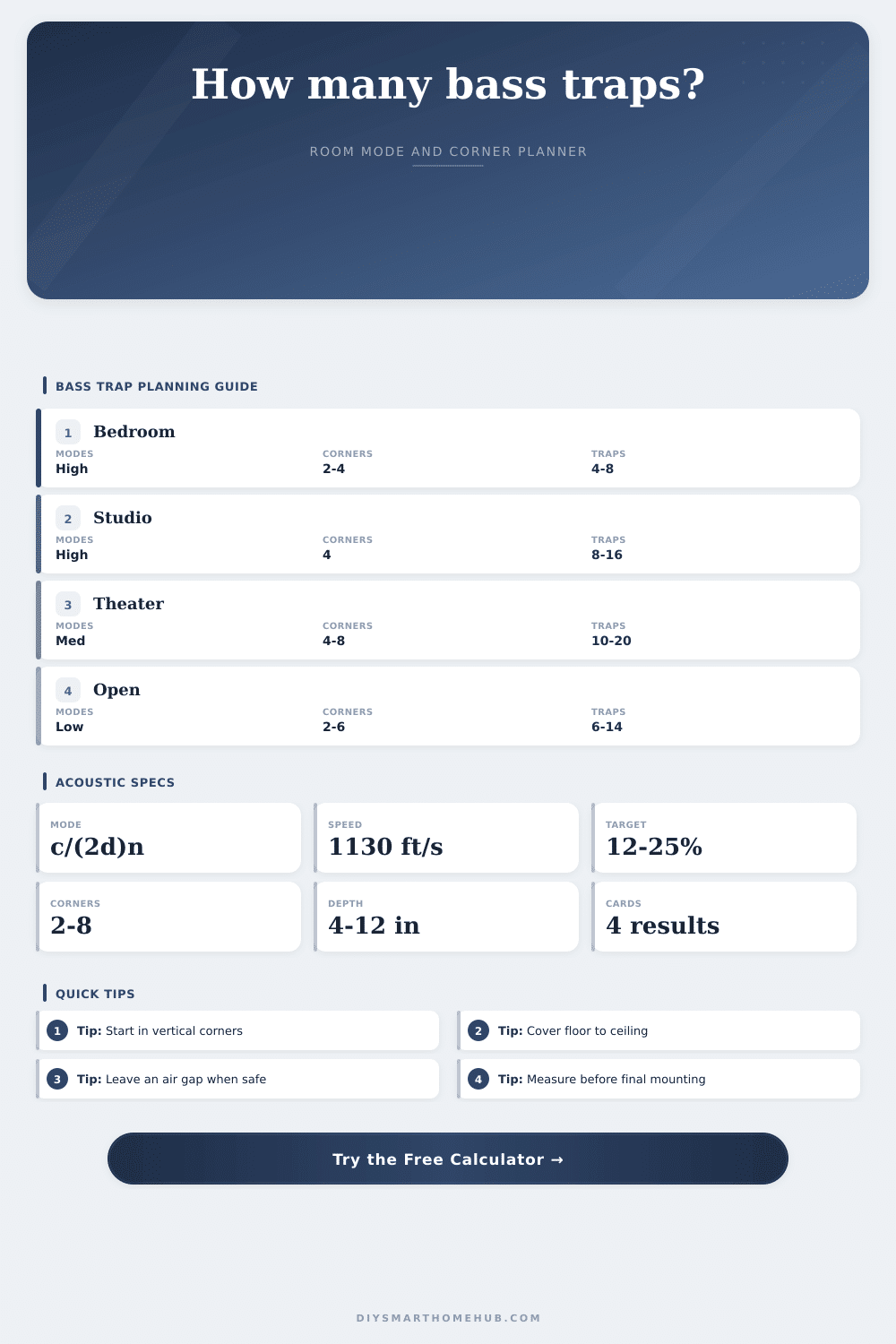
To get you a realistic count the tool factor in panel dimensions and usable corner height. It doesn’t just count panels. It calculates actual absorber face area relative to total wall surface. This ratio is what changes the sound. Most rooms require somewhere between ten and twenty percent of their surface area covered to notice a significant change in bass decay time. If you use less than that, you are mostly spending money on a placebo effect. If you cover more then that, you might over-treat the room and make it sound dead and lifeless.
Why depth matters for bass traps
Depth is far more important than most think. If we’re talking about midrange reflections, a two inch panel will work. But at a forty-hertz bass tone? It’s as if they don’t even see it. The wavelengths are simply too long. You require either depth or mass to capture that sound.
Air gaps and thickness of traps can be manipulated with the tool. Creating an air space behind a panel essentially creates more acoustic depth. That fools the sound wave into believing the absorber is larger in depth than what actualy exists. It improves performance while being inexpensive. It’s a cheap way to boost performance without building twelve-inch thick walls.
The reference tables on the page clearly lay out this connection between depth and lowest usable frequency. So, don’t try to fill all the corners in one go. Work your way out from the closest ones including the main listening position. Add something. See how it changes. Do it again. And again. If necessary.
There’s no absolute right answer here. This is acoustic treatment, not an exact science. It’s about balance. You want to control the bass without erasing it. You want to tighten things up without taking away the magic.
The tool above will help you develop a plan for how to do this. The problem many people make is treating one frequency too much and others not enough. It helps you create a room that is accurate sounding rather than quiet sounding. You want to create a room where the music breathes freely.
That’s what most folks miss. They think they need to chase down silence. When really, they should be chasing clarity. Begin with the corners, follow the math, and listen to how it sounds as you go.