Pool Chemical Dose Calculator
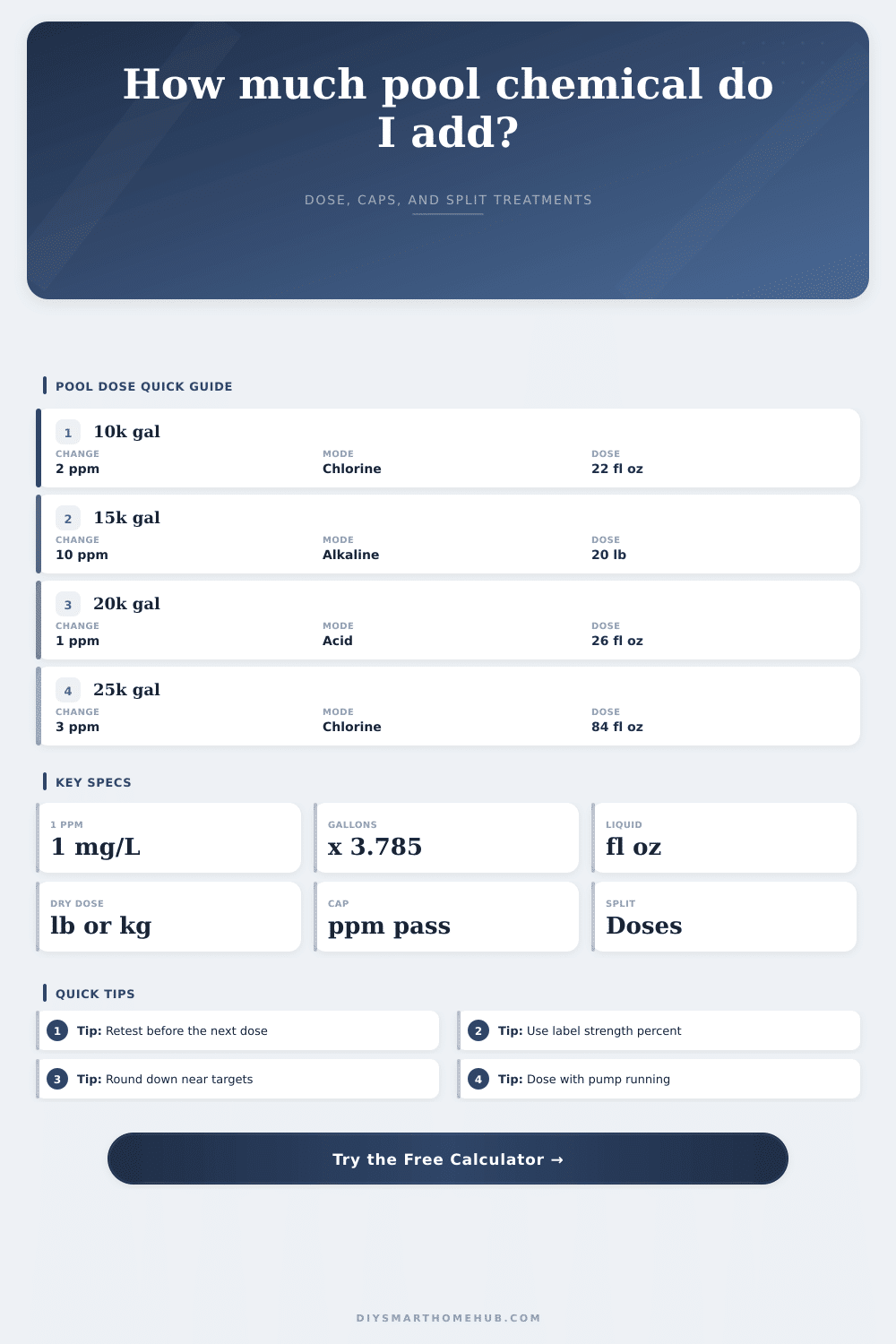
Estimate liquid chlorine, acid, or alkalinity increaser dose from pool volume, current and target ppm, product strength, treatment cap, and split-dose spacing.
🧪 Dose presetsChoose a common pool adjustment and recalculate instantly
📝 Pool and chemical inputs6 core values plus safety and spacing controls
Dose result
Enter the pool and chemical values, then calculate.
⚙️ Selected mode specsReference factors used in the calculation engine
📊 Comparison gridHow dose behavior changes by chemical mode
Best modeled as active chlorine mass added to water. Higher strength reduces the volume of product needed.
Acid response depends on alkalinity and pH buffering, so the cap is intentionally conservative and split dosing matters.
Uses a sodium-bicarbonate equivalent factor so ppm change converts into a practical dry chemical weight.
📘 Reference tablesPlanning ranges and formulas used by this calculator
Mode defaults
| Mode | Strength | Density | Cap |
|---|---|---|---|
| Liquid chlorine | 10% | 1.16 kg/L | 3 ppm |
| Liquid acid | 31.45% | 1.16 kg/L | 1 ppm |
| Alkalinity increaser | 100% | 1.68 factor | 10 ppm |
| Low-strength liquid | 6% | 1.08 kg/L | 2 ppm |
PPM mass conversion
| Pool size | Liters | 1 ppm mass | 10 ppm mass |
|---|---|---|---|
| 5,000 gal | 18,927 L | 18.9 g | 189 g |
| 10,000 gal | 37,854 L | 37.9 g | 379 g |
| 15,000 gal | 56,781 L | 56.8 g | 568 g |
| 25,000 gal | 94,635 L | 94.6 g | 946 g |
Treatment cap examples
| Need | Cap | Passes | Reason |
|---|---|---|---|
| 2 ppm | 3 ppm | 1 | Within cap |
| 5 ppm | 3 ppm | 2 | Split dose |
| 18 ppm | 10 ppm | 2 | Retest |
| 32 ppm | 10 ppm | 4 | Staged |
Common scenario checks
| Scenario | Volume | Adjustment | Output focus |
|---|---|---|---|
| Weekly chlorine | 12k gal | 2 ppm | Fluid ounces |
| After party | 18k gal | 5 ppm | Split passes |
| pH trim | 15k gal | 1 ppm | Small acid dose |
| TA raise | 20k gal | 20 ppm | Dry weight |
💡 Dose tipsTwo practical checks before applying the result
The water in your pool appears clear, yet it stinks of chemicals. New pool owners frequently make this error. They treat the water because of how it feels instead of using the test number. When you guess at the dosage, you’ll pay more, harm your filter, and possibly cloud the water.
The calculator eliminates guesswork by telling you exactly how much to add based off the desired rise and pool volume. The pool volume is shown below. This is where most people stop. This is the first number.
How to Balance Your Pool Chemicals Correctly
The second thing to know is that your pool’s capacity will not be the same as manufacturers’ stated volume. Filling the pool from the garden hose will give you an estimate of the true volume. Filling the pool from the city connection will probably overestimate the volume. Over-estimating = under-dosing (feels like nothing is happening). Under-estimating leads to overdosing, which causes high chlorine and low pH. Get the volume correct, everything else hinges on it.
Then calculate the increase in parts per million. That’s the delta (the difference) between your existing reading and target. Let’s say it’s now 1.0 and your goal is 3.0. So you need to add 2 ppm. How much? It depends on product strength. Pure shock needs less than a 10 percent chlorine solution. A 10 percent chlorine solution requires ten times the volume of a pure shock treatment. The calculator will do that math for you, if you input the percentage on label.
But you should still read the label. Chlorine does weaken over time. And a jug left sitting out in the sun for a couple of months isn’t what the label claims. The dose won’t be enough and it would of been better to check.
Careful with acids. Liquid acid neutralizes alkalinity. If you put all your acid in at one time that can cause a rapid pH change. So how does it do this? Chemistry. The safety limit in the calculator splits big changes into smaller changes. Why? Putting too much acid in too rapidly will reduce the pH too far. Too low a pH can be harmful to metal and even damage plaster. You don’t want pH to crash; you want it to simply drop. Splitting the dose forces you to stop and test again. How else would you know what’s going on in there?
Alkalinity buffers pH levels. When there isn’t enough alkalinity, pH fluctuates quickly when swimmers use pool or it rains. When there is too much alkalinity, pH won’t change even if you add acid. Raise alkalinity by adding powdered dry sodium bicarbonate. For best results, you need to dissolve this chemical in a bucket of water before applying. Never just dump a pile of dry into your pool. That will create white spots on your pool floor.
How much? The calculator tells you the amount in kg or lbs. It doesn’t say HOW to add it. But impatience is the cause of most mistakes. The chemical was added, but there was no effect. Adding more does nothing. Why is that? Time for mixing. Running the pump will help.
Chlorine can be burned away by the sun. If you test immediately after dosing, you’ll see a high concentration but it’s in a localized area. Let the water circulate so it mixes. The reference table shows typical situations. How does the dose behave based on the type of chemical? Do you think you have the correct dosage method? Use the table to verify that assumption.
Adding the right amount at the right time is chemistry. It protects equipment and saves money. You spend less time testing. Treat the water so it stays clear without being harsh, keeping the numbers accurate equals a balanced pool. It naturaly helps too. The moddern way is better than old ways.