Ice Maker Daily Output Calculator
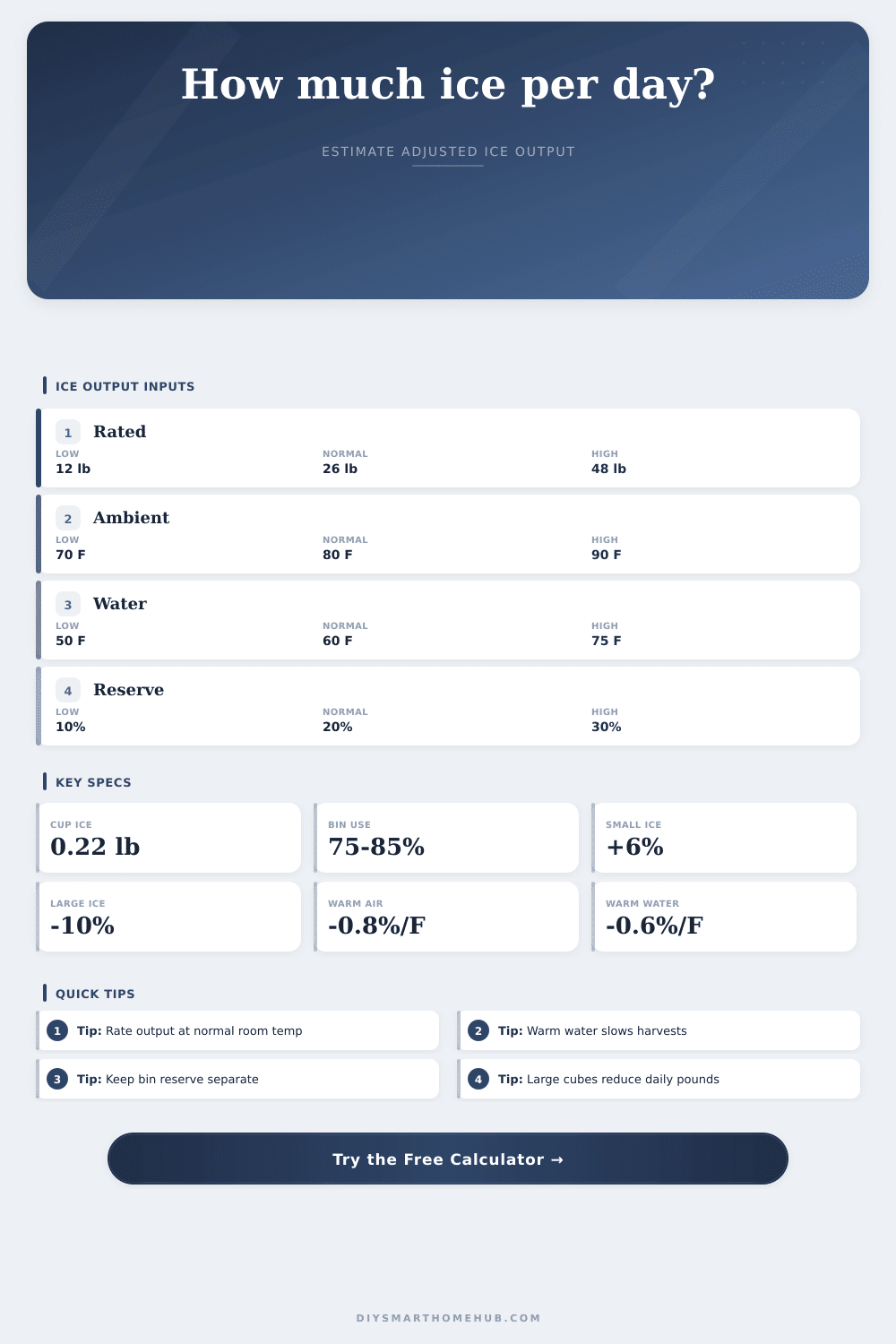
Estimate real daily ice production from rated output, room temperature, inlet water temperature, bin capacity, cube size, harvest cycle time, drink demand, and refill reserve.
Daily Ice Output Results
Calculation Breakdown
| Condition | Reference point | Daily output effect | Calculator use |
|---|---|---|---|
| Cool room air | 65-70°F | 0% to +2% | Near rated production |
| Warm kitchen air | 80°F | About -8% | Common countertop adjustment |
| Hot garage air | 90°F | About -16% | Use for summer alcoves |
| Warm inlet water | 70°F | About -12% | Adds to air derate |
| Ice style | Output factor | Approx drink load | Best calculation use |
|---|---|---|---|
| Small bullet | 1.06 | 0.20 lb/drink | Fast casual drinks |
| Standard cube | 1.00 | 0.22 lb/drink | Rated comparison |
| Large cube | 0.90 | 0.26 lb/drink | Slower dense cubes |
| Clear cube | 0.82 | 0.28 lb/drink | Bar-style ice planning |
| Scenario | Drinks per day | Ice demand | Output target |
|---|---|---|---|
| Two-person kitchen | 8-14 drinks | 1.8-3.1 lb | 10+ lb/day |
| Family kitchen | 16-28 drinks | 3.5-6.2 lb | 20+ lb/day |
| Office breakroom | 40-80 drinks | 8.8-17.6 lb | 35+ lb/day |
| Party cooler fill | 90+ drinks | 20+ lb | 50+ lb/day |
| Bin size | Reserve at 20% | Usable draw | Planning note |
|---|---|---|---|
| 1.5 lb compact | 0.3 lb | 1.2 lb | Small bursts only |
| 2.5 lb countertop | 0.5 lb | 2.0 lb | Refills often |
| 6 lb under-counter | 1.2 lb | 4.8 lb | Good event buffer |
| 25 lb commercial | 5.0 lb | 20.0 lb | Bulk service bin |
At first glance, ice seems like such an easy-to-get item. Until you actualy need some. Suddenly ice are the single most important thing in home.
Ice maker specs from manufacturers is generally quite rosy, based off ideal circumstances which are never realy encountered in anyone’s kitchen. Buy one rated for twenty-pounds-a-day, and discover instead you can barely keep up with summer cookout. Almost always the difference between spec and your own life will center around one word: Heat. More specifically, it is the amount of heat your appliance have to deals with to create ice in your particular climate. This calculator on this page fills that gap.
Why Ice Makers Make Less Ice Than You Think
First of all, we take the rated output, which is an ideal rating at room temperature, and subtract out the penalties imposed by real world. These include ambient room temperature and the heat of inlet water. Why does this matter? Ice makers are basically refrigerators with their cooling effect dumped into a bin. The hotter your room temperature, the harder they has to work. The warmer the incoming water, the slower they will freeze it. Both is compounding factors.
An ice maker that has trouble in a ninety degree garage is not broken. It’s simply performing as physics said it would. You just want to know how much you should of expect from it. Consider the environment of your machine. Are your refrigerator condensers under the counter in your kitchen? That’s a heat-trapping alcove. Stifling hot air doesn’t do great things for circulation, and even small increases in surrounding temp can reduce daily output by 10 percent or more.
Likewise, water temperature is important. Summer city water may be warmer then you think. Every degree above standard test conditions will add a little more wait time each day during every harvest cycle. Day after day those delays accumulate. Plug your local conditions into the calculator above and it will do the math for you (so that you don’t have to guess what portion of your capacity is being lost to the weather).
One other variable that trips folks up is cube size. Big, clear cubes look great in drinks, but they take far longer to make than normal sized cubes or even little nuggets. The same machine produce many more pounds per day when it churns out tiny pellets than when it makes big ol’ blocks. It’s a matter of quality vs quantity. Want to have a party? Smaller ice = volume wins the day. Are you making neat spirits? You’re cool with the slow down on production. This style gets included in calculator so you can realy know how much your desired format weighs.
Reserve space in the bin. You can bet your bottom dollar that if you run a bin down to zero, you’re going to be disappointed. It will take a while for machine to restart and build up a supply. By reserving 20 percent in the storage bin, you have a buffer when someone wants an iced drink, and then another, and another; all within the same few minutes. This reserve is a form of insurance against the built-in delay between production cycles. It protects you from running out of ice whenever there’s a brief surge in demand. (The tool comes with a handy reference table to help visualize exactly how much usable ice you have, versus how much you’ve got just sitting there.)
The overall pounds per day has become everyone’s go-to stat for comparison, which is fine… But it’s just one part of the equation. How quickly does the bin refill when dipped? And what kind of volume will that support in drinks? Those figure are where you’ll get a more accurat picture of whether or not a unit will work for you. For instance: On paper a tiny countertop unit may look like it’s going to do the job, but if it takes hours to fill back up, well… it won’t be able to keep up at crunch time. This breakdown helps put it all into practical perspective by showing how many drink are supported and the required harvest cycle.
A high-rated ice maker isn’t always the best choice; sometimes it’s choosing an ice maker that’s right for your conditions. That headline number gets chipped away by heat, water temp, and cube style. Anticipating those variables ahead of time helps you avoid running out of ice. It eliminates the guesswork and replaces it with planning. You will need more ice, but you will also have peace of mind knowing your system work when you need it. In the end, that is what keeping cool is all about.