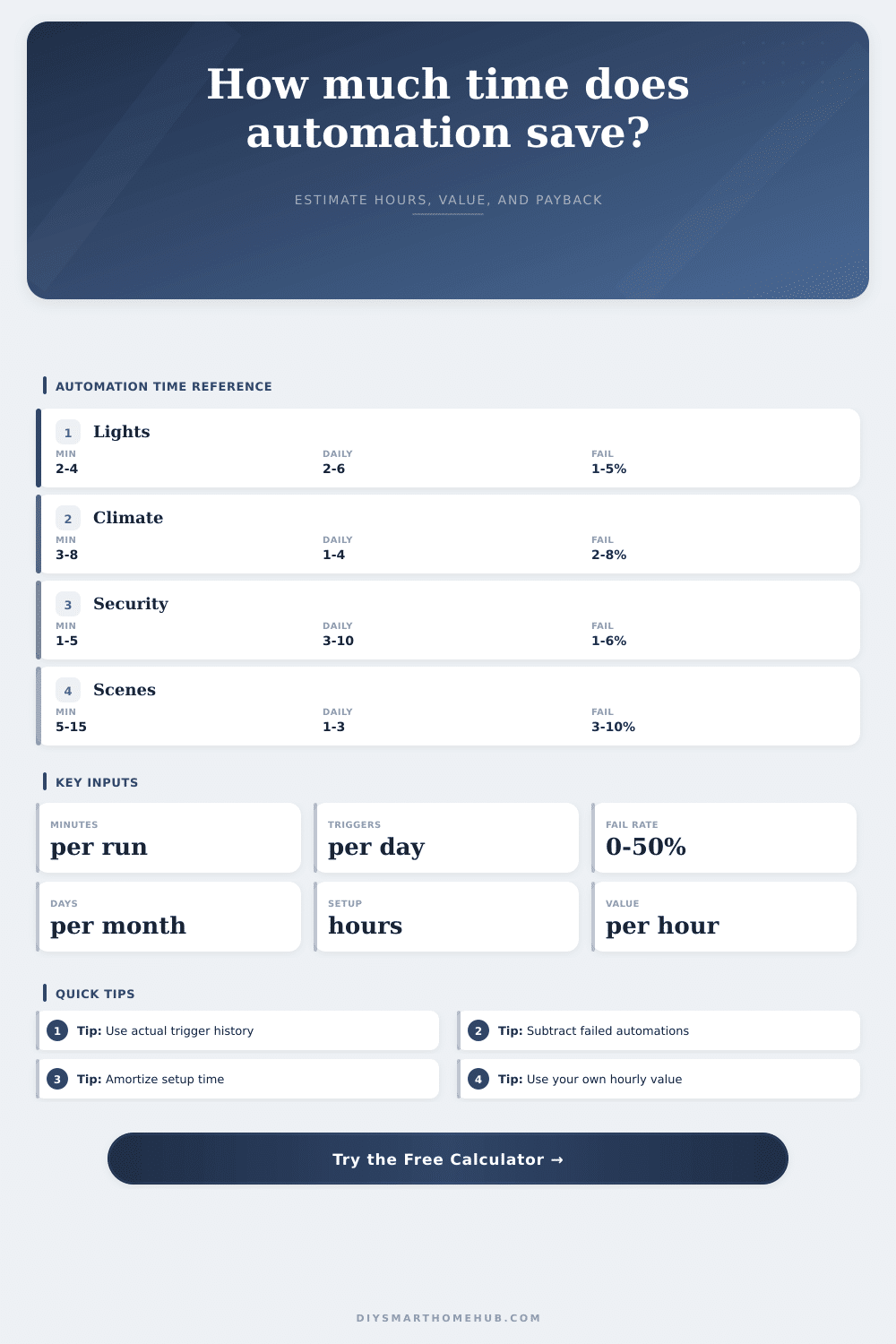
Time Saved by Automation Value Calculator
Estimate the monthly and annual value of a smart-home automation from minutes saved per trigger, trigger frequency, failed-run rate, setup time, days used, and your own hourly time value.
| Automation | Common trigger | Input to measure | Watch item |
|---|---|---|---|
| Morning or bedtime scene | 1-2 times daily | Manual steps avoided | Skipped days |
| Away and arrival mode | Presence event | Checks bundled | False presence |
| Security status check | Doors or schedule | Minutes per check | Sensor misses |
| Appliance notification | Cycle complete | Repeat checks avoided | Ignored alerts |
| Cleaning or watering | Schedule or sensor | Start and follow-up time | Maintenance runs |
| Step | Formula | Output | Purpose |
|---|---|---|---|
| Useful triggers | triggers x days x success rate | runs/month | Removes failed runs |
| Gross time | runs x minutes / 60 | hours/month | Converts saved minutes |
| Setup debit | setup hours / months | hours/month | Amortizes build time |
| Net time | gross hours - debit | hours/month | Shows practical savings |
| Payback | setup amount / monthly value | months | Compares amount to value |
| Pattern | Triggers/day | Days/month | Notes |
|---|---|---|---|
| Daily routine | 1-3 | 28-31 | Stable household habit |
| Workday only | 1-4 | 20-23 | Weekday presence rule |
| Sensor driven | 3-20 | 25-31 | Door, motion, or load event |
| Seasonal | 1-8 | 8-25 | Irrigation or heat routine |
| Occasional | 0.2-1 | 4-12 | Guest or travel scene |
| Payback | Readout | Best fit | Check |
|---|---|---|---|
| 0-3 months | Fast | Frequent routine | Confirm reliability |
| 3-12 months | Moderate | Daily convenience | Review setup amount |
| 12-24 months | Long | Low-touch comfort | Trim failure rate |
| 24+ months | Slow | Preference-driven | Use non-time benefits |
| No payback | Negative | Not time-led | Reduce setup time |
I mean, I’m sure you started simple. Lights? You probably wanted the living room to go dark as you curled up on the couch for a movie, or the hall to light up when you walked into the house. That was a nice little win.
Next you add climate control and then you add security checks. And then you set a routine where all your plug turn off and doors lock while you’re at work. Soon enough you’ve got yourself a system.
How Smart Homes Save You Time
Only now you need to ask: does this system pay you back in time? Or it simply become another thing to manage?
People view automation as a cost. You might spend a few dollars here and there on the price of a hub or an app subscription, plus some hours spent debugging and rewiring. Rarely do they view it as a savings engine. And that’s a missed opportunity. Because time is your one resource you cannot buy more of.
Three hours a week back from your smart home? That is real wealth. The calculator above will run the numbers for you, translating your specific routine into a clear monthly value. But it requires thinking about inputs in a way different than how you think about them at the store; and that’s where the value lies.
So begin with those minutes saved per trigger. Most people fails here when estimating. They believe that shutting a light off will take five seconds. It does. Except do you walk over there? Do you turn the thermostats down twice because you don’t remember whether or not you turned them on? Do you wait in the kitchen for your laundry to be done because you didn’t get an alert? Those are frictions, the automation eliminates frictions.
Save two minutes at departure from home automatically by switching your lights and locking your door. That compounds fast. After you input how frequently this happens, the calculator will handle the compounding for you.
The second lever is frequency. A sensor-driven rule triggering ten times a day is better then it triggering once a day, and even better is a single fixed trigger for your daily routine. This is illustrated in the reference table on the page. It shows that trigger volume make the difference.
A morning scene is a fixed habit. Your variable one might be “check security when someone comes to the door,” which involves door sensors. Your variable system save you more time, but it’s also more prone to breaking. Which is why run failures matter so much.
But suppose 10% of the time, it doesn’t go off. Now you are doing the work manually for that 10%. And maybe it happened twice, because you didn’t trust the thing and checked. You can subtract out those failures. Go ahead and be honest about it. Put in a big fail if your motion sensors are crappy. It’ll make it look lower overall, but it won’t be inaccurate at all.
There’s no point to having a perfect automation that doesn’t save you any time because you never use it. But there is value in an automation that works well enough times to save you two minutes each time.
The tax you pay upfront is setup time. It’s work building a complicated routine. It’s work testing it out. If your entire home stack took you five hours to set up, you have to spread that out as well. It has spread across twelve months and now you’re paying forty minutes of setup debt per month. Your automation doesn’t save thirty minutes per month. You lose time instead of saving it.
That’s the key tradeoff. Upfront complexity cost you time. Simplicity pays off faster.
But then put in an hourly figure that makes sense for you. For a CEO, two minutes is costly. But two minutes is free if you’re retired and like tinkering with stuff. Don’t plug in your salary from your job unless your time has a different value for you.
Do you want to see what the break-even point is? Then when you do, will you decide it was worth the hassle?
That is the genius of it… By doing that, you measure convenience. Smart homes are really time management tools. That’s how they actualy pay you back. It makes you think about your home that way and suddenly you’re not shopping for cool-looking gadgets anymore. You’re creating a routine that does the work. You stop focusing on features and instead worry about reliability.
Automation takes away repetition. The bottom line: the best automation is the kind you don’t remember being automated. It runs silently in the background, returning minutes to your day that you’d spent fiddling, checking and locking.
Minutes add up. Hours add up. They turn into value. It’s a simple equation. But it is a deep insight. You’re not purchasing technology. You’re purchasing your time back.