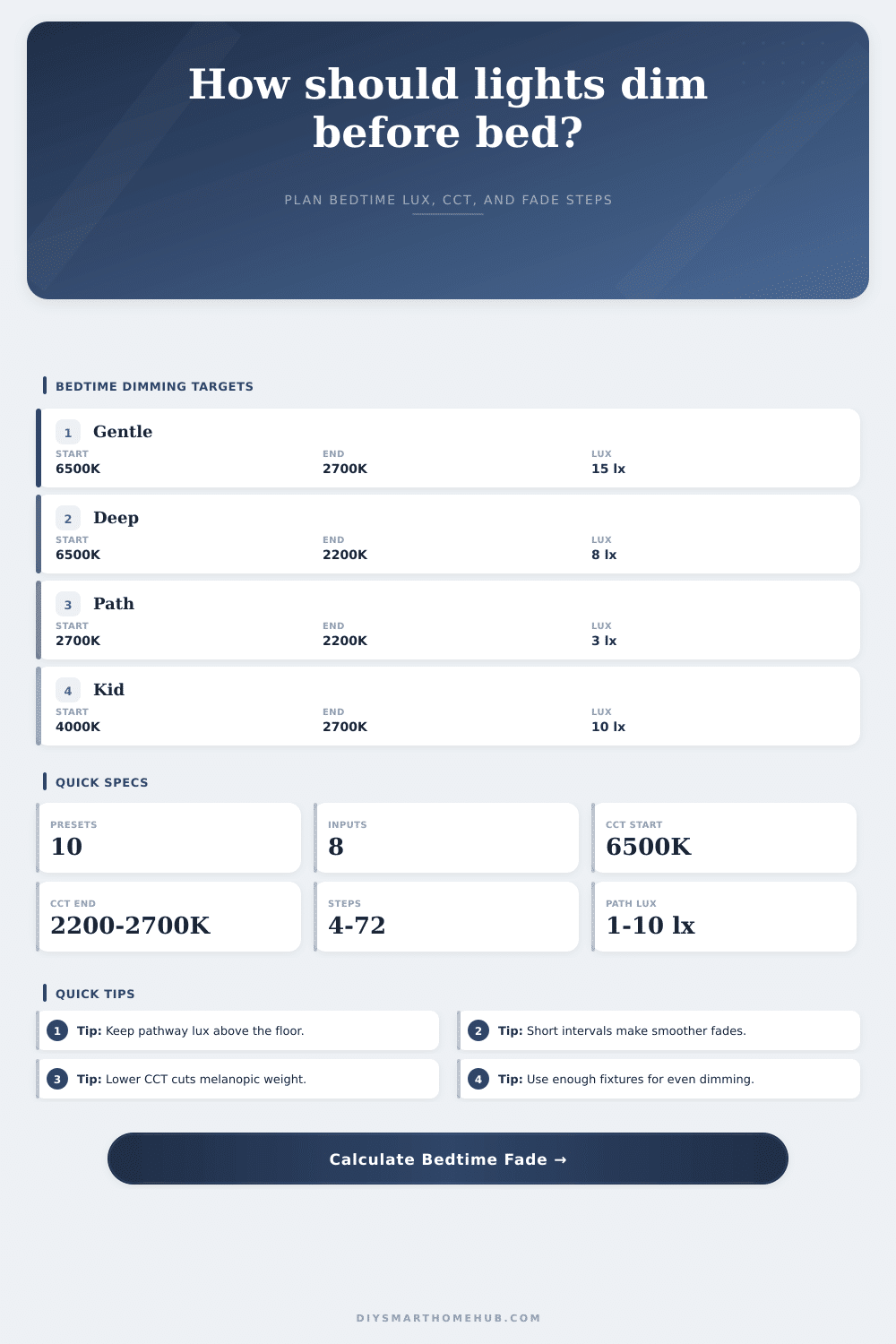
Circadian Rhythm Bedtime Dimming Calculator
Plan a smart-light bedtime fade from bright 6500 K daytime output toward warm evening CCT, low target lux, stable step intervals, and pathway-safe minimum light.
⏱Bedtime presetsPick a room pattern, then tune the fade.
⚙Calculator inputsRoom, fixtures, target lux, CCT, and timing.
📊Calculated fade detailsCore specs from the current input set.
📝Ramp step tableRepresentative automation steps.
| Step | Minute | Brightness | CCT | Lux |
|---|---|---|---|---|
| -- | -- | -- | -- | -- |
Bedtime dimming result
🔍Comparison gridHow timing and warmth choices change the same room.
📋Reference tablesPlanning ranges for dimming scenes.
| Room type | Area | End lux | Path lux |
|---|---|---|---|
| Bedroom | 120-220 ft² | 8-15 lx | 2-5 lx |
| Kid room | 90-180 ft² | 10-18 lx | 3-6 lx |
| Hall path | 40-120 ft² | 3-8 lx | 3-8 lx |
| Ensuite | 35-90 ft² | 5-12 lx | 4-10 lx |
| Studio zone | 250-500 ft² | 12-25 lx | 3-6 lx |
| End CCT | Use case | Factor | Color shift |
|---|---|---|---|
| 2700 K | Warm white | 0.43 | 3800 K |
| 2400 K | Extra warm | 0.32 | 4100 K |
| 2200 K | Very warm | 0.24 | 4300 K |
| 6500 K | Day start | 1.00 | 0 K |
| 4000 K | Neutral trim | 0.70 | 2500 K |
| Interval | 60 min steps | Feel | Best for |
|---|---|---|---|
| 1 min | 60 | Smooth | Premium scenes |
| 3 min | 20 | Soft | Bedrooms |
| 5 min | 12 | Balanced | Most hubs |
| 10 min | 6 | Stepped | Simple rules |
| 15 min | 4 | Coarse | Basic bulbs |
| Scenario | Fixtures | Ramp | Target |
|---|---|---|---|
| Reading | 2-4 | 45 min | 15 lx |
| Suite | 6-10 | 75 min | 10 lx |
| Hallway | 1-3 | 30 min | 5 lx |
| Guest | 2-4 | 50 min | 12 lx |
| Studio | 5-8 | 90 min | 18 lx |
💡Dimming tips
This calculator is a smart-light planning tool. It estimates lux, brightness, CCT, and melanopic-weight changes for automation setup and does not make medical sleep claims.
Even with the sun setting exactly at the same time each day, you still have a chance to set an established evening light routine.
In most homes, harsh overhead lights is kept on until you turn them off. Then suddenly it’s pitch black. This shocks the system, your brain doesn’t get told it’s time to start winding down. Twilight is a slow fade. Your body gets signaled it’s safe. The light say it’s time to end the day and rest during the night.
How to Set Up Your Evening Light Routine
Dimming to most means reducing brightness level. Dim the lamp and walk away…end of story. Brightness is only part of what we call light, color temperature is another part. And it is here that biology kicks in. The warmer the light shifts from cool blue-white toward the warm amber. It’s a biological shift. We are wired with sensors for light that follow its spectrum. These sensor signal our eyes, which then suppresses melatonin as long as there is blue-heavy light present. When the light becomes warmer, the suppression lift. You turn down the brightness to one percent, but bulbs still emit a daylight 6500 Kelvin. Fight your own biology.
So, plug in your fixture quantity and your room’s dimensions, and let the calculator do the math. You won’t have to guess or convert anything, and you won’t need coefficients; this tool takes hardware specs and turns them into biological timelines.
First, you tell the calculator what kind of lighting you currently have. Why? Because if you’ve got eighty lumens per square foot in that room, you’ll need a longer ramp than someone with more dimly lit space will.
Bright to dark is sudden, jarring; a sharp drop off make the viewer suddenly alert. Instead, a gradual decline, a long shallow slope, feels comfortabley; the eyes adapt without being prompted to be alert.
Then choose an end point. Options includes deeper candle-warm end points or more gentle bedroom fades. On piece of paper, it looks like 2200 Kelvin and 2700 Kelvin don’t sound that different. In practice, it’s enormous in the space. The warmer color actualy stimulates your retina less. Everyone talks about how dark this makes the room. Pay attention to how warm whatever light you leave on still is.
The calculator finds the melanopic factor. This measures how much blue light you have left that will prevent you from falling asleep. The lower the better for sleeping.
The other variable is one that folks commonly mess up, timing. A ten-minute fade is too fast. It feels like you are being asked to perform, but ninety minutes is better because it gives your body time to catch up. This tool divides up the duration into steps. Shorter steps create smooth changes; Longer ones work with basic automations where the system can handle it. The page has a reference table explaining how frequently stepping changes the feel of the transition. Smooth fades reduces the chance of waking up fully alert.
Then there are practical concerns about pathway safety, which people frequently overlook. You don’t want to step on a rug in ambient darkness and trip… The bottom line is that the calculator maintain the last lux at or above a safe minimum. That means, even though the light is low, it’s high enough for you to visually avoid hazards without switching on the blinding task lights. It’s a balance of biology with practicality. There is enough heat to define the floor so you can walk safely.
It takes some work to set it all up, including some math. Count your fixtures. You need to know your lumen ratings. You have to figure out when you’re done with day.
But once it’s all done, you have a house that adapts to human needs rather than electrical ones. And the lights don’t simply go dark. They lead you to bed.
It is a little tweak in your evening schedule. This has an enormous impact on how you start the next morning. Because the idea is to end your day softly.
You should of tried this sooner.