Bulk Battery Purchase Planning Calculator
Estimate AA, AAA, coin-cell, and specialty lithium cell quantities by device count, replacement timing, shelf-life limit, spare buffer, seasonal derating, failure reserve, and pack-size rounding.
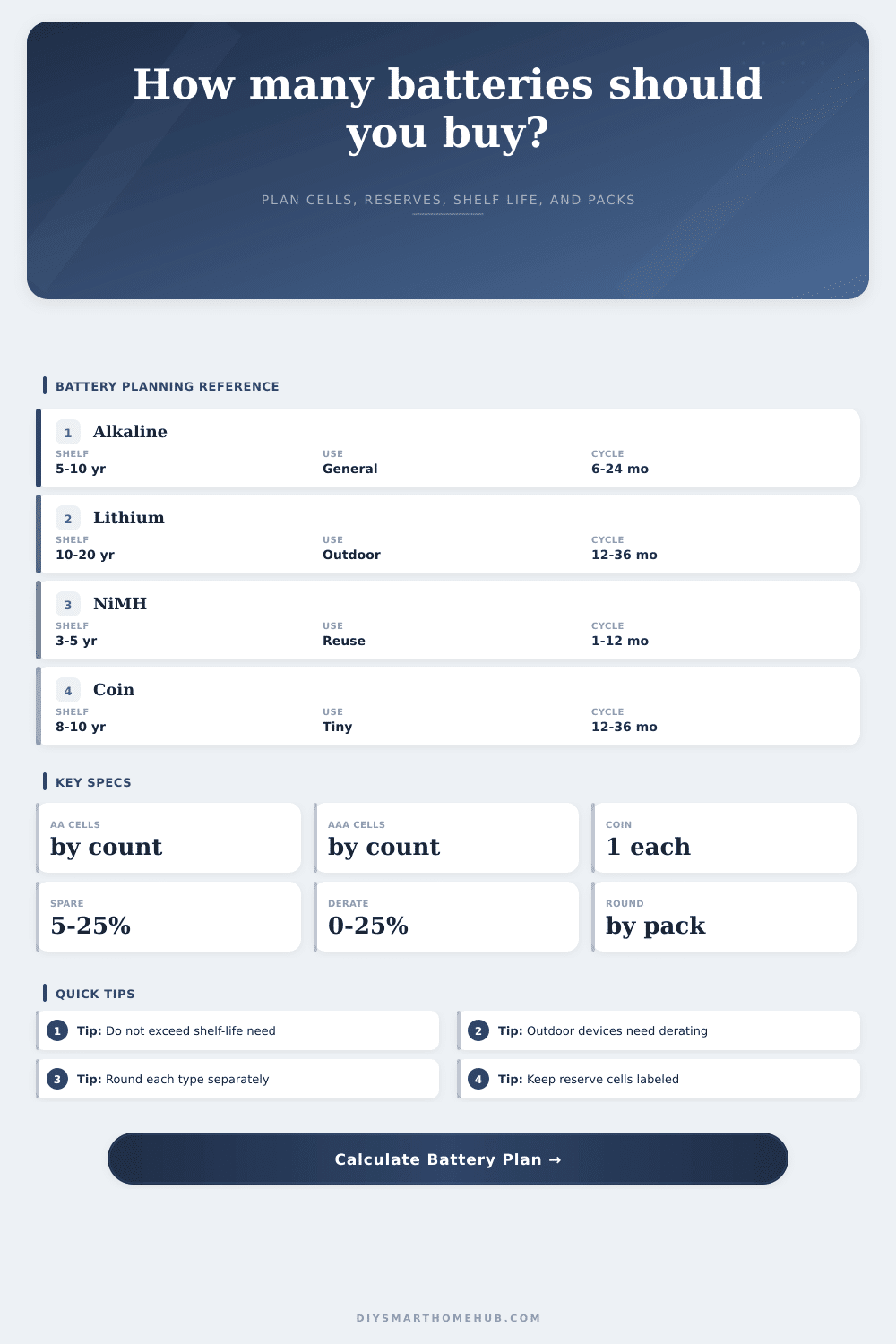
| Battery family | Typical shelf life | Smart-home fit | Planning note |
|---|---|---|---|
| Alkaline AA or AAA | 5 to 10 years | Indoor controls | Good general stock when devices are not exposed to cold. |
| Primary lithium AA | 10 to 20 years | Outdoor sensors | Strong shelf stability and better cold-weather behavior. |
| Low-self-discharge NiMH | 3 to 5 years | Recharge cycle | Useful for high-turnover cells, but stored rotation is shorter. |
| CR2032 coin cell | 8 to 10 years | Buttons and tags | Small cells often age before low-drain devices consume them. |
| Profile | AA / AAA cells | Coin / spec cells | Normal interval |
|---|---|---|---|
| Balanced mix | 2 / 2 each | 1 / 1 each | 12 to 24 months |
| Mostly alkaline | 2 / 2 each | 1 / 1 each | 9 to 18 months |
| Lithium outdoor | 2 / 2 each | 1 / 2 each | 18 to 36 months |
| NiMH rotation | 2 / 2 each | 1 / 1 each | 3 to 9 months |
| Coin-cell focus | 2 / 2 each | 1 / 1 each | 18 to 30 months |
| Policy | Spare buffer | Failure reserve | Seasonal derate |
|---|---|---|---|
| Lean | 5% | 2% | 0% |
| Normal | 10% | 5% | 5% |
| Outdoor | 15% | 8% | 15% |
| Cold season | 20% | 10% | 25% |
| Turnover | 25% | 12% | 10% |
| Rounding profile | AA pack | AAA pack | Coin / spec |
|---|---|---|---|
| Small packs | 8 cells | 8 cells | 4 / 2 cells |
| Medium packs | 16 cells | 16 cells | 8 / 4 cells |
| Bulk packs | 24 cells | 24 cells | 10 / 6 cells |
| Drawer bins | 12 cells | 12 cells | 6 / 4 cells |
And then there was the night: Tuesday, 8pm. The front door lock stop working. You are standing in the dark with keys in your hands because smart lock‘s batteries just died. Ugh. That’s what happens when you mix old-school tech with new-tech. And it reminds us how complicated home power can be. We get so used to installing gadgets, forgetting about them, until one day they don’t work anymore.
Buying batteries in bulk isn’t about hoarding. It’s about learning what your devices need and how they work. Once you know what you’re building an inventory for, the calculator do the math. But knowing why those variables are important makes sure your stockpile doesn’t turn into a shelf of dead power.
How to Choose the Right Batteries
The time line depends off the chemistry. Indoor remotes and sensor often use alkaline batteries, which are workhorses. They don’t discharge themselves very much, and then sit there quietly for years. Lithium cells behave differently. They’re pricier up front, but they excel at surviving cold weather. And they hold out longer in high-drain uses such as security cameras. When you pick a profile with a mix of these, the calculator will let you specify that, and adjust shelf-life expectations to match.
For example, if it is a mostly-lithium profile, the tool will reduce shelf-life expectations. It will also adjust replacement intervals to account for this, since you can store lithium cells for three years without any problem. NiMH rechargeables, stored for that long, has a tendency to be dead when you want them. The shelf-life limit of the tool ensures you won’t buy too many of shorter-lasting chemistry if your plan is long term.
People also tend to forget seasonality. An outdoor sensor mounted on a gate faces different stressors than one attached to an interior wall. Alkaline cells sees a large drop-off in effective capacity at cold temperatures. This environmental penalty is reflected in the planning tool’s reserve and power reduction policy. For locations where winter is cruel, using the outdoor derating option will boost the suggested number of cells. It requires you to recognize that your two-year-rated battery may only be good for 18 months in sub-zero weather. This is a brusque change. But it serves you well when it’s January and you’re rummaging around in a drawer seeking spares.
The other useful limitation is pack size. Batteries almost never come in individual quantities. They’re available in packs of 8/12/24. And that’s how the calculator approximates your exact requirements; it’ll round them up to those stock sizes. The result is excess capacity: not a bug, but a feature. Extra inventory provides a cushion against failure.
Electronic devices goes wrong at random moments. Something will cause a sensor to die (a drop of water? a moisture seepage?), and now you must replace its battery. A moisture seepge?), and now you must replace all the batteries. If you have some spares, whether they are coin cells or AA, you can address the problem right away. You won’t have to run to a shop at the last minute. And tool keeps track of this spare independently per battery type. That way it won’t suggest stocking any excess coins if you actualy need more AAs.
But it’s also dangerous. It encourages over-planning: “I’ve got this plan for a 2 year trip so I’ll buy enough batteries for that.” No good. The calculator assumes you will use the batteries before they expire, so it limits your required amount based on the shelf life of the batteries you choose. If you want NiMH, which probably won’t last more than a couple years, then the calculator won’t let you buy a year’s supply. Good thing! That limits how much you spend and keeps your drawers from filling with junk. It helps you see what you can reasonably store vs. Consume; it makes you think realisticly about your own needs rather than preparing for the apocalypse.
You will get these things in return: I need a clear target: how many packs of AAs, AAAs and coin cells should I purchase? When’s my next big swap due? Which battery chemistry am I limited by? How does it turn an unclear fear of running dry into a specific shopping cart full of items?
You enter the store and pluck out exactly as many packs as necessary. Walk away knowing your devices will stay powered through the seasons. Is it worth the time it takes to plan? Hell yes! It keeps the doors locked and the lights on. Makes it possible to livig instead of troubleshooting. Next time your door shuts with a click, think back to the effort of keeping those batteries alive.