Pet Feeder Portion By Pet Age Calculator
Convert pet age, species, target weight, life-stage calories, treats, food density, meals, and feeder gram increments into an automatic feeder portion schedule.
Detailed feeder portion breakdown
| Life stage | Dog multiplier | Cat multiplier | Feeder use |
|---|---|---|---|
| Growth under 4 months | 3.0 x RER | 2.5 x RER | Split into 4 or more small meals |
| Growth over 4 months | 2.0 x RER | 2.0 x RER | Use age changes to step portions down |
| Neutered adult | 1.6 x RER | 1.2 x RER | Common maintenance baseline |
| Intact adult | 1.8 x RER | 1.4 x RER | Higher maintenance estimate |
| Obesity-prone | 1.2 x RER | 1.0 x RER | Use target weight and close tracking |
| Weight loss | 1.0 x RER | 0.8 x RER | Use only as a starting estimate |
| Food label value | Cup weight | kcal per gram | Why it matters |
|---|---|---|---|
| 300 kcal per cup | 90 g per cup | 3.33 kcal/g | Light kibble, larger gram portions |
| 370 kcal per cup | 105 g per cup | 3.52 kcal/g | Common dry pet food planning value |
| 430 kcal per cup | 110 g per cup | 3.91 kcal/g | Energy dense food, smaller portions |
| 400 kcal per 100 g | 100 g reference | 4.00 kcal/g | Metric label, direct gram math |
| Target per meal | 5 g feeder | 10 g feeder | Daily drift at 3 meals |
|---|---|---|---|
| 18 g | 20 g | 20 g | +6 g per day |
| 32 g | 30 g or 35 g | 30 g | -6 g per day at 30 g |
| 47 g | 45 g or 50 g | 50 g | +9 g per day at 50 g |
| 73 g | 75 g | 70 g | -9 g per day at 70 g |
| Pet profile | Age band | Meals per day | Feeder focus |
|---|---|---|---|
| Small puppy | 2 to 4 months | 4 meals | High energy need with small stomach capacity |
| Adolescent dog | 4 to 12 months | 3 meals | Recalculate as growth rate slows |
| Adult dog | 1 to 7 years | 2 meals | Stable schedule and treat adjustment |
| Indoor adult cat | 1 to 10 years | 3 to 5 meals | Small meals can reduce begging between feeds |
| Senior pet | 7+ dog, 11+ cat | 2 to 4 meals | Track body condition and appetite changes |
Age-based calories
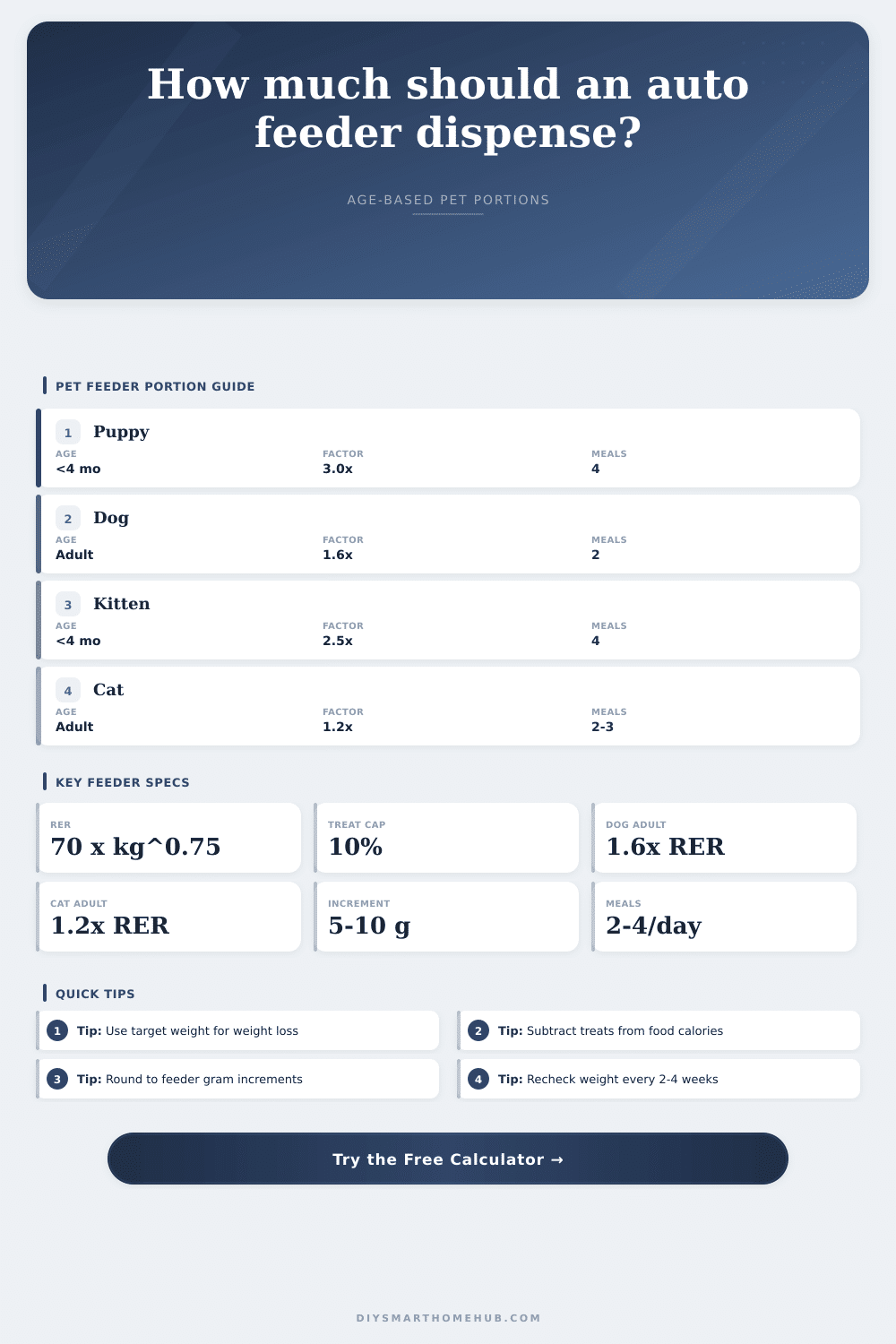
The calculator starts with RER, then applies a species and life-stage MER multiplier so puppies, kittens, adults, and seniors are not fed from one adult-only rule.
Treat-adjusted food
Treat calories are subtracted before grams are calculated, so the feeder dispenses the food portion rather than silently adding treats on top of the diet.
Real feeder rounding
Meal grams are rounded to the feeder increment, then converted back to daily calories so the result shows the effect of the device setting.
So you purchase an automatic pet feeder for the convenience of having your dog fed on time (say, at 7am), no matter what. And you purchase it because you believe that machines are consistent. But if you enter wrong number into this machine, then consistency is meaningless. If you feed the right amount but with the wrong number programmed into the machine, you have created a very efficient pet over/underfeeding system.
With the calculator above, all you need to do is plug in your pet’s weight, age, and food density. It will save you from guessing game of conversions and coefficients. Your pet will get exact grams they need, as calculated by veterinary nutrition formulas and delivered by your device.
How to Feed Your Pet the Right Amount
Resting Energy Requirement (RER) is the starting point of all the math. It’s how much energy your pet requires when it is completely relaxed and motionless in order to maintain its life. Take their weight to the power of 0.75 and multiply by 70.
Except, pets don’t sit around doing nothing. An active adult dog might need 1.6 times or more. A young growing puppy (under four months) needs at least three times the base amount just to support their fast-growing body. So those multipliers makes a big difference. Many people mistakenly use the adult multiplier when feeding a growing kitten, leading to poor energy levels and stunting growth. The Pet Calculator take into account life stage adjustments for you, so no need to memorize the chart.
Finally, there is the food. Kibble isn’t all made the same. Even though it may appear to be the same amount in the bowl, a single cup of food can weigh eighty grams or it could weigh one hundred and thirty grams. Measure by weight and you’re right on; measure by volume and you’re guessing. That’s why the calculator requests your food’s calorie density. Why? Because it turns your daily calorie goal into grams, and accounts for treats.
And here’s where treats becomes the silent killer of feeding plans. If your dog gets ten percent of their daily calories from chews, you have to subtract that ten percent from their primary meals. Otherwise, you’re feeding them 110 percent of what they require. It adds up fast.
Another wrinkle: most automatic feeders don’t pour continuously. Instead, they dispense a set amount (typically five or ten grams) using some mechanism like spinning a wheel to release it. So let’s say you want thirty-two grams for each meal. And maybe your feeder only works in increments of ten grams. In that case, you’ll need to round. Round up to forty grams? Or round down to thirty grams?
An eight gram variation on each meal doesn’t seem like much. But if you’re feeding three times a day and doing this seven days a week… You’re talking about nearly two hundred grams of additional food every single week. That is enough to add an entire pound over a month’s time. The calculator gives you a clear view of what effect rounding has on overall weekly intake. From there, decide whether you want to alternate between rounding up and down, or simply take a bit of variance into account.
The same goes for pets (or seniors) who is on diets. If they need fewer calories, then plug in a lower target weight into the formula rather than where they currently sit. Don’t let the math reward their extra weight. Feed ’em like they’re at the proper weight. It’s a sort of mental hack for your metabolism. Your body adapts to the reduced intake and the weight comes down accordingly. With this tool, you can specify what that weight should be so it adjusts the calories against the goal (not against what the scale says now).
But setting the feeder isn’t everything. The rest comes in watching what happens. Weigh your pet at least once every couple weeks. Then tweak the portions if the number doesn’t move in the direction you want.
Day after day, the feeder does precisely what you say. No more, no less. It won’t look at the dog and think she looks full, then stop. Or look at the cat and think she looks hungry, so it adds a little more. That’s the beauty of it, and the potential danger. You are responsible for seeing how things go. The scale shows you if your math is correct or not.
Start with calculated grams. Watch the body condition. Tweak accordingly. Precision serves no purpose unless it results in a healthy pet, rather than just a full bowl and a pet that is still hungry.