Reef Tank Alkalinity Dosing Calculator
Calculate alkalinity correction dose, safe dKH rise schedule, split dosing volume, daily maintenance dose, meq/L conversion, and ppm CaCO3 equivalent for reef aquariums.
Detailed alkalinity breakdown
| dKH change | meq/L change | ppm CaCO3 change | Use in dosing plan |
|---|---|---|---|
| 0.10 dKH | 0.036 meq/L | 1.79 ppm | Small test-kit adjustment or daily fine tuning |
| 0.25 dKH | 0.089 meq/L | 4.47 ppm | Cautious nano correction increment |
| 0.50 dKH | 0.179 meq/L | 8.93 ppm | Common split correction step |
| 0.75 dKH | 0.268 meq/L | 13.40 ppm | Typical upper daily plan for stable reefs |
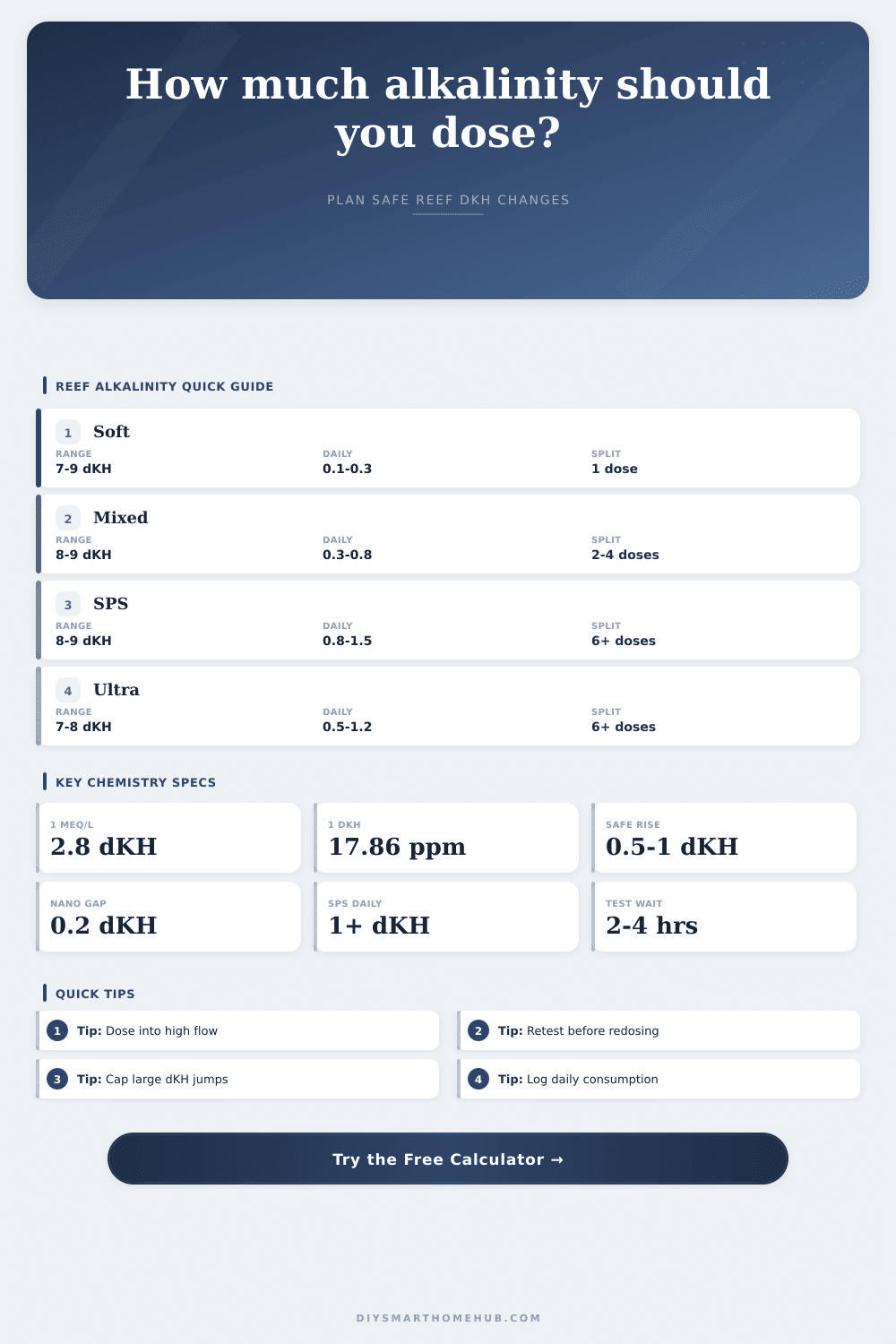
| 1.00 dKH | 0.357 meq/L | 17.86 ppm | Large daily correction limit for many systems |
| Additive style | Calculator strength unit | Typical planning value | Best dosing role |
|---|---|---|---|
| Light two-part alkalinity liquid | dKH per mL per gallon | 0.050 | Small tanks or manual fine corrections |
| Standard two-part alkalinity liquid | dKH per mL per gallon | 0.100 | General daily dosing and moderate corrections |
| Concentrated carbonate liquid | dKH per mL per gallon | 0.200 | Large systems using smaller pump volumes |
| Saturated kalkwasser top-off | dKH per mL per gallon | 0.030 | Slow replacement through evaporation top-off |
| Dry sodium bicarbonate | dKH per gram per gallon | 8.800 | Low-pH-impact one-time corrections |
| Dry sodium carbonate | dKH per gram per gallon | 13.950 | Higher-pH-impact corrections when needed |
| Reef style | Common target band | Typical daily use | Dosing approach |
|---|---|---|---|
| Soft coral and zoanthid reef | 7.5 to 9.0 dKH | 0.05 to 0.25 dKH/day | Manual or one small daily dose after testing |
| LPS garden reef | 8.0 to 9.5 dKH | 0.20 to 0.60 dKH/day | Daily dosing split around feeding and lights |
| Mixed reef | 8.0 to 9.0 dKH | 0.30 to 0.90 dKH/day | Automatic dosing with periodic test adjustment |
| SPS dominant reef | 7.5 to 8.8 dKH | 0.80 to 2.00 dKH/day | Many small events to reduce pH and dKH swings |
| Ultra-low nutrient acropora reef | 7.0 to 8.0 dKH | 0.50 to 1.50 dKH/day | Small corrections and stable maintenance dosing |
| System example | Actual water volume | 0.5 dKH correction | 0.5 dKH as ppm CaCO3 |
|---|---|---|---|
| 20 gallon nano after rock | 17 gallons | 85 mL at 0.10 strength | 8.93 ppm |
| 40 breeder mixed reef | 43 gallons | 215 mL at 0.10 strength | 8.93 ppm |
| 75 gallon with sump | 86 gallons | 430 mL at 0.10 strength | 8.93 ppm |
| 120 gallon SPS system | 130 gallons | 650 mL at 0.10 strength | 8.93 ppm |
| 240 gallon large reef | 250 gallons | 1,250 mL at 0.10 strength | 8.93 ppm |
Two-part alkalinity
Liquid two-part is easiest to automate because the dose is measured in mL, strength is repeatable, and calcium can be balanced separately.
Kalkwasser top-off
Kalkwasser adds alkalinity slowly through evaporation replacement, so it is better for daily maintenance than fast dKH gap corrections.
Dry carbonate salts
Dry bicarbonate and carbonate are useful for deliberate one-time corrections, but they should be fully dissolved before dosing into high flow.
There are many parameter that play into health of a reef tank. None is more critical than alkalinity. At the same time, none will cause more issues for a new aquarist then alkalinity. Sure, you might have ideal amounts of magnesium and calcium, but if your carbonate buffer is off, then your corals won’t be able to grow their skeleton.
Knowing what number you should of aim for on your test strip isn’t enough. You need to know how much of that number are in the water column and how much is sitting still in a poorly mixed sump or hidden within your rockwork. Alkalinity, Alk. Is one of the most mismanaged parameter.
How to Keep Alkalinity Stable
Why? Because we treat it as a thermostat. When it’s low, we shoot it back up ASAP with a big dose. This results in a alk. Spike that actually stresses our livestock more than when levels was low. We want it stable, not merely a certain value on the chart.
Once you input your current numbers and water volume, the calc does all the math for you (no need to guess at conversion factors & coefficients). It also makes you think about something many people overlook: displacement. You may have a 75g display tank, but what about the sump or that twenty gals of LR in there? That brings your total water volume closer to ninety. If you dosed for only your display volume, you’d be under-dosing the entire system. Overlooking displacement mean over-correcting.
For example, let’s say you are two degrees dKH below your target. It figures out the amount of total dose required and divides it into smaller doses. This is important because many additive, particularly concentrated liquid additives or even dry salt mix, can cause pH shifts that you don’t want. For instance, sodium carbonate bumps up pH quite a bit. By dividing this dose into several dose (for example, six or more), the chemistry remain smooth.
SPS corals are sensitive. This makes it important to keep them calm. On the page itself is a reference table detailing what various additive concentrations mean in terms of actual volume for dosing. It is a little touch, but it make sense and matters when you’re working with sensitive SPS corals.
Most keeper get hung up on understanding the difference between maintenance and correction. Maintenance is replenishing what your corals are using. Correction is plugging the hole. Until your alk has stabilized you cannot set your daily maintenance dose. When I ask for your daily measured consumption, the calculator need to know how much the level dropped in 24 hours after the buffer settled down. Setting your dose equal to what you think you should be replenishing from your last crash will overfeed the tank. Using daily consumption forces you to look at trends, not one data point.
Timing also matters. Alkalinity doesn’t disperse immediately. Depending on your tank’s water volume and its flow rate, it will take some time before the additive mix fully throughout the tank. This is true even if your tank has good flow. The tool recommends waiting two to four hours before retesting so you can be sure you’re testing all the tank water, rather than only the water next to the dosing pump. If you rush this process, you’ll make mistakes.
For example, you may test near the skimmer and see that the alkalinity appears low. You might add more chemical, only to discover later that you actualy pushed the entire tank up too far.
These are tank profiles. Common tanks is covered by the tool’s presets. This includes everything from large SPS displays down to nano soft coral tank. Different profile have different tolerance levels. For example, you’ll be able to tolerate a greater swing in a soft coral nano compared to an Acropora-packed frag tank. The calculator accounts for this when determining the safe daily rise.
Remember, one size does not fit all. How you manage your chemistry depends on your livestock, not vice versa. Alkalinity management boils down to one thing: Patience. This isn’t a task where you just fill a bucket and you’re done; it is about building up a buffer.
You’re guided by the numbers, and you know you’re on track by what you see happening. Observe your coral response. Did it react well to your dose? Did it retract? If so, you dosed too quickly or too slowaly. Dialing things in takes time. But when you get it dialed in, then it’s just a matter of waiting for your tank to run itself. At that point, you barely even notice the chemistry is there because it’s doing its job supporting life quietly. And THAT is when you know you got it.