Aquarium Top-Off Water Volume Calculator
Estimate aquarium evaporation, top-off dose volume, ATO reservoir size, water-level drop, and skipped-top-off concentration change from tank surface area and room conditions.
Detailed top-off breakdown
| Tank condition | Typical depth loss | Daily loss on 36 x 18 in | Daily loss on 48 x 24 in |
|---|---|---|---|
| Tight lid, humid room | 0.02 to 0.05 in/day | 0.06 to 0.14 gal | 0.10 to 0.25 gal |
| Glass lid, normal room | 0.04 to 0.08 in/day | 0.11 to 0.22 gal | 0.20 to 0.40 gal |
| Open top, no fan | 0.07 to 0.13 in/day | 0.20 to 0.36 gal | 0.35 to 0.65 gal |
| Open reef with fan | 0.12 to 0.24 in/day | 0.34 to 0.67 gal | 0.60 to 1.20 gal |
| Dry room, strong cooling fan | 0.18 to 0.35 in/day | 0.50 to 0.98 gal | 0.90 to 1.75 gal |
| Condition | Low effect | Typical factor | High effect |
|---|---|---|---|
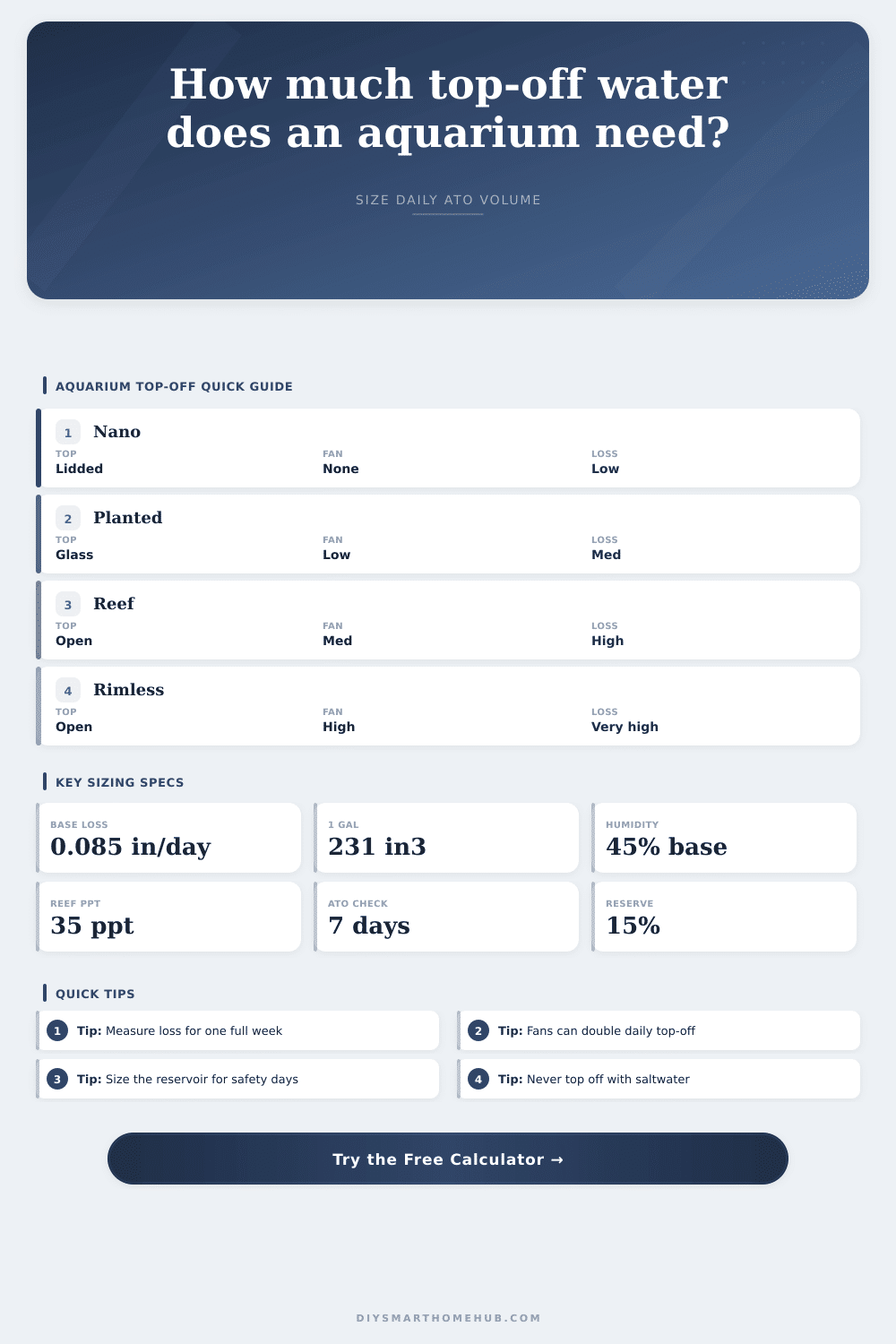
| Top cover | Tight lid 0.35x | Glass lid 0.50x | Rimless open 1.10x |
| Room humidity | 70% RH lowers loss | 45% RH baseline | 25% RH raises loss |
| Fan airflow | No fan 1.00x | Small fan 1.35x | Fan bank 1.90x |
| Lighting heat | Low LED 0.95x | Moderate LED 1.00x | Hot hood 1.25x |
| Daily top-off | 3 safe days | 7 safe days | 14 safe days |
|---|---|---|---|
| 0.25 gal/day | 0.9 gal usable | 2.0 gal usable | 4.0 gal usable |
| 0.50 gal/day | 1.7 gal usable | 4.0 gal usable | 8.1 gal usable |
| 1.00 gal/day | 3.5 gal usable | 8.1 gal usable | 16.1 gal usable |
| 1.50 gal/day | 5.2 gal usable | 12.1 gal usable | 24.2 gal usable |
| 2.00 gal/day | 6.9 gal usable | 16.1 gal usable | 32.2 gal usable |
| Skipped evaporation | 25 gal system | 75 gal system | 150 gal system |
|---|---|---|---|
| 0.5 gal | 2.0% concentration rise | 0.7% rise | 0.3% rise |
| 1.0 gal | 4.2% concentration rise | 1.4% rise | 0.7% rise |
| 2.0 gal | 8.7% concentration rise | 2.7% rise | 1.4% rise |
| 4.0 gal | 19.0% concentration rise | 5.6% rise | 2.7% rise |
Manual top-off
Best for small covered tanks with low daily loss. The interval dose should stay small enough that water level and concentration do not swing sharply between refills.
ATO reservoir
Best for reef tanks, open tops, fans, and sumps. Size the usable reservoir from daily evaporation multiplied by the safety days you want between refills.
Evaporation control
Lids, higher room humidity, and lower fan speed reduce top-off demand. Cooling fans and hot fixtures raise demand because they intentionally move more water into the air.
How much water do I need for a water top-off? The aquarium top-off water volume calculator predicts how much water will evaporates before it gets too low. This allows you to determine how large of a reservoir you should of get, as well as help manage your salinity. It take the guess work out of this process.
Salt remains; water vaporizes. Replacing that lost water with saltwater will increase salinity. The pump could cavitates or other equipment could be exposed if the water evaporate below a safe level.
How to Use the Top-Off Calculator
The calculation is dependent off airflow, humidity, temperature, and surface area (the bigger, the more water evaporates). This calculator assume this loss per day. That’s projected out weekly or monthly. This give you real numbers to calculate size of an automatic top-off reservoir.
It’s not about tank size but about surface area. Evaporation is not proportional to the volume of your tank. A narrow long tank doesn’t evaporate as quick than a wide shallow one. Why? Because it has less surface area. That’s what the tool wants: the length and width of the tank (which equals its exposed surface). And if you have an uncovered overflow box or open sump, then that surface contribute to the overall evaporation. There is a field for exposed surface percentage in the calculator for this.
You can lose double amount of water from a large open sump display tank versus a completely lidded one. Many hobbyists gets tripped up on this point.
Airflow and lighting are the hidden drivers of evaporation. Increasing airflow (via fans) cools the tank via increased evaporation. Each degree of cooling equal a drop in water volume. Lighting heat change the baseline evaporation rate according to its inputs. Modifiers include a strong fan and open top which dramatically increase evaporation. Conversely, a tight lid greatly decreases loss. The modifier columns of the reference tables on this page illustrate this. Use them to understand how the change from January to July led to the difference in your loss rate.
Another big factor is humidity. Moisture will move from high-humidity air into water but it won’t go from dry air into water (it will pull moisture from the water). So if you are in a humid coastal city, your top-off requirements will be less than someone living in a dry climate. The calculator accounts for that by adjusting the baseline to the relative humidity of the room.
This is an empirical model, a “law” based on observed experience rather than a perfect law of nature. Real-world conditions can vary. Best bet: Get a starting estimate with the calculator, then measure what you actualy lost over a week. Adjust your inputs accordingly if the numbers don’t match.
You get three important numbers as an output. You get three important numbers as an output. These include the reservoir size with a safety reserve and the daily top off volume. You also get the interval dose, which is the amount to top up if you top off weekly. Finally, you get the concentration swing. This is a warning signal; the higher it goes, the more your salinity will rise should you miss a top off.
Stable parameters mean healthy livestock. Stable parameters mean healthy livestock.
A small tank has little evaporation, so you manually top it off. A large system and reef need an auto top off. Use the calculator to determine what’s right for your set up. Less than a cup per day may be manageable manually. Maybe not. How about a gallon a day? Automation would of been better. Use the reservoir plan table to see how much storage space you need depending on safety margin. Many people goes with seven days reserve. That’s a good balance between refilling and having too much storage space.
Always replace water with fresh. Never top off with saltwater. Fresh water is best from an RO/DI unit for reefs, or dechlorinated tap water for freshwater tanks. The calculator assumes that you are replacing saltwater with freshwater to maintain a stable salinity. This prevents the specific gravity from slowly rising, which is stressful to both fish and coral. This is a preventable mistake.
Run the tank for one week to calibrate your system. Mark the water level in the reservoir. Divide the missing volume by seven. Divide by seven. Plug those numbers back into the calculator. What does it say? That’s your real world check. It takes into account your local idiosyncrasies (i.e. A draft, where is that heater located?). You observe; the tool figures out the math.
It’s a never-ending battle between you and evaporation. There’s no way to prevent it; but you can control it. By anticipating what evaporates, you’re able to keep conditions even. Your pump remains primed. Your livestock thrive. The water level doesn’t fluctuate, so you sleep easy at night.