Coffee Maker Start Offset Calculator
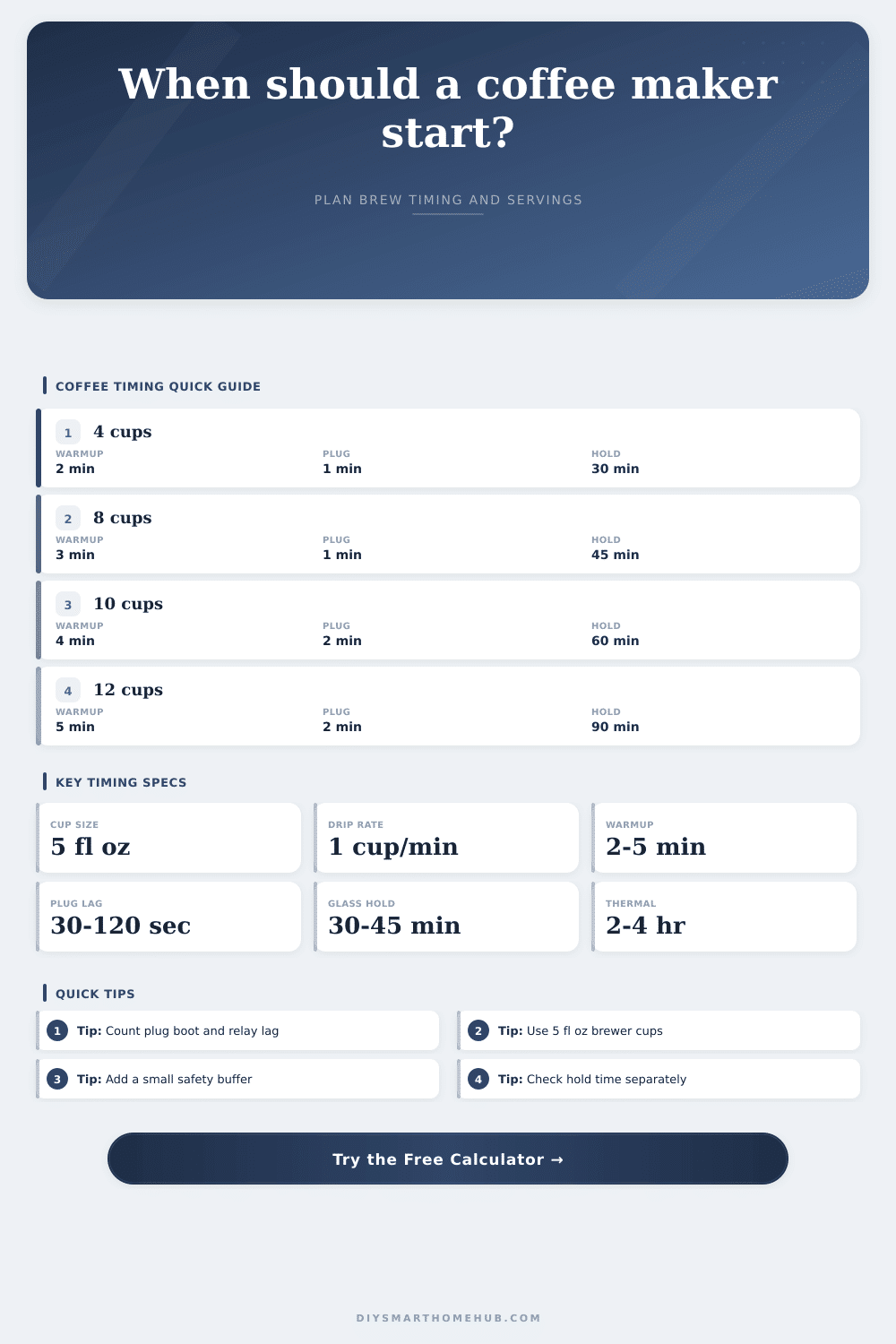
Estimate when a smart plug or automation should start a drip coffee maker so brewing, warm-up, plug delay, serving count, hold time, watts, and energy all line up with a target ready time.
Coffee Automation Timing Results
--
until plug-on command--
target minus total lead time--
warm-up + brew + plug delay + buffer--
based on selected serving size--
quality window after ready time--
brew plus selected keep-warm interval5 fl oz
Standard brewer cup
8.45 oz
250 ml metric mug
kWh
Watts × hours / 1000
24 hr
Clock rollover handled
| Batch | Typical cups | Rate to enter | Brew duration formula |
|---|---|---|---|
| Small morning batch | 4 to 5 cups | 1.00 to 1.25 cups/min | overhead + cups / rate |
| Standard pot | 8 to 10 cups | 0.80 to 1.05 cups/min | overhead + cups / rate |
| Full reservoir | 12 cups | 0.65 to 0.90 cups/min | overhead + cups / rate |
| Fast brewer | 6 to 8 cups | 1.20 to 1.60 cups/min | overhead + cups / rate |
| Automation path | Plug delay | Suggested buffer | What it covers |
|---|---|---|---|
| Local hub routine | 10 to 30 sec | 0.5 to 1 min | Relay and command timing |
| Cloud routine | 30 to 90 sec | 1 to 2 min | Cloud and WiFi response |
| Voice-triggered scene | 45 to 120 sec | 1 to 3 min | Assistant path variance |
| Older WiFi plug | 60 to 180 sec | 2 to 5 min | Reconnect and relay lag |
| Carafe setup | Hold window | Keep-warm draw | Energy formula |
|---|---|---|---|
| Glass plate, short hold | 30 min | 40 to 80 W | brew kWh + warm kWh |
| Glass plate, long hold | 45 to 60 min | 60 to 120 W | brew kWh + warm kWh |
| Thermal carafe | 120 to 240 min | 0 W | brew kWh only |
| Manual shutoff | custom | 0 to 60 W | limit warm minutes |
| Scenario | Brew volume | Serving count | Total lead estimate |
|---|---|---|---|
| Solo weekday mug | 4 brewer cups | 2.0 at 10 fl oz | 8 to 10 min |
| Two travel mugs | 8 brewer cups | 3.3 at 12 fl oz | 12 to 15 min |
| Kitchen carafe | 10 brewer cups | 5.0 at 10 fl oz | 15 to 18 min |
| Full pot routine | 12 brewer cups | 6.0 at 10 fl oz | 19 to 24 min |
The alarm didn’t ring, but that’s okay: you woke up early anyway. And there is no coffee. The coffee maker was plugged into a Smart Plug which takes some time to boot up, and then there’s another delay while the old drip-brewer heats up water. Now you’re already running late for work and just notice that pot is still empty.
This isn’t a willpower issue. It’s a math issue. To make automation work in the morning, you has to know where the invisible delays are. But most folks forget to account for warm up time. They’re aware that their average coffee maker will take about ten minutes to produce eight cups of joe. However, they don’t consider what happens after those first few seconds when cold tap water start warming up the heating element. That takes an additional two to three minutes all on its own.
How to Time Your Coffee Automation Correctly
Your automation routine will be wrong if it tells the plug to switch on precisely fifteen minutes prior to the desired cup of coffee. At best, water drips into the filter at minute five and drips out again at minute twelve (leaving three unnecessary minutes sitting on a hot plate in between). Why? Because people counts the flow of liquids while overlooking how they hold heat.
After entering your unique hardware information into the calculator above, it do the rest of the math for you. You don’t need to guess at conversions or coefficients. It also doesn’t factor in smart plug delays if that’s what you use.
Smart plugs aren’t instant switches. A relay may be triggered by a local hub routine within a few seconds, while a cloud-based automation might require up to a minute and a half. Voice commands introduce even more latency since they’re routed via an assistant server before returning back on your home network. This variation can matter if you want to hit a precise ready time. The tool allows you to enter those delays. It ensures that the start command is issued early enough to account for delay.
The other side of it is: What’s a cup? A standard mug is ten or twelve ounces, and most coffee maker define a cup as being five ounces. So when they say it makes “twelve cups,” it’s making sixty ounces, which is five big ol’ travel mugs. It is not twelve small ones. This is why people under-brew: They’re trying to get something for the whole family and wind up getting just enough for two people and a sip for everyone else. And so the calculator take those standard definitions and figures out roughly how many servings you’ll end up with given the size of your preferred mug. It closes the loop from manufacturer specs to reality.
But there are other variables you don’t see. Take energy consumption. Instead of a glass carafe sitting over a continuously-drawing heating plate, a thermal carafe relies on insulation rather than re-heating. Leaving the office at eight and getting home at nine? By the time you serve yourself a cup, it’ll taste like boiled cardboard. This lets you model that scenario as well… Calculating how much energy it would take to keep a glass plate warm for an hour, compared with the nearly zero draw of a thermal pot sealed inside airless spaces. It can help you figure out whether or not your automating is burning through electricity at the expense of flavor.
It’s not too hard to set up the routine, though you’ll want to test it out before using it to get an idea of your machine. Time yourself from plug-in to first drop, then time a complete brew cycle. Don’t estimate. Input your real values. The reference table on the page explain the setup for typical appliances, but yours may vary. Older machines are slower, and new machines with pre-infusion cycles increases the overall brewing time. Add a little time buffer to account for power fluctuations or other network hiccups, it should of take maybe a minute or two to be safe.
You want the aroma in your nose when you open the kitchen door, rather than waiting around for the machine to gurgle out the last few drops at seven zero-one instead of six fifty-eight. You don’t want the automation to dissapears entirely, but get the timing right and all that’s left is the ritual: Pouring a fresh cup when the rest of the house is still asleep.