Room Mode Frequency Calculator
Calculate axial, tangential, and oblique room resonances from inside room dimensions with the standard f = c / 2 x sqrt((p / L)^2 + (q / W)^2 + (r / H)^2) formula.
Dimension and acoustic inputs
Live room spec check
Calculation breakdown
| Mode p/q/r | Type | Frequency | Main axis | Wavelength | Cluster note |
|---|---|---|---|---|---|
| 1/0/0 | Axial | 35.2 Hz | Length | 32.0 ft / 9.8 m | Calculate to update |
| Mode type | Nonzero indexes | Example p/q/r | Relative strength | Common interpretation |
|---|---|---|---|---|
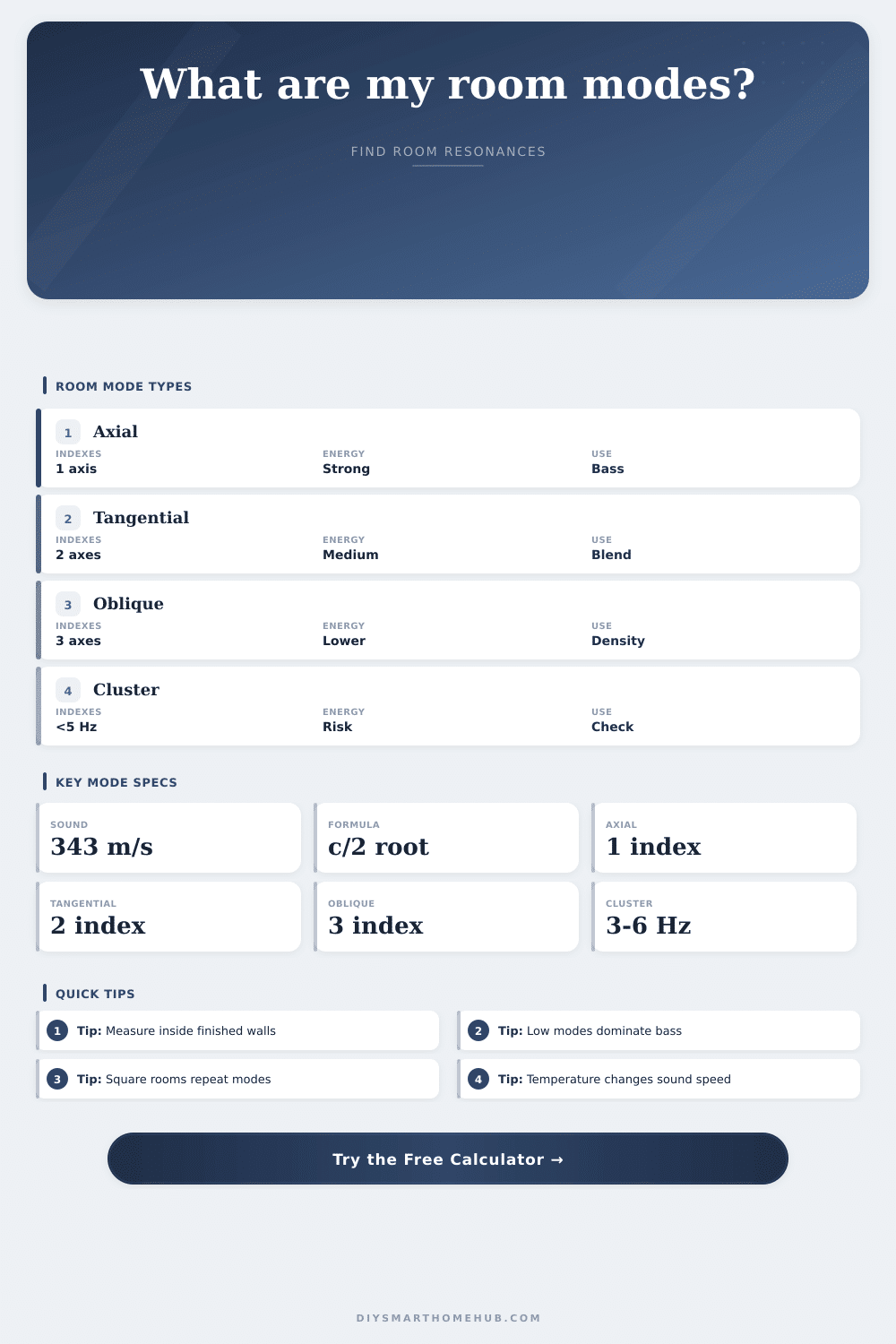
| Axial | One of p, q, r | 1/0/0 or 0/1/0 | Strongest | Pressure bounces between one pair of parallel room boundaries. |
| Tangential | Two of p, q, r | 1/1/0 or 0/2/1 | Moderate | Energy involves four surfaces and usually blends with nearby modes. |
| Oblique | All three indexes | 1/1/1 or 2/1/3 | Weaker | Energy touches all six surfaces and adds modal density. |
| Coincident or clustered | Any close frequencies | 1/0/0 near 0/1/0 | Can be strong | Multiple modes at nearly the same frequency can reinforce peaks. |
| Room example | Dimensions | Length axial | Width axial | Height axial | Likely concern |
|---|---|---|---|---|---|
| Small bedroom | 11 x 12.5 x 8 ft | 51.4 Hz | 45.0 Hz | 70.3 Hz | Width and length modes close together. |
| Apartment media | 12 x 16 x 8 ft | 35.2 Hz | 46.9 Hz | 70.3 Hz | Height mode overlaps the second length mode. |
| Studio control | 15.5 x 22 x 9.5 ft | 25.6 Hz | 36.3 Hz | 59.2 Hz | Longer room pushes first length mode lower. |
| Low basement | 13 x 18 x 7 ft | 31.3 Hz | 43.3 Hz | 80.4 Hz | Ceiling mode is high and often audible in bass. |
| Cube-like room | 10 x 10.5 x 9.8 ft | 53.6 Hz | 51.4 Hz | 54.7 Hz | Nearly repeated first axial modes. |
What happens to bass? Bass doesn’t behave like any other sound in your room. The low frequencies behaves more like pressure waves that reflect off parallel walls and tend to stack up if the walls is too close together or if their dimensions shares simple mathematical relationships. These waves will cause some notes to boom and others hollow. No amount of expensive subwoofers can fixes bad room geometry.
The first step to solving this problem is understanding where these resonances live. So what does it do? Don’t worry about using late night trigonometry and square root calculations. The calculator calculates the math for you. It take your room’s dimensions (length, width, height) and uses standard acoustic formulas to predict peak pressures.
How to Use the Calculator
That’s only half the equation. How do you interpret the results? That’s where the true benefit comes in. What you’re trying to find aren’t individual frequencies; rather, you’re looking for patterns indicating trouble.
To begin with, we’ll concentrate on axial modes. Axial modes occur between two parallel surfaces (front to back walls, for example). They typicaly present themselves as the loudest issues and they contains the greatest amount of acoustic energy. Tangential modes has four surfaces involved and are softer; oblique modes contact all six surfaces and is even softer.
Why does it matter? Because when you’re hearing something, it’s probably an axial mode that you’re experiencing first. A loss of bass response at your seat position suggest that there is some sort of phase cancellation happening between direct sound from the source and its reflection off the wall.
Before anyone has even started designing the room, one common reason why rooms don’t work well has to do with ratio of dimensions. For example a room that’s basically a cube (i.e. All three dimensions are close in length) doesn’t work well acoustically. All of the modes line up perfectly and add to each other resulting in very strong nulls and peaks. You can see it right away on the calculator. Simply type in a 10 foot x 10 foot x 10 foot space, and it will shows you sets of modes with almost exactly the same frequency.
Try to make the dimensions more spread out. Ideally you want ratios that is not obvious integer multiples. Generally speaking, a room whose length is much greater then its width tends to perform better since it shifts the first length mode down and spreads out the others over a wider frequency span.
Don’t forget about the temperature either. Air density affects the speed of sound and a heated living room will have a slightly different sound pattern compared to cold basement. The tool takes that into account with the speed of sound variable changing according to what you put in. It is a small detail, but it needs to be accurate. What good is knowing where the modes are if they’re sitting in some theoretical vacuum at standard conditions rather than your environment?
Lastly, seek out clusters. Multiple modes all fall into a range of a few Hertz. Even if indirect or off-topic, the clustering creates a density issue. It piles up the energy and bass traps can’t corral it well enough to avoid localized boom. Seeing several modes in close proximity less than 100 Hz on the output mean you’ve got a structural issue. That may shift as you move around the room somewhat, but usually the only actual solution is to adjust speaker placement or add some broadband absorption.
The laws of sound are as physical as any other law, and they has to do with distance and the way waves behave, not what you’re playing back. By mapping out these invisible pressure points before you place a single speaker, you stop guessing and start designing. It turns an acoustic chaos into something you can predict; that’s to say each note knows exactly where it should of going. And that’s why it’s worth the time it takes (just five minutes)… To run the numbers.