Smart Mop Cleaning Solution Dilution Calculator
Calculate tank volume, cleaner concentrate, water, floor coverage, pass volume, and refill count for robot mops, vacuum mops, and spray mops.
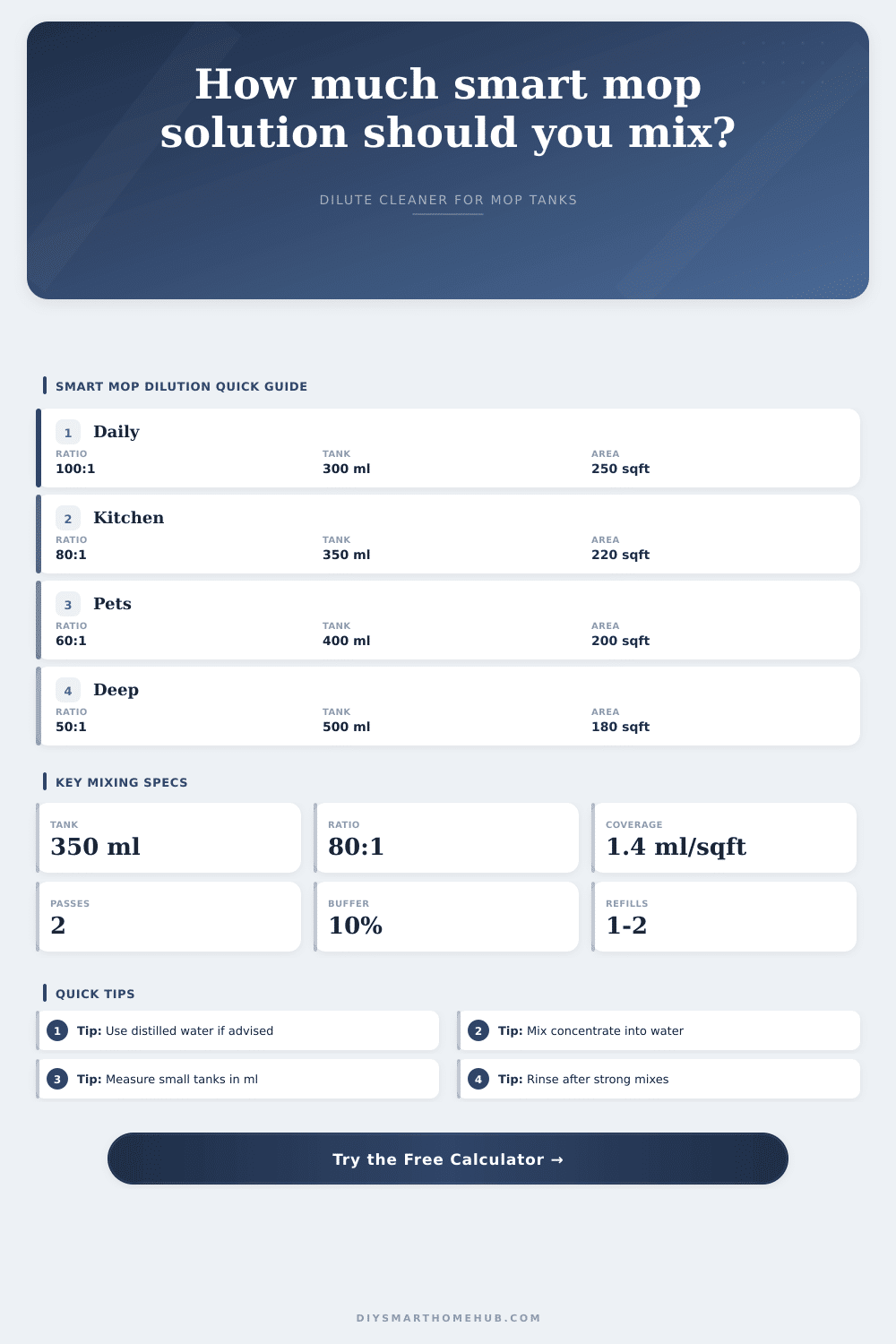
| Use Case | Ratio | 300 ml Tank | 500 ml Tank | Best Fit |
|---|---|---|---|---|
| Very light daily maintenance | 150:1 | 2.0 ml concentrate | 3.3 ml concentrate | Frequent robot routes on sealed floors |
| Sealed wood friendly clean | 120:1 | 2.5 ml concentrate | 4.1 ml concentrate | Low-residue smart mop tanks |
| General smart mop cleaning | 80:1 | 3.7 ml concentrate | 6.2 ml concentrate | Weekly mixed hard-floor routes |
| Pet and entryway soil | 60:1 | 4.9 ml concentrate | 8.2 ml concentrate | Textured tile and traffic lanes |
| Deep clean allowed surfaces | 50:1 | 5.9 ml concentrate | 9.8 ml concentrate | Short supervised high-soil pass |
| Tank Size | Rate | 1 Pass Coverage | 2 Pass Coverage | Metric Coverage | Common Device |
|---|---|---|---|---|---|
| 200 ml | 1.0 ml/sq ft | 200 sq ft | 100 sq ft | 18.6 / 9.3 m² | Compact robot mop |
| 300 ml | 1.2 ml/sq ft | 250 sq ft | 125 sq ft | 23.2 / 11.6 m² | Standard robot mop |
| 450 ml | 1.4 ml/sq ft | 321 sq ft | 161 sq ft | 29.8 / 15.0 m² | Pad-washing smart mop |
| 600 ml | 1.6 ml/sq ft | 375 sq ft | 188 sq ft | 34.8 / 17.5 m² | Vacuum mop tank |
| Mix Strength | Ratio | Concentrate Share | Residue Risk | Typical Passes | Suggested Coverage | Best Surface Pattern |
|---|---|---|---|---|---|---|
| Ultra light | 150:1 | 0.66% | Very low | 1 pass | 0.8-1.1 ml/sq ft | Daily sealed floors |
| Light sealed wood | 120:1 | 0.83% | Low | 1-1.5 passes | 0.9-1.2 ml/sq ft | Gentle damp mopping |
| Standard smart mop | 80:1 | 1.23% | Moderate low | 2 passes | 1.1-1.5 ml/sq ft | Weekly hard floors |
| Traffic lane | 60:1 | 1.64% | Moderate | 2 passes | 1.3-1.8 ml/sq ft | Pets, entry, tile |
| Deep clean | 50:1 | 1.96% | Higher | 2-3 passes | 1.6-2.1 ml/sq ft | Allowed surfaces only |
| Route | Area | Passes | Solution Estimate | Tank Planning |
|---|---|---|---|---|
| Bathroom and hallway | 120 sq ft | 1 pass | 120-170 ml | One compact tank |
| Kitchen plus dining | 260 sq ft | 2 passes | 650-780 ml | Two 350 ml fills |
| Apartment hard floors | 520 sq ft | 1.5 passes | 940-1120 ml | Three to four robot fills |
| Whole house hard floors | 1400 sq ft | 1 pass | 1700-2300 ml | Station tank or staged refills |
That’s where this thing comes in: the sort of blind panic you get when you look at the robot mop and realize it’s run out just as it reaches the kitchen. Or maybe it just finished a cleaning cycle. Now there’s a slick film on your hardwood floors that won’t buff off for twice as long then whatever was on them before.
How does that happen? You followed the directions! You believed in the technology! And yet somehow floor is far more dirty than before.
Why Your Robot Mop Leaves Dirty Floors
Here’s the thing: Most of the time it has nothing to do with the hardware. It’s all about the invisible makeup of what you put in the thing in the first place. Cleaning solution is a mystery for most. Add a bit of concentrate, fill to the brim with water, hope for the best. But this method won’t work.
Concentration isn’t an art, it’s a science. A brainy mop doesn’t scrub by feel. It uses precise quantities of solution to spread soil. Too little solution and there isn’t enough chemistry to attack the grime or grease. Too much solution and you might as well paint your floors with detergent which will always leave residue.
Simply input your tank size and room dimensions into the calculator above. It’ll do the math for you. You won’t have to convert volumes or guess at dilution coefficients anymore. And the inputs? That’s important because they represent real world factors, things that can vary from day to day. Sure, your floor size stays the same but your soil load does not. What works on a quiet Tuesday morning on sealed oak may not work on a Saturday afternoon in your entryway after three dogs has tracked in mud.
With the tool, you can account for these variations by simply choosing between different combinations of dilution ratio and soil multiplier. In other words, you’re telling the system how hard it should work. More water-to-concentrate ratio will protect a delicate surface. More active ingredients will be required for sticky spills in kitchen. It is a small thing, but it matters. Get the balance incorrect and you ruin your finish or waste cleaner.
These are the coverage rates and tank capacity. And finally, that brings us to tank size and tank coverage rate. Because most of these robot mops are small with limited tank sizes for a compact footprint, they require constant filling (particularly if you’re making multiple runs through the same room). On the other hand, larger vac mop machines carries larger loads but typically output at a faster rate to lift debris.
How much solution will your device use per square foot? Knowing this number helps ensure you don’t mix just enough for one pass. You might discover halfway through that you really needed two overlapping passes. The chart on that page breaks it down nicely, showing how output rate and tank size meet to equal total coverage.
The buffer. Most people don’t consider it. Reality bites. When mops double-back over high traffic areas they miss spots. Add a ten percent buffer to your estimated volume and you won’t find yourself running out mid-room. Otherwise, running dry will force you to drag dirty pads over pristine surfaces. It comes at no cost to you, except for some peace of mind.
A few more seconds in the routine turns it from an annoying chore into one that’s somewhat predictable. Lastly, what about the water? Mineral deposits in hard water can block cleaning agents, causing them to spot on tile and glass. If you’re looking for streak-free cleaning, it’s would of been well-worth the slight hassle of using filtered or even distilled water.
Cleaning isn’t something you do harder; it’s something you do smarter. Once you learn how surface area, concentration, and volume work together, you cease to fight against your equipment. Instead, you begin to work with it. And that sweetly balanced mix equates to no more refilling halfway through a clean. You won’t have tacky floors anymore. Just one less thing to worry about because your house is clean, and you don’t have to guess how to get there.