Robot Mop Pad Replacement Interval Calculator
Estimate how many calendar days a robot mop pad should last after adjusting its rated cycles for moppable floor area, soil level, wash frequency, cleaning solution abrasion, floor texture, and daily mop runs.
Your adjusted pad life will appear here.
| Pad type | Typical rated cycles | Best floor use | Wear note |
|---|---|---|---|
| Standard microfiber | 40-70 | Laminate, sealed tile | Balanced pickup and wash life |
| Dense microfiber | 70-110 | Large smooth zones | Longer life, slower drying |
| Scrubbing fiber | 30-55 | Kitchen, grout, entry | Higher drag and fiber wear |
| Disposable wet pad | 1-3 | Small spot cleaning | Replace by loading, not washing |
| Round spinning pad | 50-90 | Dual spinning robots | Edges can fuzz before center |
| Sonic/vibration pad | 35-75 | Stuck-on soil zones | Friction cycles are more intense |
| Adjustment | Low | Normal | High |
|---|---|---|---|
| Area factor | 0.70x small zone | 1.00x rated area | 2.00x large run |
| Soil factor | 0.85x dust | 1.00x normal | 1.75x mud |
| Wash factor | 1.00x every 2 runs | 1.05x every run | 1.31x hot plus delay |
| Floor texture | 0.92x smooth | 1.00x standard | 1.35x rough grout |
| Solution factor | 1.00x water | 1.04x neutral | 1.35x residue risk |
| Scenario | Moppable area | Daily runs | Expected interval | Main limiter |
|---|---|---|---|---|
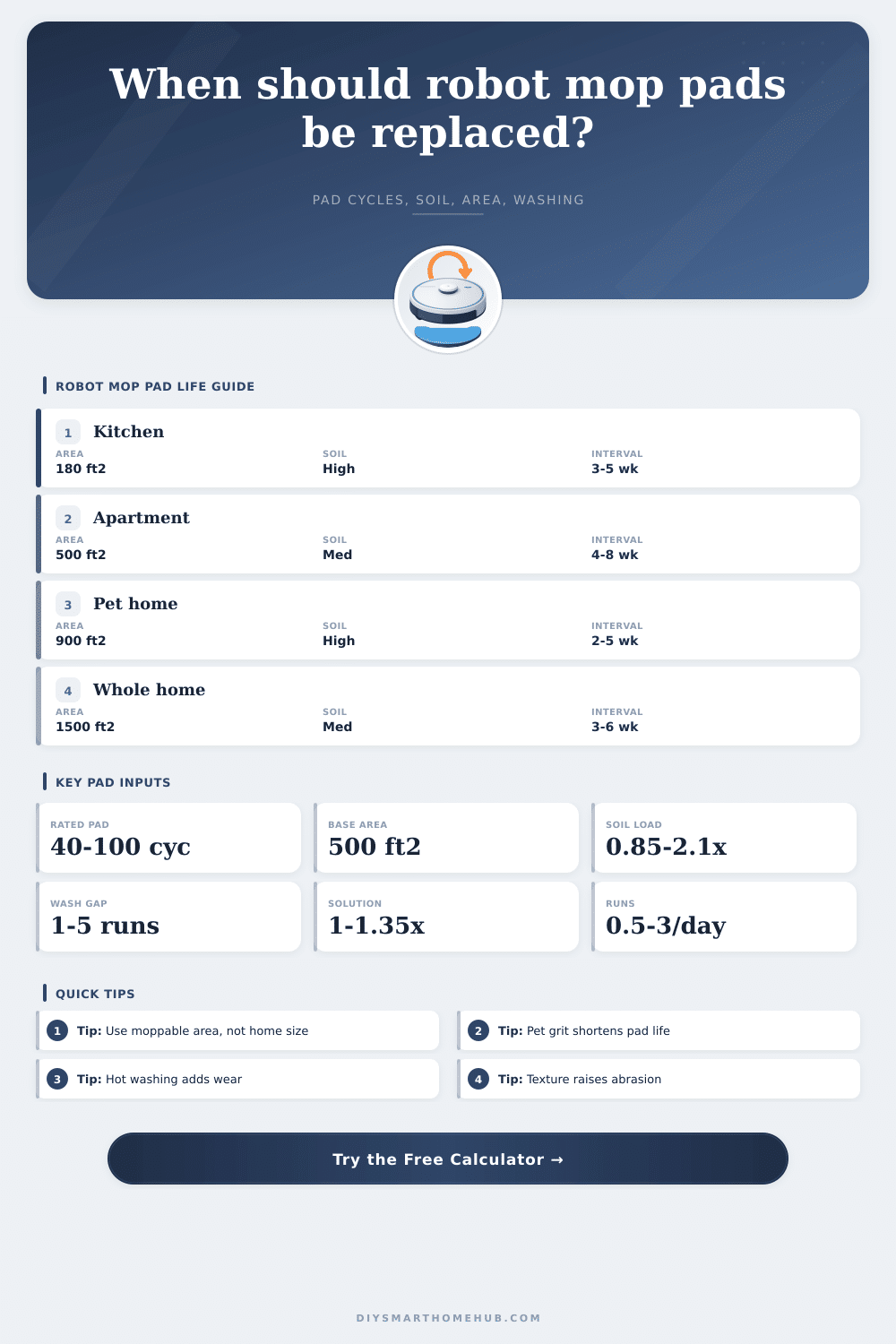
| Small kitchen zone | 120-220 ft² / 11-20 m² | 1.0 | 4-8 weeks | Kitchen soil |
| Apartment daily mop | 400-650 ft² / 37-60 m² | 1.0 | 4-7 weeks | Rated cycle count |
| Pet household | 600-1000 ft² / 56-93 m² | 1.0-2.0 | 2-5 weeks | Tracked grit |
| Whole-home smooth floor | 1200-1800 ft² / 111-167 m² | 1.0 | 3-6 weeks | Area factor |
| Grout-heavy tile | 500-900 ft² / 46-84 m² | 1.0 | 2-4 weeks | Floor texture |
You purchase a robot vacuum with a mop attachment because you don’t want to get off the couch. The marketing promises endless convenience. Nobody mention the hidden cost of those microfiber pad. They’re not as durable as you think. Buying new ones too soon waste money on perfectly good fabric, but waiting until they look bad result in streaky floors. It’s time to predict when the pad realy needs replacement, not by eyeballing it in laundry hamper.
Manufacturers will provide a set cycle count. Typically anywhere from forty to a hundred times before needing replacement. But that’s under ideal conditions that don’t realy happen in your house. Ideal conditions includes neutral water, no more than gentle washing, no heavy-duty mopping (light dust only), and an average-sized floor area. You have sticky kitchen grease, or mud tracks, or some sort of gritty abrasion caused by pet paws.
How to Know When to Replace Robot Vacuum Mop Pads
The variables are what they are: The calculator above help you adjust the baseline rating to fit the kind of damage your household is doing. It does the math when you plug in your own variable. It transforms a general spec from the manufacturer into an individualized timeline.
Soil type has far more impact then most assume (dirt tracked inside acts like sandpaper, while normal household dust wear down fibers slowly). Kids & pets who track dirt inside also create an abrasive load, this dramatically cut pad life. So you wash your pad more often? Aggressive machine washing add its own mechanical stress. There is a tradeoff between removing soil faster to protect the floor and washing less often to preserve the fabric. The tool takes this tension into account based off how often you wash/machine wash the pads yourself.
Interestingly enough, type of flooring also matters quite a bit. Rougher surfaces (e.g., textured stone, grout lines) increases friction and fray the pad’s edges, whereas smoother floors like a sealed vinyl tend to let the pad move easy. More importantly for the robot, the more time it needs to spend scrubbing instead of merely wiping, the fewer cycles its pads lasts. These factors work together, so the pages’ reference tables organizes them to match their effect.
For instance, you can see if the size of your space, the number of square feet it covers, or the toughness of your dirt is the main limiting factor. Also note that the number of times you change out pads matters. Running the same pad daily will wear it down in a straight line. By having multiple pads… Say 3 or 4. You get rest time between uses. This increases the calendar life of the set, even though the total cycles may be the same. The calculator accounts for this pad rotation, allowing you to get a replacement interval for the whole set, not just one individual pad. This is key when budgeting and stocking spare pads to ensure you can always keep cleaning without interruption.
Replace the mat when it starts getting dirty, not after it falls apart. Once the microfiber mat can no longer grip water and the pad cannot lift debris off the floor, it won’t clean well anymore. Instead, it will just push stuff around. At that point you’ll see streaks or dry spots even though the tank was recenty topped up.
If you replace the pads a bit early. Maybe add a ten percent safety margin to your guesswork, you can be sure of keeping a steady pace. That way the bot isn’t doing nothing (and looking like it’s doing something) but merely pushing dirt around.
You should of planned ahead. It all comes down to how you keep your robot mop: not so much in terms of the robot but the stuff you throw into it. That is where the system meets the floor: the pad. It deals with the most day-to-day contact with your floors (and whatever they’re wearing on them). If you think of this as a finite component instead of just some freebie add-on, it becomes one of those resources you can measure, and thus manage to keep your floors looking their best.
And by knowing which hidden-in-plain-sight factors cause wear and tear, such as wash strength, you can take action. Soiled abrasion?), you shift from reactivity (I need to replace!) to proactivity (how can I maintain?). You get cleaner floors and no more scratching your head over why your once-shiny new pad suddenly look ragged after a few weeks. And then the math makes everything fall into place. You will not be confused; you will only have cleaner and clearer time intervals.