Sump Pump Backup Battery Runtime Calculator
Estimate backup runtime from battery amp-hours, voltage, depth of discharge, pump watts, cycle rate, startup surge, reserve margin, battery age, and cold basement derating.
Runtime Estimate
| Battery type | Typical DoD for backup | Efficiency planning range | Cold capacity behavior |
|---|---|---|---|
| AGM deep-cycle lead-acid | 45% to 55% | 80% to 88% | Noticeable capacity loss below 50°F |
| Flooded deep-cycle lead-acid | 40% to 50% | 78% to 86% | Best when kept above freezing and maintained |
| Gel lead-acid | 45% to 55% | 82% to 88% | Similar cold loss, sensitive to charging limits |
| LiFePO4 deep-cycle | 80% to 90% | 90% to 96% | Good discharge behavior, cold charging needs controls |
| Lithium NMC backup pack | 75% to 85% | 88% to 94% | Needs BMS matched to surge and temperature |
| Observed condition | Cycles per hour | Typical run time | Duty-cycle range |
|---|---|---|---|
| Seepage after rain | 2 to 5 | 20 to 35 sec | 1% to 5% |
| Normal storm hour | 6 to 12 | 25 to 45 sec | 4% to 15% |
| Heavy inflow | 15 to 25 | 30 to 60 sec | 13% to 42% |
| Near-continuous pumping | 30+ | 60+ sec | 50% to 100% |
| Check | Formula | Why it matters | Result target |
|---|---|---|---|
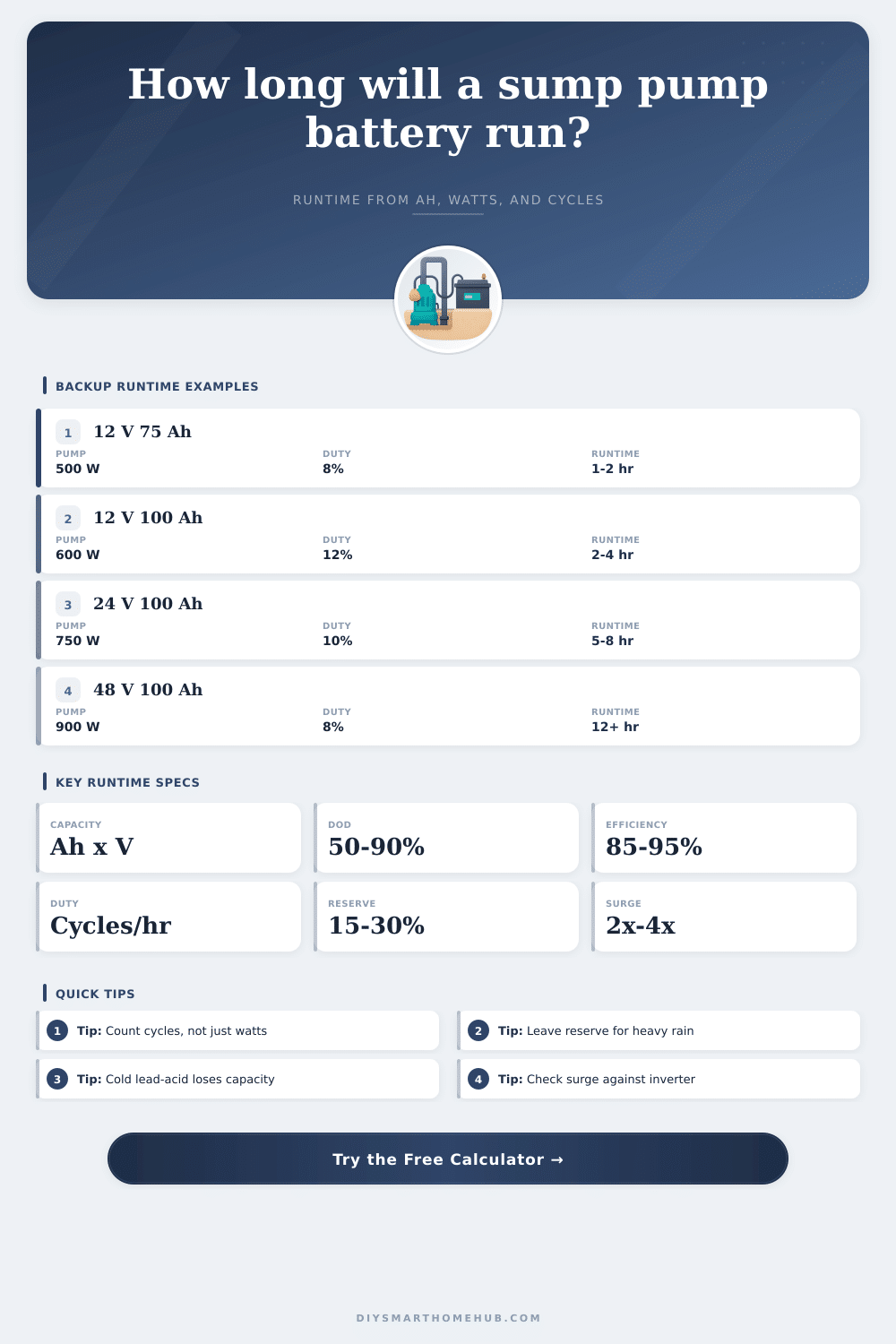
| Runtime energy | Ah x V x DoD x efficiency | Sets the battery Wh available to the pump | Higher than adjusted Wh load |
| Duty-cycle watts | Running W x duty cycle | Converts cycling into average load | Based on real cycles per hour |
| Start energy | Extra surge W x seconds x starts | Frequent starts add energy and stress | Included in average watts |
| Inverter surge | Surge W vs inverter surge W | Motor may fail to start if surge is too high | Surge rating above pump start |
| Battery current | Watts / battery volts | BMS and cables must carry running and surge current | Below continuous and surge limits |
| Backup setup | Battery bank | Assumed pump pattern | Likely runtime range |
|---|---|---|---|
| Entry backup kit | 12 V 75 Ah AGM | 500 W, 5% to 10% duty | About 1 to 3 hours |
| Standard basement bank | 12 V 100 Ah AGM | 600 W, 8% to 15% duty | About 2 to 5 hours |
| Two-battery lead-acid bank | 12 V 200 Ah AGM | 600 W, 8% to 15% duty | About 5 to 10 hours |
| Lithium backup bank | 12 V 100 Ah LiFePO4 | 600 W, 8% to 15% duty | About 4 to 8 hours |
| 24 V inverter bank | 24 V 100 Ah LiFePO4 | 750 W, 8% to 12% duty | About 8 to 16 hours |
Everything works well until it doesn’t: That’s true of livig below grade in areas of high water table or intense rainfall. For months you ignore the section between the wall and the floor, thinking that pump will take care of it. The next thing you know, there’s a thunderstorm, the power is out, the pump has died, and your beautiful hardwood floors is floating atop some gray sludge. A backup battery system are an insurance policy against that.
How big of one? What size should you get? It is hardly ever intuitive. Most folks walk into store and buy whatever they think is big enough. They do this without understanding how surge, cycling, and capacity work together, which can drain power at higher rates different than anticipated.
How to Pick the Right Backup Battery Size
If you know your battery bank and pumps accurately then use the calculator above to do math. It factors in things that rough estimations don’t. These are thing like the surge of electricity needed to start the motor. If your system can’t handle that surge, the pump won’t even turn over, making all that extra capacity useless.
Maybe your pump is rated for one-third horsepower and uses six hundred watts. However, when it starts, it may demand twice or even three times as much for just a second or two before settling down. The kicker here is that inverter must supply that power instantly. The battery bank or inverter has to shares this surge of electricity. Otherwise the pump won’t turn on… which makes all other capacity pointless. Your surge rating need some extra space so that it catches every time float switch trips.
But battery chemistry make a big difference in equation. Flooded and AGM lead-acid batteries cost less initially. But they store less useful power. It is best to run them down to roughly half their capacity so you don’t shorten there life. With safe operation, you can push lithium iron phosphate batteries to eighty or even ninety percent usage without harming them. In fact, a smaller bank of lithium may last longer then a bigger one made from lead-acid. If you look at the side-by-side comparison in usable limits on the page’s reference table, it becomes clear.
Total watt-hours stored isn’t all that matters. How many watts you can burn through before hurting your investment matter as well.
You should of know the temperature because most homeowners don’t know how much it affects things. The colder your battery gets, the less well it will do. Below fifty degrees Fahrenheit, lead-acid batteries is known for losing capacity rapidly. Your basement may be toasty warm to you. But if in January your battery is resting against a cold foundation wall, it ain’t doing what’s rated and that’s the truth. Winter storm? Derate accordingly. That’s particularly true if the outage happen overnight. Plan on keeping at least a twenty-five percent reserve to make up for lost efficiency caused by the cold.
Duty cycle is another variable that throws off simple calculations. Yes, sump pumps don’t run all day long. They cycle on/off. One that runs 30 seconds ten times an hour isn’t the same as one that runs straight for five minutes. To account for this, the calculator change them to average load. And yes, it tacks on the surge energy of each startup. That’s critical: High surge demand (lots of starts) drain batteries faster than you’d expect if they were just steadily pumping away.
You’ve got high surge demand/low duty cycle. That means your pit gets filled up fast, and then takes forever to empty out. On the other hand, you’ve got rapid fill/rapid emptying. That’s high duty cycle/repeatedly stressing connections.
At the end of the day, that’s the benefit: peace-of-mind. If it’s going to be a three-day storm, having a handle on your run time will make you feel better at 2am as you’re bailing water from the basement with a bucket. Run some scenarios through the tool. Do a multiplier for heavy rain. How long will your system last in worst case?
It is good to have a dry basement today, but it is even better if you are still dry by the time an emergency services truck pulls up to your driveway. Boring is what you want when those sirens start to wail.