Refrigerator Amp Draw Calculator
Estimate refrigerator running amps, compressor startup amps, daily kWh, and circuit headroom from nameplate watts, measured amps, volts, power factor, duty cycle, and breaker size.
Typical refrigerator amp ranges
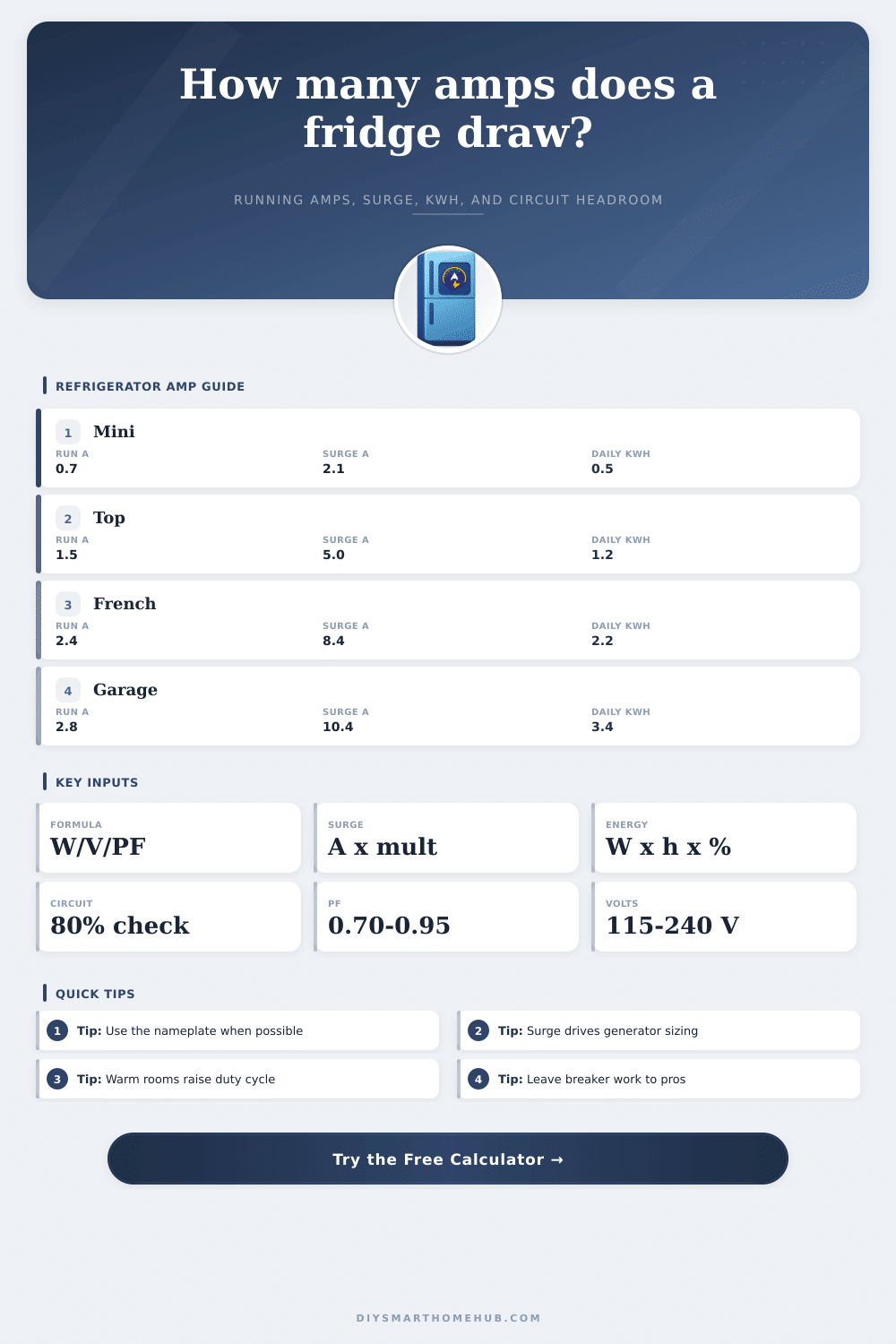
| Refrigerator type | Running amps at 120 V | Startup multiplier | Planning note |
|---|---|---|---|
| Mini fridge | 0.5 to 1.0 A | 2.5x to 3.5x | Small compressor |
| Compact apartment | 0.8 to 1.4 A | 2.8x to 3.8x | Moderate cycling |
| Top-freezer | 1.2 to 2.0 A | 3.0x to 4.0x | Common kitchen unit |
| French door | 1.8 to 3.0 A | 3.2x to 4.5x | Larger cabinet |
Formula guide
| Quantity | Formula | Use when | Output |
|---|---|---|---|
| Running amps | W / V / PF | Watts label | Compressor A |
| VA amps | VA / V | VA label | Line A |
| Startup amps | A x multiplier | Surge sizing | Peak A |
| Daily kWh | W x h x duty / 1000 | Energy estimate | kWh/day |
Duty cycle clues
| Condition | Duty range | Effect | Example |
|---|---|---|---|
| Cool room | 20% to 30% | Lower kWh | Basement |
| Normal kitchen | 30% to 45% | Typical kWh | 72 F room |
| Busy kitchen | 40% to 55% | More starts | Door openings |
| Hot garage | 50% to 75% | High kWh | Warm space |
Circuit checkpoints
| Breaker | 80% point | Fridge run target | Surge check |
|---|---|---|---|
| 15 A | 12 A | Below 3 A | Shared load matters |
| 20 A | 16 A | Below 4 A | More margin |
| 30 A | 24 A | Special circuit | Check outlet rating |
| Inverter | Use rating | W and surge | Peak watts matter |
You might wonder if something is wrong with your home’s electrical system when the refrigerator’s compressor kicks in and causes kitchen lights to flicker. It sounds like a big deal because it just happened suddenly, but all the compressor do is take a big gulp of electricity at start-up. After it quiets down its power usage is far lower. That surge lasts only under a second, but it trips breakers, and makes people who see only the average watts listed on nameplate wonder: Is that going to blow my fuses? Will it annoy my neighbors?
Enter your nameplate information into calculator on the page and do the math for yourself. Stop guessing! People also tend to confuse watts with amps and think that watts/volts = amps. Then they neglect power factor, since most motors is inefficient in extracting power from the grid compared to how much current they draws. For example, a fridge may say it’s drawing eighty-five watts. In reality, it pulls much more apparent current because magnetic fields created in compressor motor are not exactly in sync with voltage wave. If you don’t take that into consideration, then you’ll overestimate the amount of wire your circuit can handle.
How to Size Your Circuit for a Fridge
The tool takes all of this into consideration. It also lets you enter a power factor (typically ~0.7 to 0.8 for older appliances). Bottom line: It doesn’t matter what wattage an appliance draws; it matters what ampere it draws, and your breaker doesn’t care about watts. So if you’re just sizing your inverter/generator by watts, you could very easily gets surprised when the motor turns on.
There’s also the issue of startup surge, which is a primary reason for failure of inexpensive inverters. For first few milliseconds a standard compressor will pull three to six times as much current as it runs, and unless your inverter has sufficient capacity to support that instantaneous spike, it’ll fail. You want something beefy enough to handle not just the continuous demand of your appliances, but also whatever that initial spurt of current require.
That’s where the table on that page comes into play: it lists normal current draws for common fridge sizes (from miniature to giant, French doors to garage units) along with their typical “multiplier” factor (the amount by which the load increase during startup). That way you can figure out what size appliance you’re dealing with and thus know how powerful an emergency power supply needs to be. It will also help explain why your old fridge keeps tripping the breaker when air conditioner comes on in the other room: they’re battling each other for space on same circuit.
Duty cycle makes all the difference with energy bills. Your fridge doesn’t just sit there humming; it’s cycling on and off, maintaining temperatures. That duty cycle may be only twenty percent if your fridge lives in a cool basement. But move that same fridge into a sun-drenched kitchen or hot garage, and its duty cycle will spike to, say, seventy percent (or more). Even though the instant amp draw remain unchanged, the increased runtime means more total kilowatt-hours consumed during a day. That is why two otherwise-identical fridges in separate households shows different electric bills, location determines workload. Move a fridge to garage and prepare for increased daily energy usage as well as more-compressed-on/off cycling, adding wear to motor.
Leaving some margin of error is key to circuit safety. Electrical codes will generally recommend running circuits at less than eighty percent load continuously, which means on a fifteen-amp circuit you’ve got twelve amps to work with, at best. Deduct other items on that circuit (microwaves, lights), and then fit your fridge in there. If you’re squeezing things, consider devoting an entire circuit to the fridge. Not much, but it can avoid nuisance trips when you’re trying to make dinner. The last thing you want is for the toaster to come along and steal the ice cream.
First thing, look at your name plate. What are the actual numbers? They are not what the sales brochures say. Those are the ones you should of plan around. Understanding the difference between the startup surge and the running load will keep food cold and prevent your gear from melting down. Blowing fuses is a waste of money and can burn out equipment. It is all about maintaining that steady state while understanding the spike.