Extension Cord Load Calculator
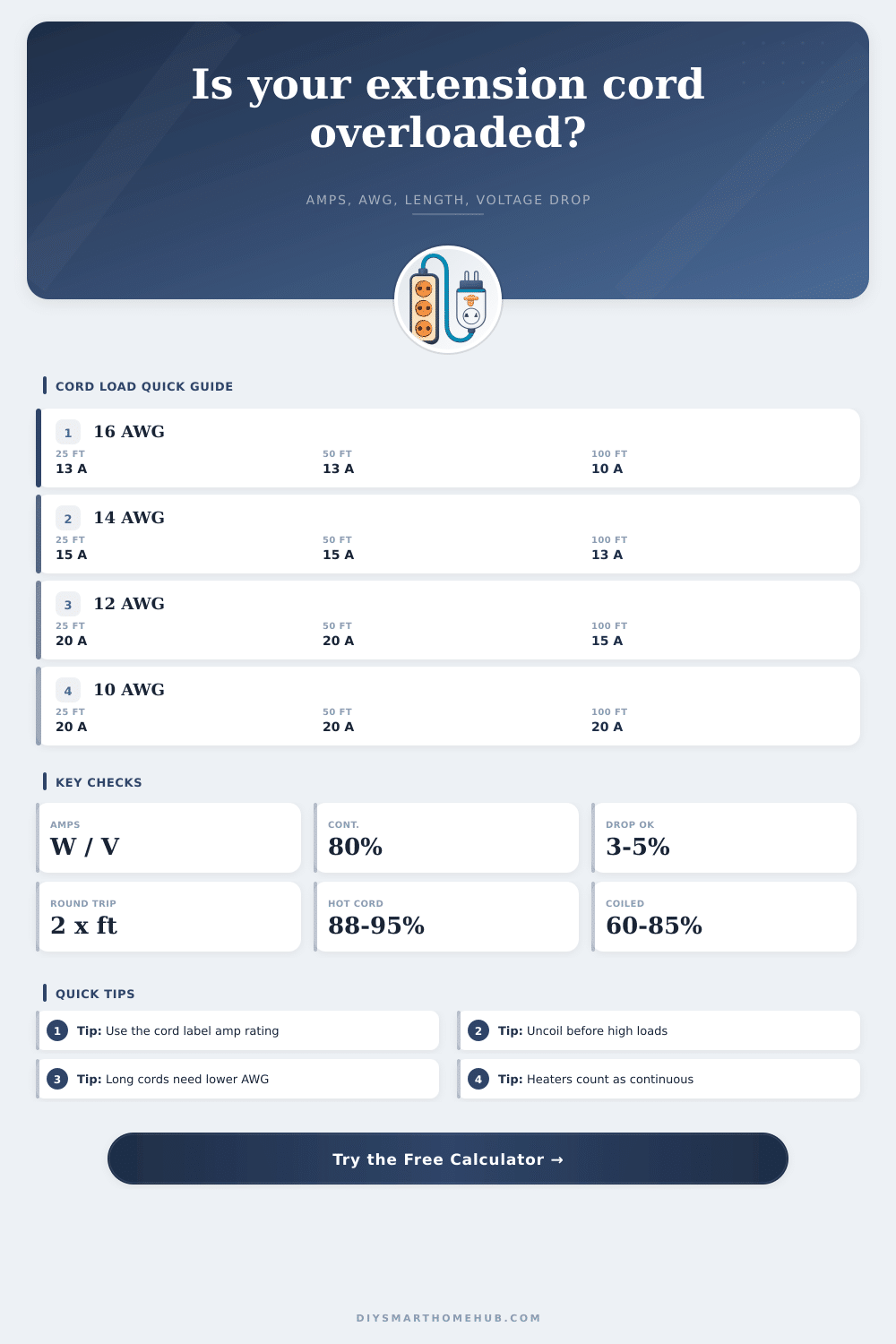
Check whether a cord is suitable for a load by converting watts to amps, applying AWG and length capacity, 80% continuous-load planning, coil and temperature derating, and round-trip voltage drop.
When watts are entered, current equals watts divided by supply volts.
Loads expected for 3 hours or more are compared to 80% of adjusted capacity.
Voltage drop uses out-and-back copper resistance for a cord circuit.
Drop equals amps times adjusted ohms per 1000 ft times round-trip feet.
| Cord size | 25 ft | 50 ft | 100 ft | 150 ft |
|---|---|---|---|---|
| 18 AWG | 10 A | 7 A | Not advised | Not advised |
| 16 AWG | 13 A | 13 A | 10 A | 7 A |
| 14 AWG | 15 A | 15 A | 13 A | 10 A |
| 12 AWG | 20 A | 20 A | 15 A | 12 A |
| 10 AWG | 20 A | 20 A | 20 A | 15 A |
| 8 AWG | 30 A | 30 A | 25 A | 20 A |
| 6 AWG | 40 A | 40 A | 35 A | 30 A |
| Cord size | Ohms/1000 ft | Round trip at 100 ft | Typical role |
|---|---|---|---|
| 18 AWG | 6.385 | 1.277 ohms | small electronics |
| 16 AWG | 4.016 | 0.803 ohms | light appliances |
| 14 AWG | 2.525 | 0.505 ohms | medium tools |
| 12 AWG | 1.588 | 0.318 ohms | heavy tools |
| 10 AWG | 0.999 | 0.200 ohms | long high loads |
| 8 AWG | 0.628 | 0.126 ohms | large portable loads |
| 6 AWG | 0.395 | 0.079 ohms | large connectors |
| Condition | Factor | Applied to | Calculator meaning |
|---|---|---|---|
| Normal ambient | 1.00 | Amp limit | Up to 86°F or 30°C |
| Warm ambient | 0.95 | Amp limit | Above 86°F to 95°F |
| Hot ambient | 0.88 | Amp limit | Above 95°F to 105°F |
| Very hot ambient | 0.80 | Amp limit | Above 105°F |
| Partly coiled | 0.85 | Amp limit | Some turns bundled |
| Mostly wound reel | 0.70 | Amp limit | Cord left on reel |
| Tight coil | 0.60 | Amp limit | Heat cannot escape well |
| Load type | Watts | Amps | Runtime note |
|---|---|---|---|
| Router and modem | 35 W | 0.29 A | continuous |
| PoE switch | 85 W | 0.71 A | continuous |
| LED work lights | 180 W | 1.50 A | continuous if left on |
| Garage freezer | 600 W start | 5.00 A | motor surge |
| Shop vacuum | 1440 W | 12.00 A | intermittent motor |
| Space heater | 1500 W | 12.50 A | continuous heat |
| Pressure washer | 1680 W | 14.00 A | motor load |
Extension cords seem pretty straightforward, right? Plug it in at one end and plug it in at the other end. Yet you can take what should of a basic electrical task (plugging a lamp into a wall socket) and turn it into an engineering project by using a low-cost, long extension cord for a big-time power consumer such as a space heater. The air will stink of melted plastic, the motor will hum and light bulbs will flicker.
Why? Most likely due to heat and resistance, two facts most people forget about when shopping for extensions cords, which they purchase purely on the basis off length: “I need a 25-foot cord,” so therefore I’ll get one marked for thirty amps and put whatever load I want on it. Wrong!
How To Choose The Right Extension Cord Safely
There’s a reason why the physics of electricity are distance-sensitve, and why wires must maintain certain temperatures. Voltage drop is the main problem. Resistance exists… Electricity flows over copper wire at a certain cost. And just like water flowing down a long hose, the further away the electricity travels, the weaker its pressure becomes. A thinner, longer cord can reduce voltage reaching your tool from one-hundred and twenty volts to one-hundred and ten volts. To make up the difference, the motor has to pull more current. This heats up the cord. This makes the motor even less efficient. This creates a vicious cycle of lower efficiency and higher cord temperature. Before you burn out something or blow a fuse, the calculator will help you visualize that tradeoff.
Coiled cords is another issue. To make life easy, many folks wrap their cords onto reels. As electrical current passes through a wire, it produces heat. When a cord is hung loosely, that heat escapes into the surrounding air. However, when it’s tightly coiled, that heat becomes trapped in the loops. That trapped heat melts insulation, which causes a significant drop in the safe amperage rating. Even though your wire may appear to be correctly sized on paper, the heat created can cause you to exceed the heat limit of the wire. It’s not only good practice to uncoil the cord when cleaning things up, it’s mandatory for long-term loads.
With constant loads, be careful. When you start up a device, there might be a brief 20-amp surge, but that won’t trip your 15-amp breaker. But if something is drawing heavily for three hours or longer, then the cord and wiring will heat up and eventualy reach a temperature where the plug will melt before the device fails. This means that while an outlet is rated to handle 15 amps, most electric codes say only 80 percent of its rating may be used for extended periods. That makes a fifteen-amp outlet effectively a 12-amp maximum for continuous appliances such as servers or heaters. Failure to follow this rule results in house fires, not appliance failure.
Gauge size matter more than brand loyalty. The American Wire Gauge (AWG) system is backward: A lower number indicates a larger/thicker wire. Twelve-gauge is heavy-duty enough for most power tools; sixteen-gauge is fine for lamps. For air compressors or welders at greater distances, you need ten-gauge. Remember: Thicker isn’t the same as longer; never replace a thinner with a longer cord. Because current capacity decreases based on length, that thin cord on a high-draw tool will compromise safety. The calculator refers to tables to determine whether your set-up is safe.
Look at the label on the cord itself. That’s where makers will put the wattage and maximum amperage it can handle on the jacket. Regardless of what your multimeter reads, if it’s labeled for thirteen amps, then it’s thirteen amps. And this is taking into account the size of conductors, the quality of the insulation, and safety margins. Treat it like a hard ceiling.
Finally, there are the ambient conditions where the cord will be used. Heat causes damage to insulation, and cold increases conductivity of copper just a bit. So running a wire outdoors in the summer on hot pavement will decrease the safe capacity of it. These limits is adjusted by the tool taking ambient temperature into account. They turn these theoretical electricity values into real-world numbers. Plug in what you want to draw in watts, then select your cord length. Then it recalculates.
And that’s why you might use a thicker cable for a new shop vac than with your old dust pan. Until electricity goes out or does some damage, you don’t see it. But when it comes to extension cords, treating them as a piece of equipment instead of just a connector will make sure an operation runs smoothly. The resistance math checks out. So heed those figures and let the juice flow from the wall to your tool in safety.