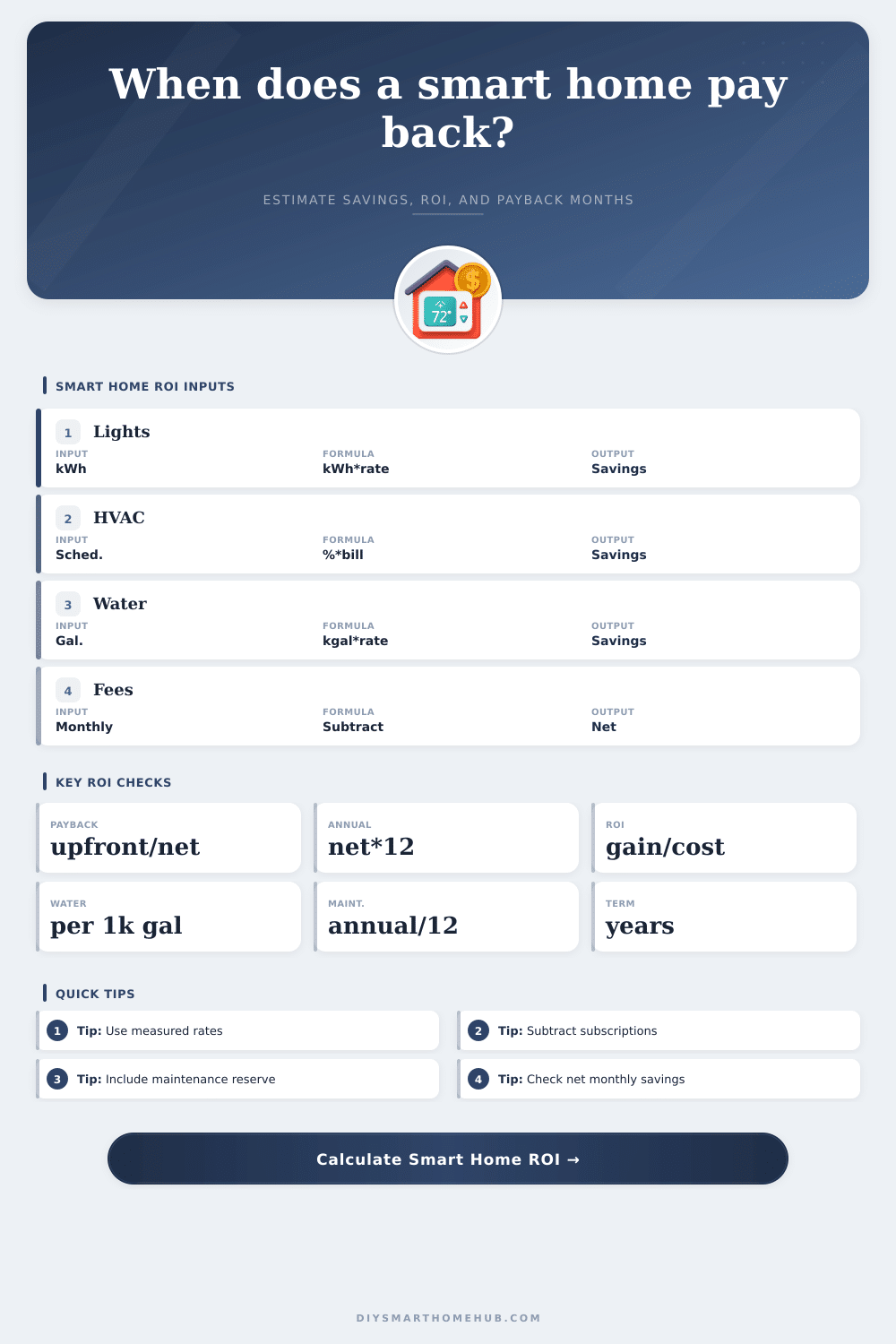
Smart Home ROI Payback Calculator
Estimate whether automation savings exceed subscriptions, maintenance reserve, and upfront spending using lighting kWh, thermostat schedule savings, standby reduction, water savings, and a chosen analysis term.
Lighting and plug-load energy savings
Thermostat schedule and water savings
Recurring adjustments
Enter assumptions, then calculate.
| Savings area | Calculator formula | Typical input | Result type |
|---|---|---|---|
| Lighting schedules | Watts x hours x days / 1000 x kWh rate | 50 to 600 W reduced | Monthly electricity savings |
| Standby automation | Idle watts removed x off hours x days / 1000 x kWh rate | 10 to 150 W removed | Monthly electricity savings |
| Thermostat schedules | HVAC kWh/month x schedule percent x rate x active months | 3% to 15% HVAC change | Annual energy savings |
| Water controls | Gallons/day x days x months / 1000 x water rate | 10 to 250 gal/day | Annual water savings |
| ROI metric | Formula | What it means | Watch item |
|---|---|---|---|
| Net upfront | Upfront spend - rebate | Amount that must be recovered | Do not go below zero |
| Net monthly savings | Gross monthly savings - monthly deductions | Cash-flow benefit after recurring items | Can be negative |
| Payback months | Net upfront / net monthly savings | Months to break even | Undefined if savings are zero |
| ROI percent | (Total net savings - net upfront) / net upfront x 100 | Return over selected term | Term length changes it |
| Scenario type | Common driver | Often limiting factor | Modeling note |
|---|---|---|---|
| Lighting only | Occupancy and dimming hours | Low wattage homes | Use actual connected load |
| Thermostat heavy | Seasonal HVAC kWh | Short heating/cooling season | Annualize then average monthly |
| Water focused | Irrigation skips and leak reduction | Flat-rate water billing | Set water rate to zero if unmetered |
| Subscription heavy | Monitoring or cloud fees | Recurring deductions | Subtract before payback |
| Project size | Upfront range | Primary savings path | Check first |
|---|---|---|---|
| Single room | $100 to $400 | Lighting and standby | Actual hours reduced |
| Apartment | $200 to $900 | Plug load and schedules | Subscriptions |
| Whole home | $800 to $3000 | HVAC plus lighting | Device replacement reserve |
| Outdoor water | $150 to $1200 | Gallons avoided | Metered water rate |
Smart home devices is primarily purchased for their convenience: You’d like your lights turned off when you exit a room, or perhaps you’re looking to teach the thermostat your schedule so it can start saving you some money by not heating an empty house. Fair enough, but there’s an economic side of this equation that we don’t talk about nearly enough. And this time around, it’s not about if it works or not as advertised; it’s about if the hardware will pay for itself relative to your utility bill.
That is a completely different perspective and will change the way you view the purchase. After plugging your own rates and savings estimates into the calculator above, it do all the math for you. No conversions or coefficients needed, so you don’t have to guess.
Will Smart Home Devices Pay for Themselves?
Before you get started with the numbers, here’s what you should know: The purchase price of one product isn’t necessarily its true upfront cost. Include the cost of sensors, hubs, and any necessary wiring. Add the cost of hiring an electrician or handyman for setup. Then, add all those figures together. Otherwise, you’ll be tempted to underestimate your total upfront cost and overestimate how quickly you can recoup your investment.
Next up are the ongoing line-item deductions. A lot of today’s products involves subscription fees for higher-level monitoring services or cloud-based data storage. These take a bite out of your overall gross savings. This tool factors them in by deducting their cost before calculating your per-month net gain. That’s where most folks fall off the wagon. Their calculations might show a possible $30/month savings on electricity usage, but they’ll overlook the fact that $5/mo goes right back out the door to some other entity for use of there service.
The one variable that’s typically the most quantifiable is the wattage of lighting, for example. You switch out your incandescents to LEDs, add occupancy sensors in lightly trafficked spaces: you know exactly how much energy has been saved, immediately.
Another low-hum drainer? It is standby power. Smart plugs can shuts down juice to items that spend 20 hours per day doing nothing but sitting there, such as kitchen appliances with digital clocks, or entertainment centers. A little bit of juice here and there, but that adds up over all the home.
The catch is knowing which saves feel like savings, and which really are. Turning a light on and off automatically doesn’t necessarily mean you would of done so yourself.
The HVAC side is more difficult to quantify unless you do some audit. You’ll read about huge amounts of savings from thermostat algorithms. But this depends on your climate zone and your home’s insulation characteristics. If your home keeps its temperature real well, there isn’t much room for improvement. If it bleeds heat like a sieve, then no matter how smart the thermostat is, it won’t overcome the laws of physics. On the calculator, you plug-in your best guess at percent reduction, so it will force you to get realistic about what is possible.
In areas where sewer costs are very expensive (and they vary widely), water saving can pay off even quicker then energy. Smart irrigation controllers and leak detectors helps avoid wasting water when you’re not home or sleeping. Even one hidden slab leak can cause hundreds of dollars worth of damage and lost resources. Avoiding that situation might save enough money to justify the cost of the whole system.
And then there’s maintenance. Devices age out of support, batteries die, sensors drift out of calibration. Reserving a little each month for those costs. Because they’re unavoidable… Grounds your projections in reality. They help avoid that rosier perspective: “I’ll save forever and it’s all perfect!”
No, life gets messy. Utility rates rise and fall; seasons change; people change their behaviors. Those thing will affect your real return on investment. The point isn’t perfection, but to establish a baseline so that you can tell whether the system is doing what you want it to do, or just collecting dust in your wallet.
Begin by trying it in one room, track the results openly, and expand only if the math adds up. That discipline turns this from a fun toy into a smart money decision.