Dehumidifier Pint Capacity by Area Calculator
Estimate the dehumidifier pints per day rating to target from floor area, ceiling height, dampness severity, room temperature, runtime, and bucket or drain setup.
Dehumidifier capacity estimate
Enter room conditions and calculate to see the recommended pint capacity and drainage runtime.
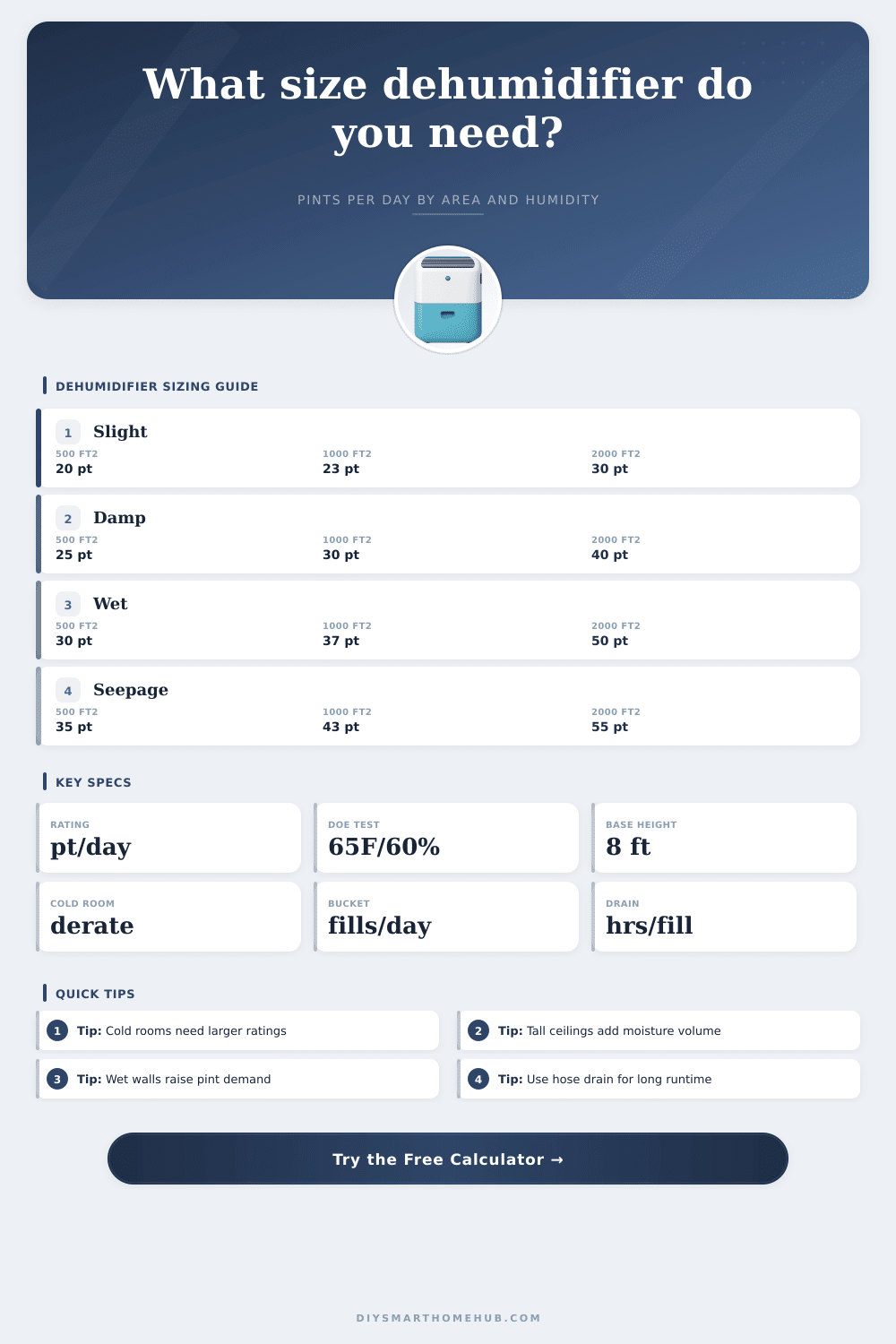
| Observed condition | 500 ft² | 1,000 ft² | 2,000 ft² | Calculator use |
|---|---|---|---|---|
| Slightly damp | 20 pt/day | 23 pt/day | 30 pt/day | Musty air, occasional humidity above target. |
| Very damp | 25 pt/day | 30 pt/day | 40 pt/day | Cool walls or floors, frequent damp smell. |
| Wet | 30 pt/day | 37 pt/day | 50 pt/day | Sweating walls, high RH, damp surfaces. |
| Wet plus source | 35 pt/day | 43 pt/day | 55 pt/day | Seepage, laundry drying, or recent water entry. |
| Room temperature | Standard compressor | Low-temp compressor | Desiccant | What it means |
|---|---|---|---|---|
| 80°F / 27°C | 115% | 110% | 98% | Warm air lets compressor units remove more water. |
| 70°F / 21°C | 103% | 103% | 97% | Close to rating conditions for most room estimates. |
| 65°F / 18°C | 100% | 100% | 95% | Portable DOE label basis is near this condition. |
| 60°F / 16°C | 82% | 90% | 92% | Cold basements need extra nameplate capacity. |
| 55°F / 13°C | 62% | 74% | 90% | Coils can run cold and may frost or cycle. |
| 50°F / 10°C | 45% | 58% | 85% | Use low-temp or desiccant assumptions cautiously. |
| Setup | Calculator output to watch | Typical practical limit | Best fit |
|---|---|---|---|
| Bucket only | Hours before bucket full | Often 6 to 24 hours | Small rooms, occasional use, daily emptying. |
| Gravity hose | Condensate pints per hour | Limited by slope and drain access | Basements, utility rooms, floor drains. |
| Condensate pump | Continuous removal demand | Needs pump capacity above hourly condensate | Sink, standpipe, or elevated discharge route. |
| Smart plug monitoring | Runtime hours and duty percent | Depends on humidistat cycling | Checking whether the selected unit is keeping up. |
| Scenario | Area | Likely capacity band | Drainage note |
|---|---|---|---|
| Small bedroom | 120 to 220 ft² | 20 to 30 pt/day | Bucket can work if humidity load is mild. |
| Cool basement zone | 600 to 1,200 ft² | 35 to 70 pt/day | Cold derate often drives a larger rating. |
| Laundry or bath area | 100 to 300 ft² | 30 to 50 pt/day | Source moisture can fill a small bucket quickly. |
| Crawlspace | 400 to 1,500 ft² | 35 to 80 pt/day | Use volume, temperature, and continuous drain logic. |
| Whole-floor open area | 1,000 to 2,500 ft² | 50 to 100 pt/day | Airflow path matters as much as nameplate size. |
You didn’t smell that water in your basement ’til there was too much of it to breathe. The musty odor that shows you have some kind of mold growing mean the ambient humidity has exceeded fifty percent mark. Before that time, the wall might be covered with condensation but you wouldn’t smell it yet. You just bought a dehumidifier rated for fifty pints; you run it for a week and your basement still feel wet.
Chances are good it’s not the dehumidifier. More often, it’s the rating sticker. Dehumidifiers is tested by manufacturers in optimal circumstances (at a temperature of seventy degrees Fahrenheit). Odds are yours is running in a basement that’s sixty degrees. Those ten degrees make all the differance, because compressors operates less efficient in cooler temperatures.
How to Pick the Right Dehumidifier
When it comes to sizing this stuff right, don’t just look at sq ft figure in that real estate listing. If two rooms are both 1000 sq ft but one has eight foot ceiling while the other has nine-foot, vaulted ceilings, there’s more air inside the latter room. To make matters worse, the extra air volume from those higher ceilings is actualy what you need to account for when drying things out.
That’s where the included calculator comes in: simply enter your room sizes plus ceiling height and it does all the math for you. Most folks never factor in vertical space at all. When they see a small floorplan they grab a small unit. Then they’re puzzled as to why their unit runs constantly or why water bucket fills up every four hours. It is because the unit isn’t getting close to desired humidity level.
The efficiency of a dehumidifier are also greatly influenced by temperature. In a conventional compressor model, the cooling coils gets so cold they frost up when surrounding air temperature drops. The machine has to stop dehumidifying and start defrosting. That’s one reason why it loses capacity while not doing anything to reduce humidity. A standard fifty-pint unit may actualy only pull off twenty-five pints if the area you’re using it in is around sixty degrees or below. Basically, you got a machine that’s operating at half its rating. The chart on the page illustrates the drop quite well: ratings falls with colder temperatures. Desiccant or low-temperature units can helps solve the problem, but they come with their own set of compromises regarding cost and energy usage.
Next is how moist the air is. Is it just kind of humid in your bedroom? Does the laundry room need some regular assistance because there’s always a wet article of clothing evaporating moisture into the air several times per day? That’s why the inputs on dampness has levels. One level is “slowly accumulating ambient humidity,” which is what I’d call “slightly damp.” Another level is “actively fighting back against evaporation from walls, floors, machines,” aka, “wet plus source.” Underestimate the burden here, and you’ll never get ahead. Your unit will start and stop until it settles into a stale pattern, not naturaly bringing the humidity to a safe level for your possessions.
Practicality also enters the picture when it comes to drainage: While it’s nice that they’re easy to drain into a big bucket, you’ll have to do so two times a day if there’s a rainy day, and who wants that? To avoid constantly emptying the bucket and to be able to run it while you are away for long periods, you would of needed something like a pump or gravity drainage via a hose. You set the estimated removal rate, and the tool will tell you how many hours you can run it before the bucket overflows. That way, you won’t come home to a puddle around your appliance because the bucket overflowed.
Don’t overbuy: Don’t purchase the biggest capacity you can possibly swing. Purchase the appropriate size for the amount of air you want to move, the conditions (temperature/moisture source) you face, and then run it efficient. You’ll save on electricity by running a small (appropriately sized) unit correctly, versus purchasing an oversized unit that needs to short-cycle its compressor constantly.
Be honest with yourself regarding the size of space. Know the true temperature when it’s cool. Have reasonable expectations about the moisture entering the room. After knowing what makes the humidity rise, selecting a dehumidifier is no longer about marketing specs, it’s as simple as physics. Respect the load and the air will remains dry.