Breaker Load Balancing Calculator
Balance 120 V and 240 V loads across a split-phase panel, check each breaker against continuous-load limits, and estimate neutral imbalance from the A and B leg difference.
| Load name | Watts | Voltage / legs | Breaker | Run time | PF | Load amps |
|---|---|---|---|---|---|---|
| Circuit 1 | -- | |||||
| Circuit 2 | -- | |||||
| Circuit 3 | -- | |||||
| Circuit 4 | -- | |||||
| Circuit 5 | -- | |||||
| Circuit 6 | -- | |||||
| Circuit 7 | -- | |||||
| Circuit 8 | -- |
Split-phase balance results
Split-phase load formulas
| Load type | Amps formula | Leg A | Neutral |
|---|---|---|---|
| 120 V on A | W / (120 x PF) | full amps | adds to A side |
| 120 V on B | W / (120 x PF) | 0 amps | adds to B side |
| 240 V two-pole | W / (240 x PF) | full amps | 0 amps |
| MWBC split | W / (120 x PF) | half load | A/B difference |
Breaker loading reference
| Breaker | 80% cont. | 125% check | Typical use |
|---|---|---|---|
| 15 A | 12 A | load x 1.25 | lighting, small loads |
| 20 A | 16 A | load x 1.25 | outlets, network gear |
| 30 A | 24 A | load x 1.25 | small HVAC, dryer |
| 40 A | 32 A | load x 1.25 | range, heat equipment |
| 50 A | 40 A | load x 1.25 | EV-ready, subfeed |
| 60 A | 48 A | load x 1.25 | large two-pole load |
Smart home planning examples
| Load group | Usual voltage | Balance note | Continuous? |
|---|---|---|---|
| Network rack and NAS | 120 V | Place opposite office load | Often yes |
| PoE camera switch | 120 V | Small but always on | Often yes |
| LED driver panel | 120 V | Can be grouped by floor | Maybe |
| Mini-split condenser | 240 V | Balances both hot legs | Maybe |
| Garage tool outlet | 120 V | Peaky noncontinuous load | Usually no |
| EV-ready circuit | 240 V | High balanced load | Often yes |
Common balance targets
| Result | Suggested reading | Neutral effect | Next review |
|---|---|---|---|
| 0-10% | Very even | Low difference | Confirm breakers |
| 10-20% | Generally balanced | Moderate | Watch continuous |
| 20-35% | Worth rebalancing | Higher difference | Move 120 V loads |
| 35%+ | Strong imbalance | Large difference | Panel review |
| Neutral near limit | Check conductor rating | Possible concern | Use electrician |
| Breaker over 100% | Load exceeds rating | Separate issue | Reduce load |
If you’ve been around a split-phase electrical panel (two hot legs), then you’ve probably heard that the wires shouldn’t get overloaded. You may or may not know that this creates all sorts of crazy trouble as soon as the two legs stop getting along. Ideally, both legs will be about equally weighted with Leg A carrying enough load, and Leg B carrying enough load to allow Leg A some space while keeping lights on. Your main breaker will trip too early if Leg A becomes over-loaded and Leg B just sits there being nothing but pretty. On paper, total house wattage appears fine. The problem is looking at the sum and missing the distribution.
The calculator up top does the math for you after you input your circuit loads. No need for you to do the coefficient conversions… just save yourself from guessing.
How to Balance Your Electrical Panel
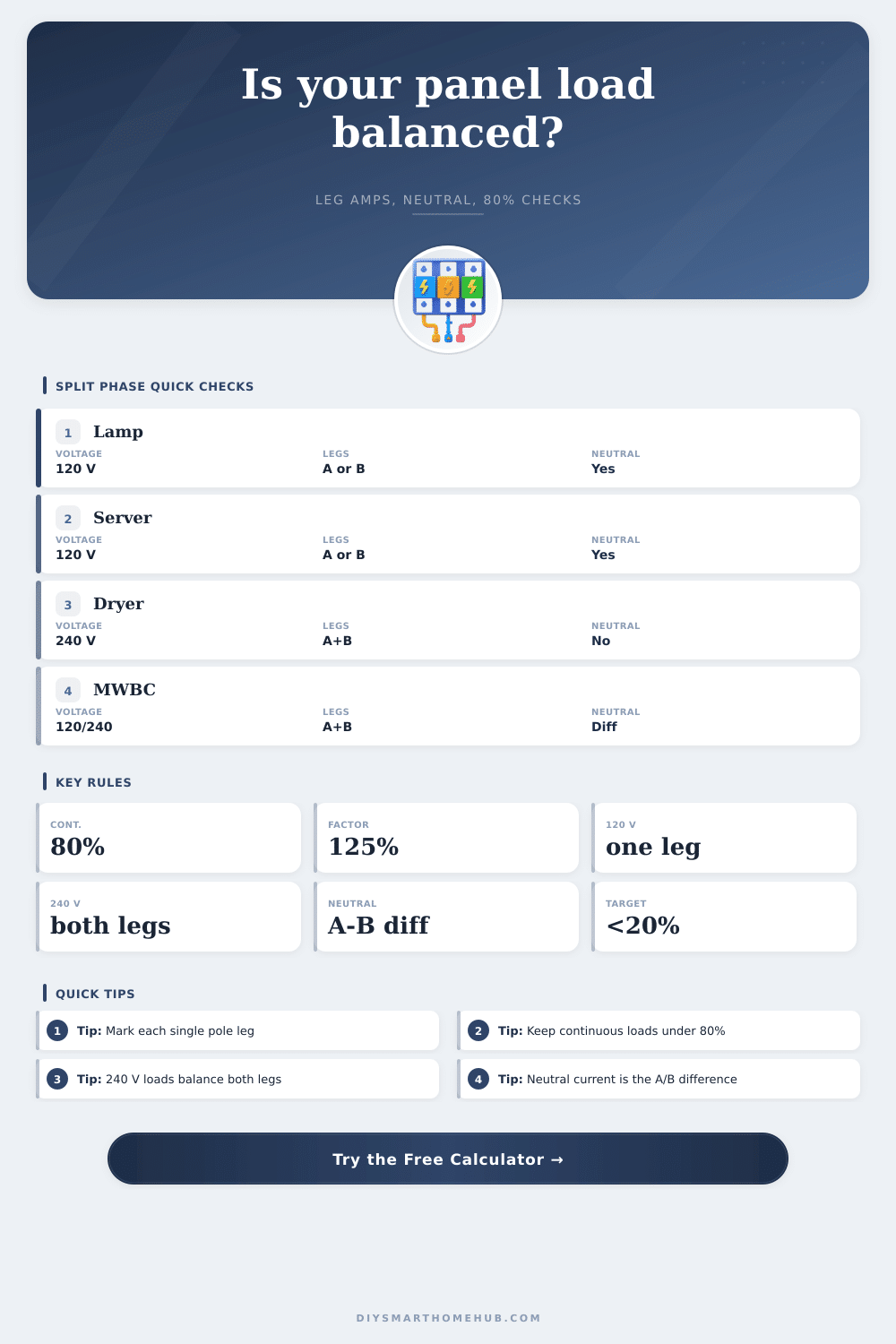
Your panel should be thought of as a seesaw. Regardless of how many kid there are on the seesaw, if you put all heavy ones on one side, it still tilts over. An electric range or dryer is a 240 volt appliance, which means it takes current off both legs at once; it just sits smack dab in the middle of the seesaw and stabilizes everything.
The key to understanding this is knowing what exactly is getting measured. Because these large appliances take equal amounts of current from A and B, there is no imbalance. The problem arises when we cram all those 120-volt circuits onto one leg. That’s where this whole “continuous loading” thing comes into play.
According to the National Electrical Code, any load that runs for over three hours must follow what is called the “eighty-percent rule.” Essentially, you cannot run anything that uses more than eighty percent of the breaker’s rating for extended periods of time. So if you’ve got some LED drivers or security cameras or a network rack that’s running twenty-four seven, those are considered continuous loads. Multiply their amp draw times one point two five, and then determine whether it will fit onto the breaker.
That’s what people miss. They look at nameplate amps and assume they’re okay, but they don’t account for the fact that the device will build up heat and need that safety margin.
The neutral wire carries the difference between Leg A and Leg B. When both legs is exactly in balance, they cancel each other and the neutral just about carries nothing. However, when one leg is light and the other heavy, remaining current must be carried back by the neutral to the transformer. Excessive current on the neutral can lead to overheating of conductors and voltage instability, frying sensitive electronics. It is a small detail, but it matters.
The percentage imbalance provides a quick health check of how evenly your power is distributed. Ideally your imbalance would be below 20 percent, but less is better. When thinking about remodeling or adding new circuits, consider which leg the single-pole breakers is on. Is it possible to move some of that 15-amp circuit onto the lighter leg? That could of solved the issue without having to upgrade anything else.
The page has a great table as a reference which visualizes how various kinds of loads shift the current around between both legs and the neutral wire. It’s neat because it will help you see where something like an easy outlet circuit might make more difference then you realize.
Keep in mind: Amps aren’t equal to power. For any particular wattage, you’re really only pulling so many amps from the wall; it depends on the power factor. Switching power supplies (like those used in moddern chargers and computers) tend to have a low power factor, which means they requires more amps to do the same amount of useful work. This can lead to a “balanced” looking panel on paper, while the panel is working too hard in real life.
These little inefficiencies are easy to forget about…until something trips when you least expect it.
Then there’s the addition of smart home. There are smart plugs. There are sensors. Little network switches runs all the time. Each pulls just a couple watts but adds up fast when spread across multiple circuits. The idea is to group those always-on devices on separate legs so you can maintain a low current on the neutrals. Why? Spreading out your static load gives you a solid foundation. This lets you start adding your dynamic loads, like kitchen appliances that turn on and off or vacuums coming in and out.
Run the numbers before breaking out the breakers Use the tool as a way of simulating rearranging circuits in your head before opening the panel door. Swap the legs around. Account for continuous loads. Observe the change in imbalance percentage. You’ll probably discover that balancing isn’t necessarily about increasing capacity but making the most out of what’s already there with some smart swaps and shuffles.
Balanced panels are cool running, long lasting panels that won’t drive you crazy with annoying nuisance trips. It is all about balance. You must keep the weight even on the seesaw so no one side tips over and dumps the load when you least expect it.