Lighting Circuit Wattage Load Calculator
Total lighting watts from fixture count and wattage, convert watts to circuit amps, check 80% continuous-load planning capacity, estimate LED fixture headroom, and derate the dimmer.
Lighting load result
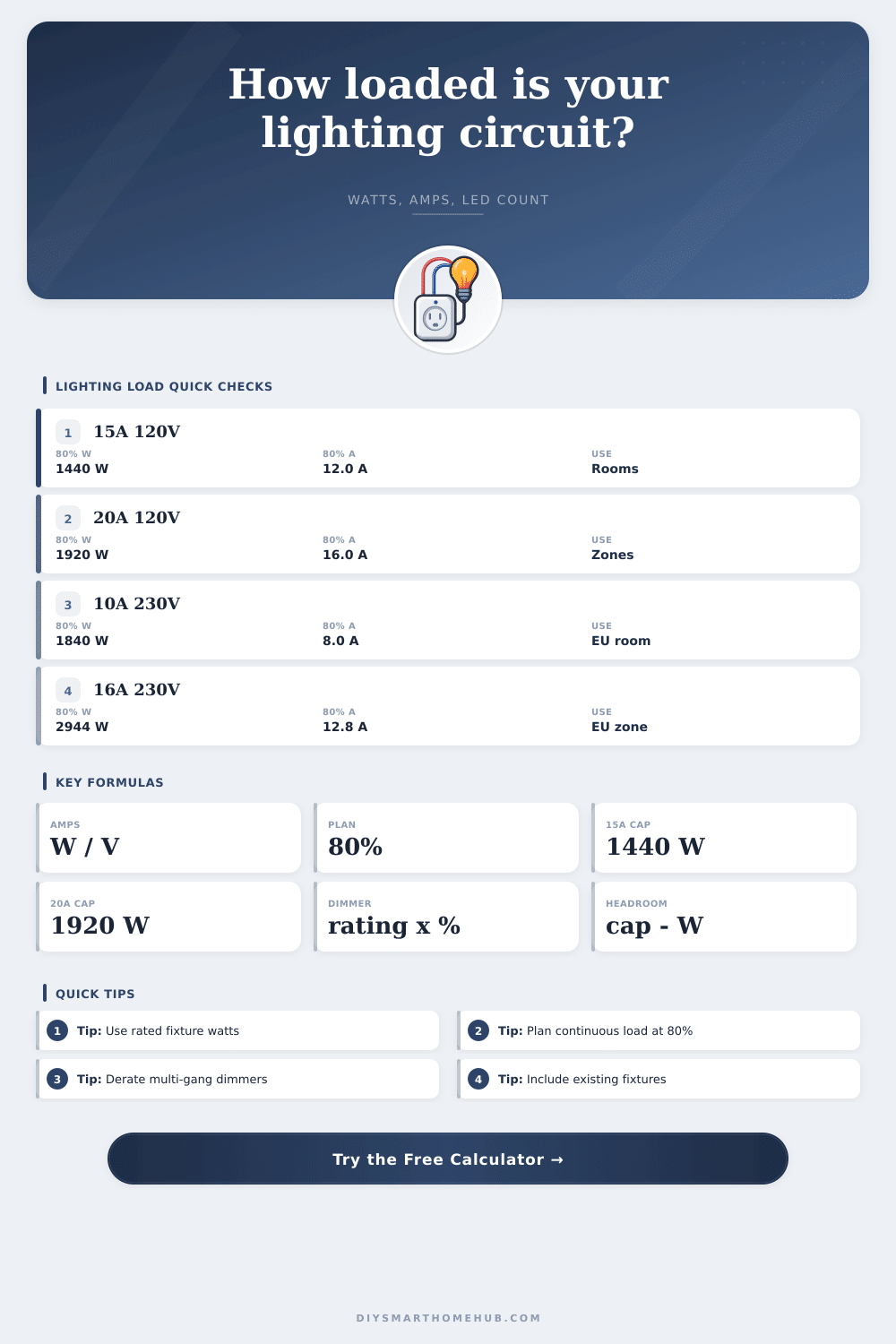
Common lighting circuit planning capacities
| Supply | Full watts | 80% planning watts | Planning amps |
|---|---|---|---|
| 120 V, 15 A | 1800 W | 1440 W | 12.0 A |
| 120 V, 20 A | 2400 W | 1920 W | 16.0 A |
| 240 V, 15 A | 3600 W | 2880 W | 12.0 A |
| 230 V, 10 A | 2300 W | 1840 W | 8.0 A |
| 230 V, 16 A | 3680 W | 2944 W | 12.8 A |
| 24 V, 5 A driver | 120 W | 96 W | 4.0 A |
Typical fixture input watts
| Fixture type | Typical input | Example use | Calculator note |
|---|---|---|---|
| LED downlight | 7 to 12 W | Bedrooms, halls | Use fixture label watts. |
| LED bulb | 8 to 12 W | Lamps, pendants | Count each lamp socket. |
| LED strip zone | 40 to 96 W | Cabinets, coves | Include driver input loss. |
| LED shop light | 35 to 55 W | Garage, utility | Count each bar fixture. |
| Fluorescent fixture | 50 to 90 W | Older utility lights | Ballast draw may add watts. |
| Halogen lamp | 35 to 75 W | Track, accent | Load rises quickly per head. |
Dimmer derating reference
| Dimmer condition | Factor | 600 W load rating becomes | 150 W LED rating becomes |
|---|---|---|---|
| Single device, fins intact | 100% | 600 W | 150 W |
| Mild heat derate | 90% | 540 W | 135 W |
| Two-gang box | 80% | 480 W | 120 W |
| Three-plus gang box | 70% | 420 W | 105 W |
| Compact enclosure | 60% | 360 W | 90 W |
| Manufacturer table | Label | Use listed value | Use listed value |
Example LED fixture counts at 80%
| Supply | Target watts | Available watts | Approx fixture count |
|---|---|---|---|
| 15 A at 120 V | 9 W LED | 1440 W | 160 fixtures |
| 15 A at 120 V | 12 W LED | 1440 W | 120 fixtures |
| 20 A at 120 V | 9 W LED | 1920 W | 213 fixtures |
| 20 A at 120 V | 45 W shop LED | 1920 W | 42 fixtures |
| 10 A at 230 V | 10 W LED | 1840 W | 184 fixtures |
| 24 V, 5 A driver | 6 W segment | 96 W | 16 segments |
It is frustrating when you flip the switch and nothing happens. Or worse, your kitchen is pitch black because your LEDs shares a circuit with your toaster. That’s usually because you don’t understand capacity. Lighting seems like a low-impact load, particularly since moddern LEDs use very little energy. But what efficiency breeds is a trap. Small individual loads makes it possible to install lots of fixtures before you hit the breaker’s limit.
The calculator above takes care of the math for you, eliminating the need to wonder whether adding one more light might trip the breaker. It’s not so much about total number of watts as it is what happens to those watts over time. Since lights are frequently lit for three or more hours at a time, electrical codes consider lighting circuits to be a continuous load and must be planned out to match. That means they apply an eighty percent rule which cuts down on what you can get out of a circuit.
Why You Need an LED Lighting Calculator
In theory, a one hundred twenty volt, fifteen amp breaker can safely take in eighteen hundred watts before tripping. But you want to plan on fourteen hundred forty watts to ensure the circuit remains safe when used for extended periods. Why? So there is no nuisance tripping while you are working or having a party.
Homeowners see the LED bulb rating and then forget the rest of the chain. Then there’s the fixture itself, which also adds electrical drag. Dimmers and other drivers is also inefficient. Even if a dimmer is rated for a one-hundred-fifty-watt LED load, that figure decreases if you install it into a tight multi-gang box containing other switches. These places gets hot, so the electronics back down their output to match. You may be able to fit enough fixtures to exceed the breaker rating, but that could of also burn out your dimmer, since you’ve neglected the derating factor. It is a small detail, but it is important if the room lights goes out.
The other point is headroom. Just because you can run sixteen LED downlights off one circuit doesn’t mean you should. Leave some space to move things around and make room for growth. Want to change out a fixture for something brighter? Got plans to add some accent lighting? Great… Leave 10% or better on each circuit as breathing room for these kinds of tweaks. Make it a planning tool instead of a calculation. Check to see whether the system will fit tomorrow’s different requirements in addition to today’s.
How does it work? The calculator makes it super simple to combine all of this. This becomes especially helpful in renovation situations when there may already be items plugged into the circuit. Older wiring may have shared lines with other appliances/outlets and taken away capacity without you realizing. Factor in those elusive watts and you’ll have a true sense of what’s available in the space. It becomes more than just an exercise; it gives you a practical guide for your own home. No more guessing whether those lights are going to flicker. You will just know how much you can safely install.
The balance between lighting quality and electrical safety is what lighting design is all about. You desire great lighting in a place that won’t blow up your breaker box. Knowing these boundaries will allow you to increase the amount of light without blowing out your wiring. Each amp are important. Each fixture counts. Respect the numbers and let’s get the lights shining brightly while you go have fun!