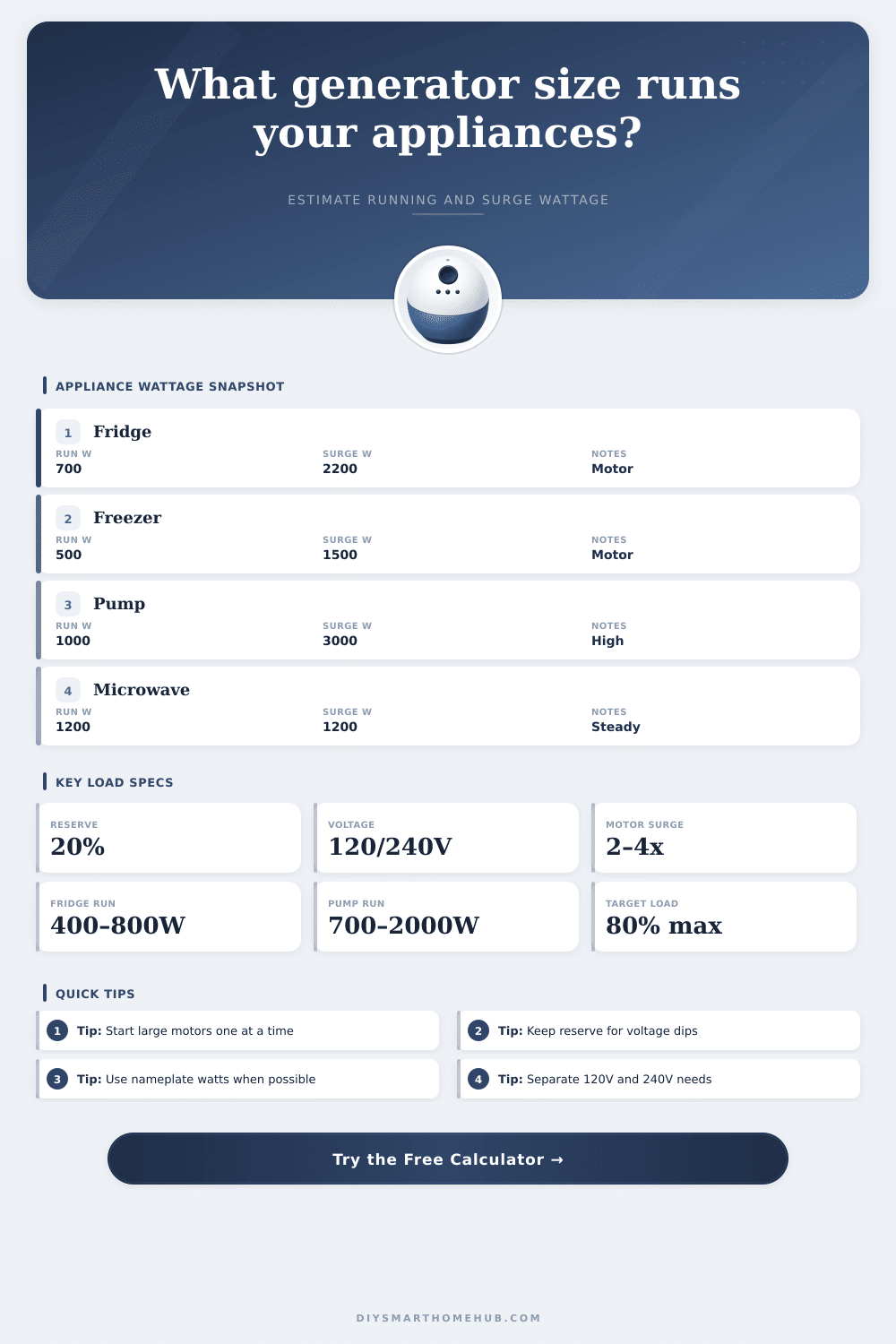
Generator Wattage for Appliances Calculator
Estimate running load, motor starting surge, reserve margin, and voltage amperage for a household generator plan.
The calculator separates steady loads from motor starting demand so the recommended generator is sized for both continuous operation and short startup spikes.
| Appliance | Typical Running Watts | Typical Starting Watts | Calculator Note |
|---|---|---|---|
| Energy-efficient refrigerator | 350-550 W | 1,200-1,800 W | Compressor cycles, not constant draw. |
| Full-size refrigerator | 600-800 W | 1,800-2,400 W | Use higher surge for older units. |
| Chest freezer | 300-500 W | 1,000-1,800 W | Startup surge is the key sizing factor. |
| Upright freezer | 500-700 W | 1,500-2,200 W | Often similar to a refrigerator. |
| Microwave oven | 1,000-1,500 W | 1,000-1,500 W | Mostly resistive/electronic load. |
| Coffee maker | 800-1,200 W | 800-1,200 W | Add as other steady load if needed. |
| Appliance | Typical Running Watts | Typical Starting Watts | Calculator Note |
|---|---|---|---|
| 1/3 HP sump pump | 700-900 W | 1,500-2,900 W | Short but demanding startup. |
| 1/2 HP sump pump | 900-1,100 W | 2,000-3,500 W | Use wet-weather overlap if likely. |
| 1/2 HP well pump | 1,000-1,500 W | 2,500-4,000 W | May require 240 V output. |
| 1 HP well pump | 1,800-2,200 W | 4,000-6,500 W | Check pump controller rating. |
| Gas furnace blower | 400-800 W | 1,000-2,000 W | Motor load with seasonal priority. |
| Oil burner system | 700-1,200 W | 1,500-2,500 W | Count controls and blower together. |
| Load Group | Typical Running Watts | Starting Watts | Calculator Note |
|---|---|---|---|
| LED lighting group | 60-250 W | Same | Add all bulbs expected at once. |
| Router and modem | 15-40 W | Same | Small but often critical. |
| Laptop workstation | 60-180 W | Same | Include monitor if used. |
| Television | 80-250 W | Same | Large screens vary widely. |
| CPAP device | 30-90 W | Same | Humidifier mode can raise draw. |
| Window fan | 80-200 W | 200-600 W | Small motor with modest surge. |
| Generator Class | Useful Running Range | Best Fit | Watch Point |
|---|---|---|---|
| 2,000 W inverter | 1,600-1,800 W | Fridge, lights, electronics | Limited motor surge headroom. |
| 3,500 W portable | 2,800-3,200 W | Basic home essentials | Stagger pump and microwave starts. |
| 5,500 W portable | 4,400-5,000 W | Kitchen plus furnace or sump | Confirm 240 V outlet if needed. |
| 7,500 W portable | 6,000-6,800 W | Well pump homes | Balance 120 V legs on split phase. |
| 10,000 W standby | 8,000-9,000 W | Large essential panels | Still manage large simultaneous loads. |
| 14,000 W standby | 11,000-13,000 W | Broader household coverage | Air conditioning may need soft start. |
| Load Type | Surge Behavior | Planning Factor | Best Practice |
|---|---|---|---|
| Compressor | Brief high spike | 2.5x to 3.5x | Allow fridge startup before adding pumps. |
| Well pump | Heavy motor start | 3x to 4x | Use 240 V if the pump requires it. |
| Resistive heater | No motor spike | 1x | Count full steady wattage. |
| Electronics | Minimal spike | 1x to 1.2x | Group with small steady loads. |
| Blower fan | Moderate motor start | 2x to 3x | Prioritize heating before convenience loads. |
| Sump pump | Frequent cycling | 2.5x to 4x | Keep reserve when rain is active. |
It’s late November, a Tuesday evening; the power flickers and then it’s gone. And now what? Your first thought isn’t that your looking at a darkened space. It’s how to get heat going again. It’s how to get water running and food kept cold, all with limited supply of fuel.
Most people tend to do what comes naturaly: buy the most powerful generator they can, plug everything in, and go. Usually this mean having a tripped circuit breaker… Or a very costly error, within 20 minutes of switching that motor on.
How to Choose the Right Generator Size
Backup power sizing has as much to do with sequence, timing and knowing the behind-the-scenes requirement of each appliance as it does sheer horsepower. That’s the heart of the matter: How do you tell the difference between surge watts versus running watts?
For instance, when you read nameplate on your fridge, you’ll find a reasonable wattage; maybe something like 600 watts. What that doesn’t include is the additional burst of power needed to start the thing after being off for a while. While it’s only for a few seconds, motors requires much more current at startup than during normal use, often two to four times their operating load. Therefore if you don’t have enough grunt in your generator to get through that instantaneous peak, it will trip and shut down before you ever get the lights plugged in.
And there’s where the calculator comes into play: Once you key in all of your appliances’ details, it crunches numbers for you so you don’t need to worry about following all these passing peaks and valleys from device to device. This is an important insight that shapes your thinking about inventory. It’s not as simple as just adding up total number of watts in the house. Rather it’s about figuring out most critical loads, and what order those should come online.
Perhaps your water well pump pulls two thousand watts when it starts up and only draws twelve hundred while running. Your furnace blower might pull eight hundred to get moving, and four hundred once there’s airflow. What happens if the well pump and furnace both kick on simultaneously? You can see how total immediate draw shoots way up.
The tool lets you modify all-at-once load factor, and that gives you a real-world knob for modeling whether you think all your motors is going to turn on together, or whether some of them will stagger through their cycles. Keep that setting down low because more realisticly, none of your appliances tend to start perfectly in synch.
The other variable that seems like an afterthought but acts as your insurance policy is reserve margin. Adding twenty percent extra capacity isn’t a waste of money; it acts as your insurance policy. This is simply about taking into account aging equipment that require more current over time. It also accounts for voltage drops when heavily loaded and the occasional impulse to plug in one more space heater during a cold snap. If you run a generator at its absolute maximum rating, it will produce poor power quality (which damages sensitive electronics such as laptop chargers and routers), and the engine won’t be very efficient. Having some headroom means the engine runs smoother and lasts longer when running long periods of time.
Many folks forget about what voltage their biggest load will draw. One-hundred-twenty volt standard residential outlets is just dandy for little things like computers, lights and kitchen appliances. But many of those big air conditioners and HVAC units as well as deep well pumps can’t run at all or won’t run very long without two-hundred-forty volt power. If your backup plan includes maintaining water pressure, you’ll want to use a generator capable of running dual-voltage or split-phase power. Reading the label on your pump controller is better different than guessing from the hp rating in the manual.
After you’ve got those core loads identified, it’s really just a matter of figuring out how many electrons you can afford, i.e., budgeting for watts. If both their microwaves and sump pumps turns on at once, well, that’s one watt for the microwave and one watt for the sump, so no watts left for either.
Medical equipment such as oxygen concentrators or CPAP machines take priority over comfort items, which should of been considered a luxurius load in a power outage. Next is infrastructure: things like heat and water. Next are comfort item.
For unknowns, those appliances that lack an obvious wattage label, or whose label has faded; there are some rough guides from common household appliances in the reference tables accompanying the calculator.
In the end, your optimal generator plan isn’t about running everything. It’s about running what needs to run. You need to be confident it will work without blowing the breaker. That next time the lights go out, you’ll know precisely where electricity flows and why, turning a catastrophic event into a manageable inconvenience.