Breaker Fill Calculator
Plan panel fill from labeled spaces, maximum circuits, existing breaker poles, tandem allowance, planned circuits, and continuous-load breaker sizing.
📋Panel Planning Presets
⚡Panel And Breaker Inputs
Breaker fill estimate
Calculation breakdown
📊Breaker Planning Spec Grid
📐Reference Tables
| Breaker type | Physical spaces | Circuits counted | Planning note |
|---|---|---|---|
| Full-size 1-pole | 1 | 1 | Common 120 V branch circuit for lighting or receptacles. |
| 2-pole common-trip | 2 | 2 | Common 240 V load or feeder; it occupies two adjacent panel spaces. |
| Tandem / duplex | 1 | 2 | Two 120 V circuits in one space where the panel label permits it. |
| Quad breaker | 2 | 4 | Special panel-listed layout; verify handle ties, common trip, and labeling. |
| Panel label style | Physical spaces | Maximum circuits | What it means |
|---|---|---|---|
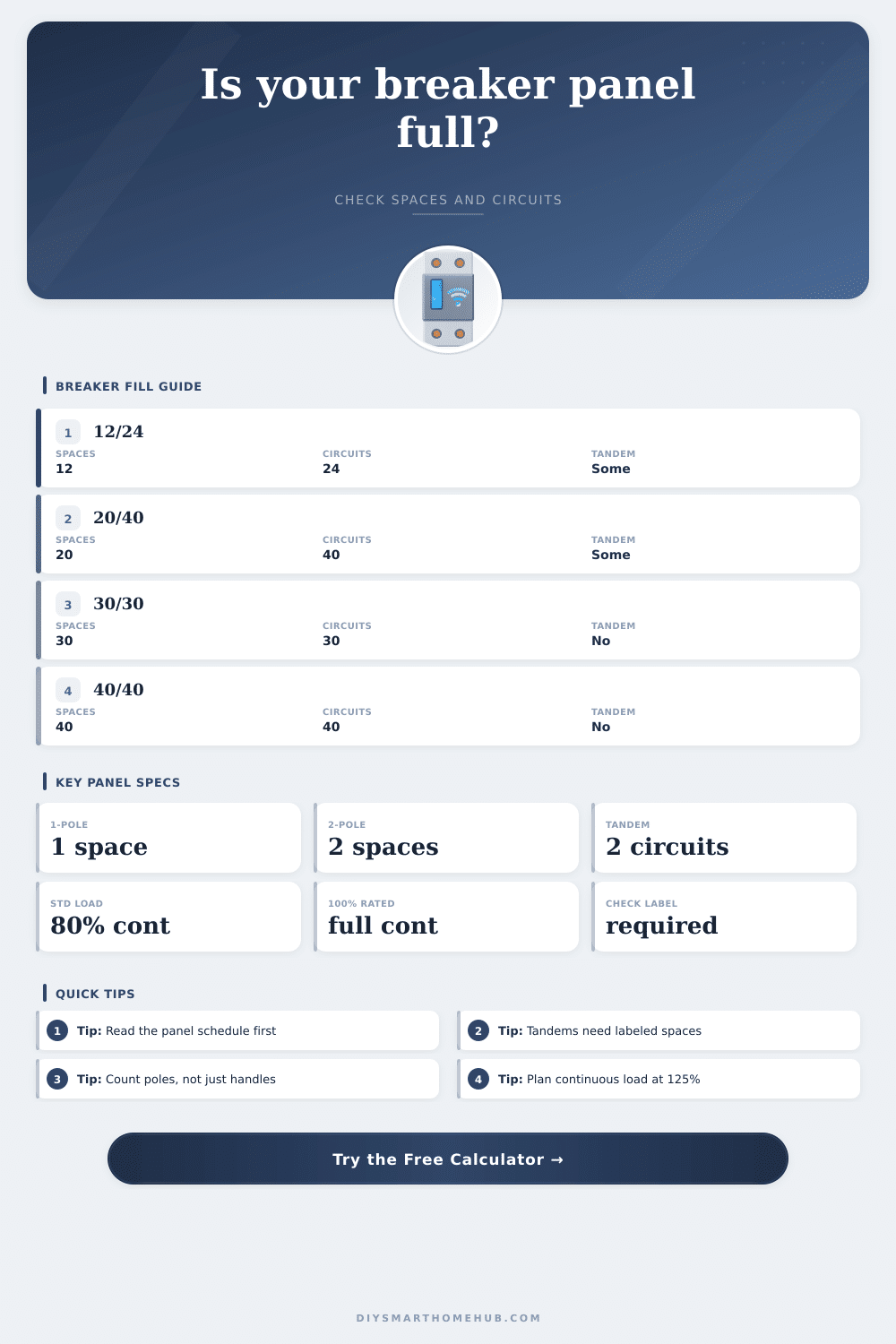
| 12/24 | 12 | 24 | May permit tandems in some or all labeled spaces. |
| 20/20 | 20 | 20 | Spaces and circuit limit match, so tandems usually do not add capacity. |
| 30/40 | 30 | 40 | Only the labeled tandem positions can raise circuit count above spaces. |
| 40/80 | 40 | 80 | Large loadcenter label that may allow many tandem or quad positions. |
| Breaker rating | 80% continuous planning | 100% rated assembly | Formula check |
|---|
| Scenario | Added circuits | Likely spaces | Planning focus |
|---|---|---|---|
| Smart home hub | 1-2 single-pole | 1-2 | Often space-limited only when the panel is already near full. |
| Kitchen remodel | 4-6 single-pole | 4-6 | AFCI/GFCI needs may limit tandem options even if space exists. |
| EV charger | 1 two-pole | 2 | Panel fill is separate from service/load calculation capacity. |
| Heat pump add | 1-2 two-pole | 2-4 | Outdoor unit, air handler, and heat strips may need separate breakers. |
| Workshop | 3-6 mixed | 4-8 | 2-pole tool circuits quickly consume physical spaces. |
⚖Comparison Grid
| Option | Space impact | Circuit impact | Use when |
|---|---|---|---|
| Add full-size breakers | Uses one space per pole | Simple one-for-one count | Open spaces and open circuit count both remain after the plan. |
| Use listed tandems | Saves one space per pair | Consumes two circuit positions | The panel label allows tandems and the circuit type does not require full size. |
| Add a subpanel feeder | Usually uses two spaces | Usually counts as two poles | More breaker positions are needed, while service/load capacity is confirmed separately. |
| Replace panel | Resets space constraint | Uses new labeled limits | Existing panel is at its labeled limit or lacks needed breaker types. |
🔧Breaker Fill Tips
Every homeowner knows how many things is plugged into their wall outlets, but few understand the contents of that electrical panel in the hallway closet. Can I install another circuit for my electric car charging? Or put in an outlet for my new garage door opener? You might see the same black handles and think there is the same number of allowed circuits.
However, those limits are not based off physical space. They depend on the panel’s fill, electrical code, and label from the panel maker. Misunderstanding results in either improper installation, which trips instead of melts, or failed inspection, leaving your house unsafe.
How to Check Your Electrical Panel Capacity
Circuits are not spaces. Spaces and circuits is not the same thing. While a standard single-pole breaker take up one slot and provides one circuit, tandem breakers can stuffs two circuits into physical space of one. A standard single-pole breaker occupies that space. A range or dryer double-pole breaker use two adjacent slots but remains a distinct entity in other respects. Two circuits can occupy the physical space of one slot with tandem breakers. They is allowed only if the panel manufacturer specifically authorizes them.
Many old panels prohibits tandems completely. Using one where they’re not permitted voids safety listing of the whole assembly. It is a liability problem pretending to be a storage hack.
Breaker panels vary in how many actual slots they has for breakers and whether they allow tandem breakers in some spots but not others. Read label on the inside of the breaker panel door before you purchase any new breakers. That label will list total max # circuits allowed. Then use the breaker fill calculator to enter that information along with what’s there already and it will tell you precisely where you can fit more breakers for future projects.
Note: This is the difference between available circuit capacity and open physical slots. If you’re adding a feed for a workshop or a heat pump, these are two different number. To plan, remember: It’s not just the gauge of the wire; it’s also the load duration. In the National Electrical Code, any load running for three hours or longer is considered to be continuous. While your kitchen lights may go on and off intermittently, a fridge compressor or an HVAC unit frequently run long enough to count as continuous. Generally speaking, this means that you can’t use the full rating of a standard breaker on such loads. Instead, you’d have to size the circuit based on eighty percent of the breaker capacity. That is, with a twenty-amp breaker you would only have sixteen effective amps available for continuous duty. This is because the breaker (and the wiring) is protected from being overloaded over time.
Pushing a panel to its limit is important. If you routinely hit the wall on either circuit count or space (or both), adding a subpanel is often the cleanest solution. It use two slots in the main panel but otherwise opens up a whole new set of spaces elsewhere. That’s easier than replacing the main service entrance (a much bigger and more expensive job) or trying to jury-rig tandems into forbidden spots.
The table on the page show how various breaker types impact both circuit and space counts, side by side. That makes the tradeoffs clear so you can decide if you really need extra capacity, or can consolidate existing circuits. We must respect the limits of the equipment while managing our daily power needs and the panel. I don’t expect anyone to be an electrician but we all can learn and respect the numbers on label inside the panel door. Whether installing one outlet or remodeling the whole house, knowing what your fill status is will keep you from costly errors in the future.
That mysterious box of metal becomes more than a cause for concern; it’s now something you can manage as part of the setup of your home. Then when you turn on the new light for the first time, it shines a little brighter knowing that it was done right. You should of checked things earlier so it would of been smoother. Actually, those moddern panels is hard to understand. If people could recieve better info, they might not have such luxurius problems with electrical work. It’s naturaly easier when you know the facts.