Roller Shade Size Calculator
Calculate roller shade fabric width, finished drop, cut length, tube wrap, side gaps, mount deductions or additions, and fabric roll width fit.
📌Roller shade presets
📏Window, mount, fabric, and tube inputs
Roller shade sizing result
Finished shade dimensions and fabric cut length will appear here.
🧵Shade spec grid
📊Reference tables
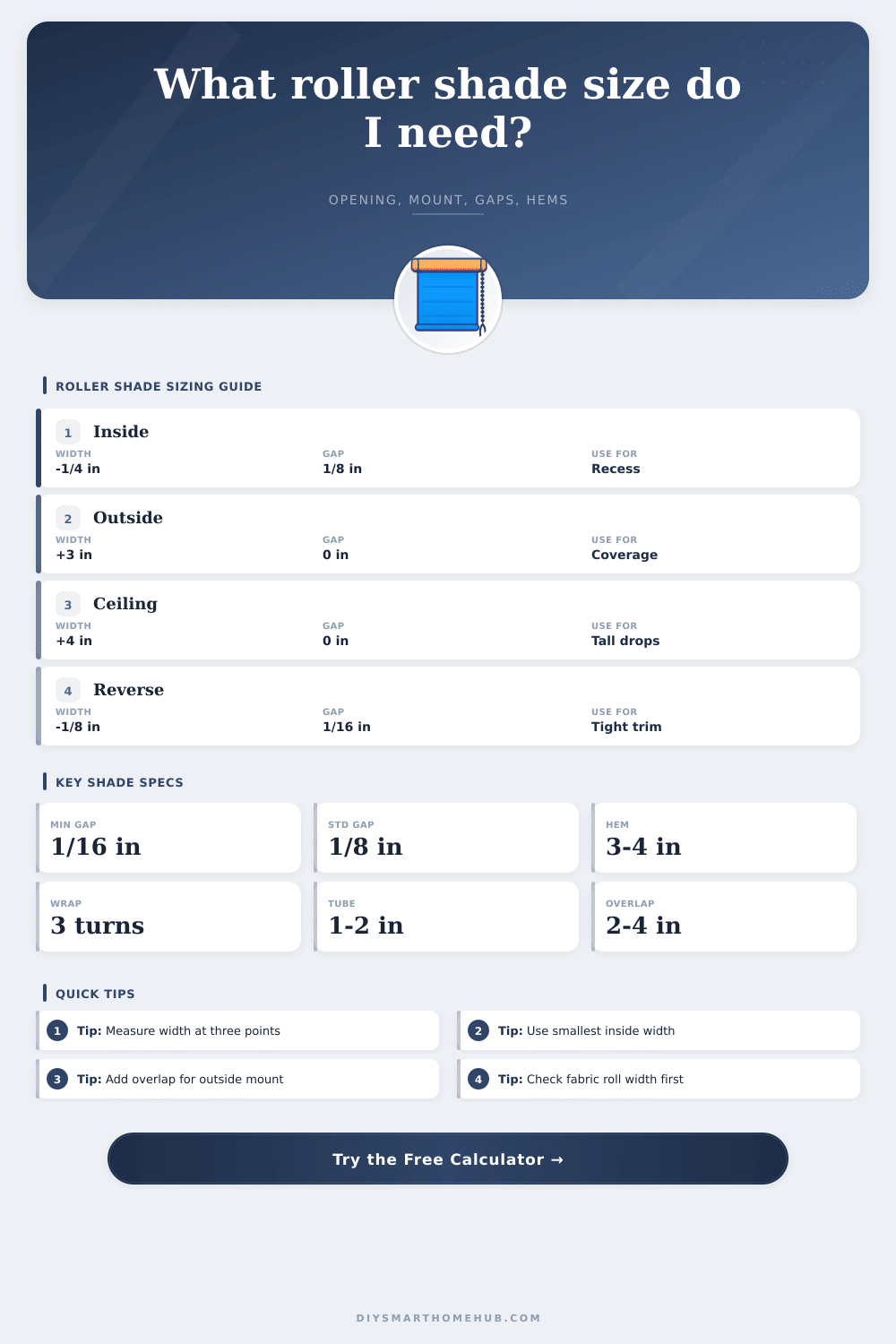
| Mount type | Width adjustment | Drop adjustment | Typical side gap |
|---|---|---|---|
| Inside mount recess | Deduct 1/8 to 3/8 in from opening | Deduct small bottom clearance | 1/16 to 1/8 in per side |
| Outside mount overlap | Add 2 to 4 in total coverage | Add 2 to 4 in below opening | Often 0 in fabric gap target |
| Ceiling mount overlap | Add 3 to 6 in total coverage | Measure full ceiling-to-stop drop | Often 0 in fabric gap target |
| Reverse roll tight trim | Deduct 1/8 in for trim clearance | Use exact drop plus pocket allowance | 1/16 in per side when hardware allows |
| Tube diameter | Circumference | 3-turn wrap | Best use |
|---|---|---|---|
| 1.00 in | 3.14 in | 9.42 in | Small shades and short drops |
| 1.25 in | 3.93 in | 11.78 in | Common residential shades |
| 1.50 in | 4.71 in | 14.14 in | Wider shades or heavier fabric |
| 2.00 in | 6.28 in | 18.85 in | Tall drops and large openings |
| Fabric type | Recommended gap | Hem allowance | Sizing note |
|---|---|---|---|
| Solar screen | 1/8 in each side | 2.5 to 3 in | Open weave can reveal uneven edge trimming |
| Light filtering | 1/8 in each side | 3 to 4 in | Balanced choice for most window openings |
| Blackout | 1/16 to 1/8 in each side | 3 to 4.5 in | Outside overlap reduces edge light gaps |
| Woven texture | 1/8 to 3/16 in each side | 3.5 to 5 in | Thicker fabric may need wider bracket clearance |
| Project preset | Opening size | Mount basis | Main sizing focus |
|---|---|---|---|
| Inside bedroom | 35 x 58 in | 1/4 in width deduction | Clean recess fit with standard gaps |
| Outside living | 48 x 60 in | 3 in added width | Better side coverage over trim |
| Patio door | 72 x 80 in | 4 in added width | Wide roll width and larger tube check |
| Metric condo | 110 x 150 cm | Outside overlap | Metric entry with cm conversions |
💡Roller shade sizing tips
When measuring a window, there’s more than simply noting two numbers on your tape measure. You might not realize it, but fractions of inches matter when laying out measurements. They can make the difference in whether a shade fit cleanly or jams into the frame. That’s where a roller shade size calculator comes in handy, it help fill in the gap from the bare opening measurements to the final fabric pieces that gets cut and hung.
So how does this work? It’s more complicated than just knowing what those numbers represent. What you see when you glance at that thing is a representation of your windows physical limitations on the fabric. Most people mess up by selecting their mount type. With an inside mount, for example, subtractions will be made so the roller tube fit into the small depth of window jamb. For outside mounts, additions are calculated to allow enough coverage over any trim or wall.
How to Measure Your Window Correctly
The math is simple enough, but it is not forgiving if you miss something. A half-inch off on the width deduction and suddenly your fabric is catching on the sill with each lift of the shade. The width considerations aren’t the whole deal. Vertical measurements involve far more variables than most people think. Consider how much room you need at the top for the fabric to stick to the tube itself. You also need room at the bottom for whatever weight bar or roller mechanism are being used, plus some extra for the hem allowance. And then there’s the wrap allowance. When the shade is up, it doesn’t completely roll back on itself onto a small spool. There are still a few turns of fabric left on the drum. So if you were to cut your fabric to match your window, the bottom would of been several inches higher than expected.
By plugging in your desired wrap and the tube diameter into the calculator, it figures all these math equations for you so that you don’t have to order too little (or worse…be stuck with an awkward short drop). There’s one more wrinkle: how does the fabric itself behave? Raw measurements don’t account for that. Is it a light and airy linen blend or a dense, heavy blackout vinyl? Will the thicker material bind in narrow brackets if the side gap isnt just a bit wider? To address this, the tool will update its recommendations depending on which kind of fabric you choose. So not only do you have to think about your hardware and your soft goods together, but it also gently guides you toward proper clearances. When dealing with tight tolerances, it doesn’t let you forget about actual bulk of what you’re using.
Then there is the usable width of your fabric roll. Many times your fabric bolt will be ninety six inches wide (standard), however if it’s pattern matched, or has selvage edges this may not be true. The calculator will determine if your cut width will fit on a normal roll without having to have a seam. Seams on roller shades are typically viewed as bad since they don’t look finished and can lead to tracking problems. If the tool flags your width, you’ll immediately see if you must either turn the grain of the fabric or if you should plan on ordering custom width. It is a small thing, but it is something to consider when planning how much fabric you’ll need.
You should take several measurements because many DIYers don’t, and window frames does warp over time. Chances are the top and bottom width are not equal. If you’re doing an inside mount, use the narrowest measurement so you don’t get all jammed up when installing it. If doing an outside mount, give yourself a little more coverage to help cover up any irregularities in the line of the trim or wall. This helps protect your work from flaws in the home itself.
So how do I size my roller shades? You do it with some flexibility. It’s not an exact science; it’s more like planning for reality. The calculator provides a starting point, taking into account all those pesky variables: hem allowances, wrap losses, etc. So yes, you’ll want to confirm your sizing using a real-life tape measure (before you commit to cut). But knowing those variables in advance makes what could be a confusing tangle of numbers into a clear-cut game plan. When the math adds up on screen, hanging the shade is easy. Don’t forget to allow for error; fabric has a mind of its own, and perfect frames are few and far between.