String Light Length Calculator
Estimate outdoor cafe light length from patio span pattern, anchor distances, sag percentage, hanging drops, socket spacing, perimeter or zigzag layout, lead length, slack, and strand maximum length.
String Light Plan
| Hang style | Typical sag allowance | Slack reserve | Best use |
|---|---|---|---|
| Taut guide wire | 2% to 5% | 4% to 6% | Permanent patio runs where support cable carries the load. |
| Cafe swag | 6% to 10% | 6% to 10% | Decks, pergolas, and backyards with visible gentle arcs. |
| Loose party drape | 10% to 15% | 8% to 12% | Temporary events, fabric tents, and soft canopy lighting. |
| Dense canopy | 4% to 8% | 6% to 10% | Close parallel runs where spacing matters more than deep sag. |
| Long open span | 8% to 14% | 10% to 15% | Yard spans between trees, poles, walls, or detached anchors. |
| Bulb look | Socket spacing | Approx sockets per 50 ft | Visual density |
|---|---|---|---|
| Mini globe or fairy cafe line | 6 to 12 in / 15 to 30 cm | 50 to 100 sockets | Dense sparkle for railings and small balconies. |
| Compact patio bulbs | 12 to 18 in / 30 to 46 cm | 33 to 50 sockets | Even light on pergolas and small decks. |
| Standard Edison cafe bulbs | 24 in / 61 cm | 25 sockets | Classic backyard and restaurant patio spacing. |
| Large event bulbs | 30 to 36 in / 76 to 91 cm | 17 to 20 sockets | Open, festive canopy with fewer bright points. |
| Commercial festoon runs | 36 to 48 in / 91 to 122 cm | 13 to 17 sockets | Long lanes, tents, and overhead event swags. |
| Layout mode | Distance inputs used | Length formula before sag | When to use it |
|---|---|---|---|
| Separate anchor spans | A + B + C + D | Sum of all entered direct spans | Independent runs between posts, walls, trees, or fence points. |
| Perimeter rectangle | A long side, B short side | 2 x A + 2 x B, plus C and D if entered | Deck edges, balcony rails, courtyards, and patio borders. |
| Zigzag canopy | A length, B width, lane count | Lanes x diagonal between alternating sides | Overhead canopy where strands bounce side to side. |
| Pergola grid | A length, B width, run count | Runs x A plus cross runs x B | Parallel runs with a few cross ties over rafters or beams. |
| Radial spokes | A radius, spoke count | Spokes x A, plus optional rim C or D | Center pole, tree, firepit, or tent hub layouts. |
| Project | Typical measured span | Suggested sag | Planning note |
|---|---|---|---|
| Small apartment balcony | 18 to 30 ft / 5.5 to 9.1 m | 3% to 6% | Short lead length can be the deciding factor. |
| Dining deck perimeter | 55 to 85 ft / 16.8 to 25.9 m | 5% to 9% | Measure the real railing path, not just deck size. |
| Backyard zigzag canopy | 80 to 160 ft / 24.4 to 48.8 m | 8% to 12% | Diagonal lanes often need more length than expected. |
| Wedding tent or pavilion | 180 to 350 ft / 54.9 to 106.7 m | 10% to 15% | Separate long runs when product max length is limited. |
| Market booth frame | 35 to 55 ft / 10.7 to 16.8 m | 2% to 5% | Socket density matters more than deep swag. |
Measuring the deck instead of the wire path is your first mistake outdoors. Your twenty-foot patio may actualy translate into thirty feet of wire, since there are heights and angles involved between that large oak post and the wall sconce on the opposite end. Then there’s gravity dragging the copper cable down, causing it to droop. Buy exactly twenty feet of cord, and those bulb will dangle six inches from the ground, all sad necklaces in a discount bin.
Plug your layout style and anchor distances into the calculator above and the math is done for you. You won’t have to guess about conversions and coefficients that tend to trip up most weekend DIYers. The key here is to understand what we mean when we say “sag.” By definition, the shortest distance between two points is a straight line, except that lights aren’t hung from a tautly stretched guide wire; they’re not hanging in straight lines. It is better to have them softly curved, it puts less stress on mounting hardware. They look more attractive.
How to Measure Your String Lights
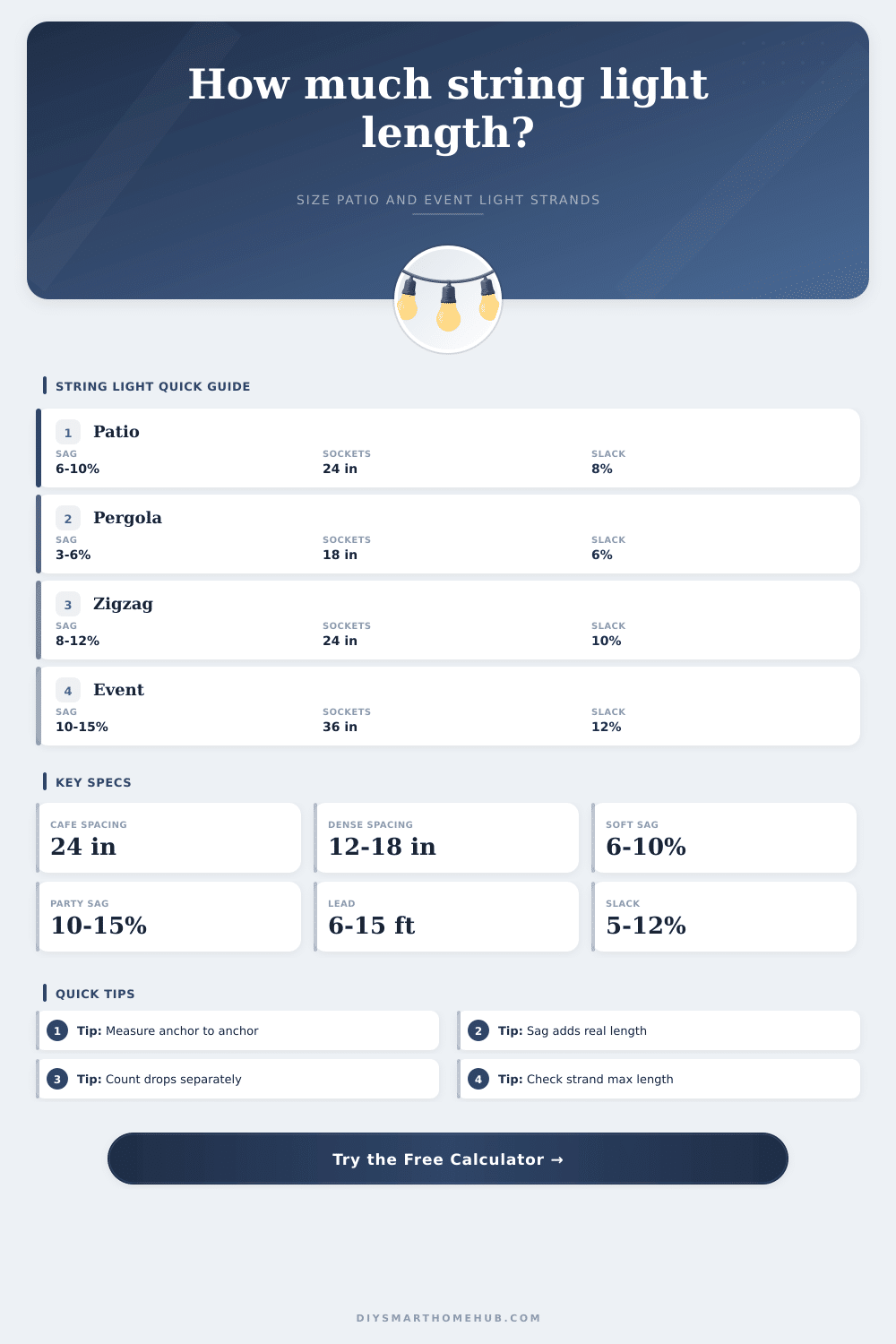
That gentle curve lengthens the run. On average, you’ll want about 6-10% more length for each span (between anchor points) then the total desired overall length of a normal cafe swag run. This is not to account for the possibility that something might shift, but rather because it is geometry. If you’re having multiple runs, the calculator will ask for the sag %/span. This way it can properly multiplies the number based on the correct span number for each run. This avoids an underestimate of a few critical inches at the end where everything connects.
The number of inches between sockets determines whether a string of them is more like an atmosphere or a useful task light. Tighter means a dense glow, lush-looking from afar, but conceals the individual bulbs. Further apart means each becomes a focal point by itself, that’s great if your driveway (or long tent) is so big you actually want to see the pattern in the lighting. The page has a table comparing the two. It explains that with 24 inches between sockets, you gets roughly twenty-five sockets per fifty feet. Half that spacing gives double the number. So if you’re aiming for a certain number of sockets for some desired look, know that this will determine overall length required.
What is lead length? That would be the length of the unlit cord running from your first bulb back up to your smart plug or power source. In many cases when you’re installing these, you don’t think about this at all. You won’t realize it until later, when you have the lights anchored in place and see that the outlet isn’t on that same wall. For this method, I typically add eight or ten feet. Otherwise by the time the sun sets, you’ll be scrambling around with extension cords. There’s a field for that too so it can be included in your overall order instead of being added on as an afterthought.
And then there are the verticals that need their own accounting. Pendant lights hung off of main horizontal run use up some of your cable length on their vertical tails. Since that doesn’t contribute to the span between anchors, those go into the count as well. Otherwise your horizontal line will be spot-on and you won’t have any wire at all left over to hang the fixtures down to table height. It is a small thing, but it matters if you are trying to use every last inch of a single long strand or order custom lengths. You should of planned better.
And lastly, never exceed the maximum length allowed for any individual strand. There are voltage drop and electrical safety reasons why makers has limited the length of the string when daisy-chained. So if your total is longer than what the product limits allow, then you’ll need to divide up the run at some sort of anchor point… Perhaps by running two shorter lengths back-to-back rather than one super-long one that’s impossible. That’s where the number of strands you’ll need comes from when you input that max length into the calculator. This prevents you from ordering a single hundred-foot roll that frankly just won’t work with your bulb type.
Plan ahead, measure well, account for the curve, and let the numbers tell you before you buy.