Grow Light Coverage Area Calculator
Estimate grow-light fixture count, canopy coverage, achieved PPFD, DLI, mounting spread, fixture spacing, and overlap from canopy size, PPF output, beam angle, photoperiod, and reflective wall factor.
Coverage Results
| Canopy use | Typical PPFD | Common hours | Typical DLI range |
|---|---|---|---|
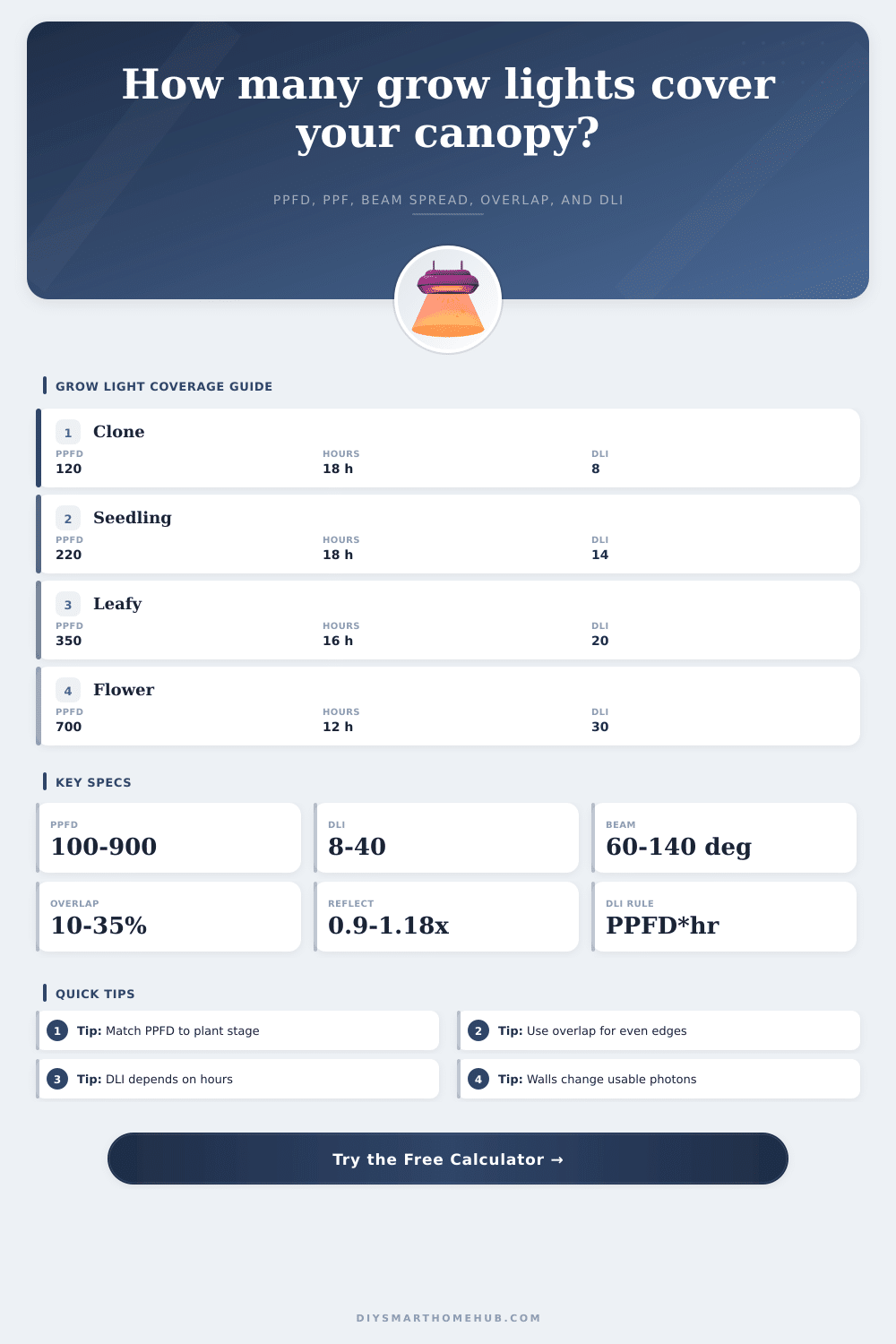
| Cuttings and clones | 80 to 180 umol/m2/s | 16 to 20 hours | 5 to 13 mol/m2/day |
| Seedlings and starts | 150 to 300 umol/m2/s | 16 to 18 hours | 9 to 19 mol/m2/day |
| Leafy herbs and greens | 250 to 450 umol/m2/s | 14 to 18 hours | 13 to 29 mol/m2/day |
| Vegetative fruiting crops | 350 to 600 umol/m2/s | 14 to 18 hours | 18 to 39 mol/m2/day |
| Flowering or fruiting canopy | 550 to 900 umol/m2/s | 10 to 14 hours | 20 to 45 mol/m2/day |
| Mount height | 80 degree beam | 110 degree beam | 130 degree beam |
|---|---|---|---|
| 12 in | 1.7 ft dia | 2.9 ft dia | 5.1 ft dia |
| 18 in | 2.5 ft dia | 4.3 ft dia | 7.7 ft dia |
| 24 in | 3.4 ft dia | 5.7 ft dia | 10.3 ft dia |
| 30 in | 4.2 ft dia | 7.1 ft dia | 12.9 ft dia |
| Condition | Factor | Use when | Effect |
|---|---|---|---|
| Open bench | 0.90x | Dark or open sides | More photons needed |
| Average room | 1.00x | No close reflective sides | Neutral baseline |
| Light tent walls | 1.08x | Pale or reflective walls | Better edge return |
| Compact enclosure | 1.18x | Close reflective sides | Highest modeled return |
| Example canopy | Area | PPFD goal | Fixture PPF example | Planning note |
|---|---|---|---|---|
| Clone tray | 8 sq ft / 0.74 m2 | 120 umol/m2/s | 150 to 250 umol/s | Low intensity, wide spread, long hours. |
| Herb counter | 6 sq ft / 0.56 m2 | 300 umol/m2/s | 250 to 450 umol/s | Moderate DLI from compact coverage. |
| 4 x 4 veg tent | 16 sq ft / 1.49 m2 | 450 umol/m2/s | 500 to 800 umol/s | Coverage and photons often both matter. |
| 4 x 8 fruit tent | 32 sq ft / 2.97 m2 | 650 umol/m2/s | 700 to 1100 umol/s | Multiple fixtures improve uniformity. |
| 8 x 8 room canopy | 64 sq ft / 5.95 m2 | 700 umol/m2/s | 900 to 1400 umol/s | Grid spacing usually sets final count. |
| Step | Formula | Input used | Result meaning |
|---|---|---|---|
| Canopy area | length x width | Canopy dimensions | Square meters that need photons. |
| Required PPF | PPFD x area / reflect | Target PPFD and wall factor | Photon output before fixture count. |
| Beam footprint | 2 x height x tan(angle/2) | Mounting height and beam angle | Estimated footprint diameter. |
| Fixture spacing | footprint x (1 - overlap) | Overlap target | Distance used for layout grid. |
| DLI | PPFD x hours x 0.0036 | Achieved PPFD and photoperiod | Daily photons per square meter. |
Coverage: You purchased that grow light because of its huge output rating printed on the box. Big numbers on paper sounded great… until you suspended it inside your grow room and realized there’s this black spot on the end where plants don’t grow well at all. That’s the coverage trap, total photon flux is only half the equation. How does it distribute those photons over your real-world canopy? And equally important, how do you know? The geometry are taken care of for you with the calculator above. No more guesswork; does one large panel cover all your leaf better then two smaller bars?
First, consider your desired PPFD. That’s an abbreviation for Photosynthetic Photon Flux Density. It represents the number of photosynthetic photons per second per square meter of canopy. The figure doesn’t apply equally to all plants. Seedlings is fragile and can absorbs in high light conditions. Flowering cannabis requires high density if they’re going to get good and resinous. Match the light intensity to plant life stage. Fruiting crops will push it quite high. Moderate numbers works well with a leafy green such as lettuce. Going wrong here are the quickest path to wasted electricity and stressed out plants.
How to Set Up Your Grow Lights Correctly
Then there’s the matter of how many fixtures and where to place them. That all depend on the beam angle, and height they are mounted. If you have a wide beam angle, it will spread the light further, but also dilute its strength on the edges. With a narrow beam, you’ll concentrate the light, but leave holes between fixture if you get too far apart from each other. The tool models that tradeoff for you. And based off what it knows about your space, it figures out how many units can fit your area while considering the natural drop off at the edges. You don’t want bright spots in the middle, with dark areas around the edge. Fixing that is one reason why we recommend adding some overlap. Setting a 25% overlap target makes sure that the edges of adjacent light footprints merge into a uniform wash, instead of creating a patchwork quilt of bright and dim areas.
But what about the other walls that surround your growing area? Walls painted dark absorbs light. Open bench walls do too, they literaly steal light away from your plants. Reflective surfaces reflect stray light right back into the canopy, increasing efficiency without requiring additional bulbs. The calculator uses a simple wall factor to account for this. Running your lights in a reflective grow tent? That’s a modest increase in usable light compared to an open shelf surrounded by dark spaces. It’s a small multiplier, but it adds up over time.
Finally, do you know your daily light integral? That’s a combination of how many hours your lights are on (the photoperiod), and how strong they are. You can produce the same amount of light each day by running them strongly for fewer hours or weakly for more; some plants prefers one balance, while others prefer a different one. For example, leafy crops need long days at moderate strength so as not to bolt, whereas flowering ones often favor shorter, intense bursts. Depending on what you’re growing, your ideal DLI will vary. The calculator estimates yours, based off the PPFD you’ve attained and the photoperiod you select. Is it insufficient? Your plants lack sufficient energy to finish their metabolic cycles. Is it too high? It would of be a waste of power or potential light stress.
There are three factors in planning any lighting setup: how much power? Where do I put it? How far does it go? And when is it on? For what duration? In other words, there must be enough light going onto the correct area at the proper length of time. The chart below (from the linked page) explains all that for typical stages. It breaks down how PPFD relates to DLI which relates to hours. So check off your target points prior to shopping for equipement.
You can calculate cover area based on the beam spread. You know how to adjust by overlapping to fill gaps. You can use those two together to create uniformity across an entire growing area. No more shooting in the dark. Instead, you design to make the most of every photon. A patch of shade becomes a sea of green.